
What if Robespierre was on Twitter
The case of Donald McNeil and the New York Times
I barely remember business class during College, only a few concepts stuck with me throughout the years. My mind has always been somewhere else and I could only pay half-attention to things like “company organization”, “Kanban boards” and Kaizen philosophy. But I remember clearly when we touched the concept of “groupthink” my attention spiked from the very beginning. It was something that was probably speaking directly to me. I was fascinated to discover the fallacy in decision-making when is bounded by social pressure and relationship constrains.
Probably that’s because it was one of the few notions that I could also apply to direct experience: from school teamwork to deciding the movie to watch on a saturday night with friends, it was already easy to see this recurring pattern even among the simplest things. More often than not final decisions weren’t influenced by real interest or benefits but by the more powerful social relations. The human need for conformity and social-acceptance often override rationality in favour of the most accepted idea in the group. Groupthink can have some mild effect like wasting a saturday night re-watching “50 First Dates” because your (now ex) friend is really a Adam Sandler’s fan or can have much more disastrous snowball impact, like the multiple failures of a badly designed airplane.
And the group is not always right. It can be sometimes completely wrong, like when an online petition pressured the White House to re-build the Death Star. Jokes apart, is always hard to contrast consensus once it cement in people’s minds. When groupthink morph into unanimous consensus, the group can transform itself in “mob” and when herd mentality sets in is even harder to step back from it. Mobs want quick answers, want solutions, want scapegoats to blame and to clean the conscience against.
There have been disastrous examples of similar groupthink hidden in the past history of my hometown, where a street dedicated to “Simonino” remains as a reminder of the tragic consequences of this faulty thinking. The death of the young child remains a unsolved mystery still now, but there has been suspects of a murder from the beginning. The small Jew community was an easy target back then and nothing could have proven the contrary to the mob of people already convinced of someone’s guilt before any possible trial of innocence. And even in case of a trial, confessions of guilt were obtained through torture. It wasn’t truth what people were looking for, but someone to blame.
Is probably the reason why the “lamb” is chosen as symbolic representation of Christ in the Bible, as the sacrifical animal that would have cleansed people from their sins. The people in the Old and New Testaments had some deep insights on human nature that we have completely dismissed centuries later, some stories offers a close representation of human behaviour, as the choice for the popular “Barabba” instead of that buffoonish idiot that screamed to be King of Israel and so it was executed.
When yesterday I stumbled upon the open letter of Donald McNeil on the reasons of his firing as science reporter for the NYT, I had the intense feeling of a déjà vu.
I don’t know Donald McNeil anything more than a handful of articles and the sudden “fame” he’s currently enjoying for this latest controversy. And I don’t really want to delve into the details of this particular case, which is totally out of my competence. There could have been much more things left unsaid that could be traced back to personal relations in the job, beyond the scope of the scandal itself. Who really knows?
I certainly don’t. But I just can’t help but notice the dynamic at play and the unpleasant feelings it brings up, like a script already seen in other movies.
What disturbed me the most, in the whole story, was the distortion and manipulation of “truth” (whatever it may be) by all the backdrop of involved actors, so much so that the portrait that emerges of the reporter is of a monstrous and rambling alcoholic, raging against anyone that comes in sight with vilifying offences. I don’t personally know any of the people involved, but I’m normally very cautious in my judgements when I meet someone in real life, giving often the benefit of the doubt even when I happen to disagree with someone’s stances. This simple rule of thumb seems to not apply anymore if a single word is enough to define someone, seemingly irreversibly.
Once a convintion, a single idea is set in the collective mind, then nothing can back it down. The more you try to explain your position, the more you prove your supposed guilt in the eyes of your accusers.
Call me naïve, but I probably miss the times when a simple concept like presumption of innocence was a solid value that used to distinguish human law from the jungle.
Thirty minutes on Twitter had been enough to prove me wrong. You can be quickly called names and vilified out of thin air and in front of a gratuitous defamation is your turn to demonstrate the contrary. As if you really have to admit to be a walking monster 80% of the time and a nice person the rest 20%. How can’t anyone realize the absolute inanity of this? Am I the only one?
Look, I don’t want to condone in any way the misuse of words in a derogatory and offensive way and honestly I shouldn’t feel bad for what happened. For me respect is absolutely essential and offensive words don’t even come to my mind when I interact with other people. Still, I can’t not see some of the hypocrisy that underlines the rules of social interaction. One of the most common words you can hear everyday in my language is a full-out blasphemy. Is supposed to be a colorful exclamation and is socially “forbidden” but I can’t pretend to be “shocked” when I hear it. Some of my friends keep repeating blasphemies as part of their lexicon. Guess what? We’re still friends. Their personality is much more faceted than a single word. I can forgive them for it, as they forgive me for all the possible reasons I could be a terrible friend to them. Forgiveness and acceptance are essential for building peaceful relations.
Donald McNeil shouldn’t have said the N word. I agree. He should have perhaps apologized more. Or better. But that should have been the end of it. Instead he became a ticking bomb for the most prestigious redaction in the world, incapable of dealing with the controversy. Human Resources under pressure couldn’t do anything but kick him out. No middle ways.
People want heads, not compromises. It didn’t matter if that word wasn’t directed at anyone or that it wasn’t used in an offensive and harmful way. The truth is only what people want to believe.
That single word ended up defining an entire career, over 40 years of experience and a Pulitzer candidacy. This is what happens when zealotry override reasoning. Zero tolerance for any mistake.
Even New York Times Editor in a public statement admitted it: context has no importance anymore. Which is chilling, coming from one of the most prestigious desks where information is crafted everyday to give better sense of the world. When technology has reached Oled screens with depth of 68 millions colors to represent all the imperceptible gradients of reality, information seems to have reverted back to 8-bit pixels and the simplicistic representation of a Super Mario game.
Reality is made of nuances, not black and white. And an institution such as the New York Times should know it better.
Maybe Donald McNeil is really a racist? — I’m wary about using that word, it should be pondered well and not hurled against someone light-heartedly — I personally don’t know the answer, but I haven’t seen or read proofs in that direction. I personally think that McNeil is a “normal” person that sometimes happen to make mistakes, as everyone do.
I may also be completely wrong and McNeil only received the right punishment from its company. I won’t pretend to care so much of the personal life of someone I barely knew prior of the current controversy. In fact, I don’t care.
I just observe the whole dynamic with a mix of puzzlement and awe. Is it really a word enough to crush one’s reputation, melt down a prestigious newspaper while nobody could come up with better solutions? What a world we live in if is possible to take anything out of context and use it against as a weapon?
I think respect should be enforced at any level, also with the language. But I don’t think this primary concern should override a sense of balance and common sense.
And most importantly, is there a way to deal with all of this reasonably and avoid any extremism in both ways? Are really context and nuances dead?
Today we can debate around this non-issue, but what happens when this pattern of arbitrary trials takes hold on an over-zealous internet population educated to see all its requestes addressed with no questioning?
Before Jacobin was a cool magazine, it used to be the name of the insurrectionalist that kicked the historic Revolution in France, the previous autocratic institutions of Louis XVI’s era were replaced by new Republican ones. A Committee of Public Safety was instituted to deal with the monarchists stances of some strata of population. One of the most radical exponents of the Jacobin Club was Maximilien Robespierre, a lawyer that quickly came to prominence within the Committee, becoming its principal leader.
Robespierre took advantage of the extraordinary powers of the Committee to introduce extreme measures to establish the new Republic. He was firmly convinced that any means were necessary and justified in the pursuit of his vision of the ideal democracy, indifferent of its human costs.
His rule passed to history as the “Reign of Terror”.
During the chaotic period following the collapse of the monarchy and the power vacuum that resulted, Robespierre emerged as a de-facto dictator, supressing any form of dissent and ordering trials and executions in the name of the Revolution and the Enlightenment. It was in this climate that the Law of Suspects was passed to tighten the powers of the Committee even more. With this law, anybody could be suspected of anti-revolutionaries stances and summarily executed.
The Reign of Terror was a period marked by a state of institutionalized paranoia that ended only with the execution of Robespierre himself and the final restoration of civil rights.
“True religion consists in punishing for the happiness of all, those who disturb society” — M. Robespierre
The problem is that all the deaths and trials had been probably executed with a supreme good in mind. How could you even oppose it? Would it mean that you were against the Revolution? That would had you killed as well. This is the fundamental problem when peer pressure tranforms itself into mob mentality if nobody criticizes it. Once consensus reaches critical mass if often too late to step back at that point.
I feel a similar pressure today, as I have to be extremely careful on what I publically say online or while interacting with others. I have to always be mindful that words can be misinterpreted and used against me one day by some strangers I’ve never met.
Critics are also impossible.
«How come you defend Donald McNeil? Are you also racist?»
Spoiler alert: no, I’m not. I only advocate for the space to be anti-racist and yet criticize. There should be a middle-ground.
But mobs don’t like middle-ground. They rely on in-group mechanics to identify allies and enemies, so that if you don’t agree on everything you’re considered out of it. And if the in-group identifies itself on anti-racist stances, everyone outside is then automatically seen as racist, white supremacist, fascist or [insert defamation here]. Doesn’t matter whether if true or not.
The search for enemies to unify the group is a typical in-group behaviour. Is the natural application of the Law of Suspect without the need to pass a decree by a Committee of Public Safety.
«How come you don’t support the Revolution? Are you a monarchist?»
That simple suspect would had you killed next day by a sans-culotte more zealous and less doubtful than you.
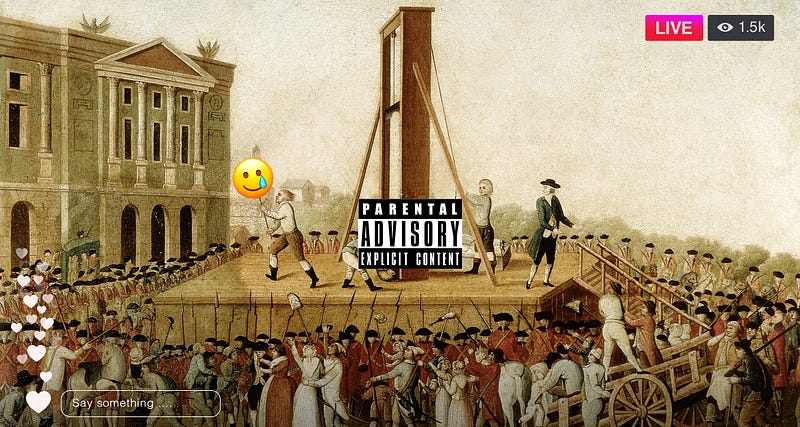
If Twitter had existed during the French Revolution, Robespierre would have probably resorted to isolate any dissent with a tweet. Ruining someone’s reputation is definitely cleaner and more effective than executions.
I don’t know if Donald McNeil’s case has anything to do with all of this or is destined to burn as straw fire and be forgotten next day. But the story certainly gave me a lot to think about.
Wether right or wrong, I just hope that critical thinking, reasoning and context will remain crucial values and won’t die off too soon, executed by a mob of unanimous voices too loud to listen the reason.
On a similar note, another article that seemed to have anticipate exactly this:


