
If only we had six fingers
(or six toes)

The young guys coming to work as carpenter helpers and apprentices these days are driving me crazy. They’ve been coming to work schooled in the wonders of the metric system, indoctrinated to the point that they can’t read the measuring tape in front of their eyes. I try to open those eyes for them but it’s hard to override the bad programming that was laid down as unquestionable truth by their well meaning teachers.
Like employer based health insurance, the metric system was an accident of history, and it’s even more clunky. This clunkiness stems from the fact that we have ten fingers and ten toes. While counting on your fingers is easy and natural, it’s no way to run a numeric system. When people count on their fingers, they choose the total count as the basis of their arithmetic, so lucky us, we got base ten, which works OK for matching our fingers to numbers but is good for little else. For the many other practical tasks we ask our numbers to help with, like doling out market goods, dividing distances, or packing multiple objects in crates, we would have been so much better off with six fingers.
There’s a reason that beer comes in six packs, not to mention cases of 24. You can arrange that six pack into two rows of three cans and can then stack two six packs vertically, side by side, or in a row for your twelve pack, or even double up your twelve pack for a case. And of course, you can divide any one of those packages between three carpenters;) None of that is easy with five cans, which are going to have to be grouped by twos and threes, and then carefully reversed and nestled if you want to stack them into a group of ten.
There’s a reason that eggs and doughnuts are sold by the dozen. You can divide that dozen between two people, three people, four people, or even six people . Try doing that with 10 eggs. The number ten has two prime factors, 2 and 5; divide your ten eggs between two people and you’re done. Now, if we had a sensible six fingers, we would have counted on those fingers and set our numerical system up in the base twelve, the number that has three prime factors, 2 x 2 x 3, and can be divided by the numbers 2, 3, 4, and 6.
When I first started mulling over the reasons why I liked my American Standard English carpenter’s tape, the ease of working with 12 inches as a base for the foot struck me. Then, of course, curiosity required that I had to consult Mr. Google. Turns out there was a whole movement devoted to the mathematical elegance of base twelve, the Douzenal Society of America (or Great Britain) who had put a lot more thought into it than I had. They showed, for instance, how much easier it was to deal with douzenal (decimal) equivalents of fractions, as shown below;
1/2 = .6
1/3 = .4
1/4 = .3
1/6 = .2
1/8 = .16
each of which is at least one douzenal place shorter than its decimal equivalent and none of which is an infinite repeater like 1/3 in decimal, which is written as .3333333_, with similar nonsense for 2/3, and 1/6.
They pointed out that there are twelve tones in the “octave” scale we use for music, allowing for notation without sharps or flats, that of course there are 24 hours in the day (two circuits of 12 on the clock face), twelve months in the year, and if you just have to count on your fingers, you have twelve knuckles on your four fingers.
But making a fourth grader’s life less miserable is just one feature of the base twelve that we never got, the base twelve that biology stole from us.
Fractions are basic to our understanding and use of numbers, they are whole divisions of real things. We can see the 6 slices of pie in the tin and understand that we get 1 of the 6 pieces, 1/6 of the pie. This is easier to visualize and more true to life than the knowledge that we get .16666667 of the pie. Of course in base twelve, if we insisted on using the “douzenal” equivalent of those divisions we would at least know that we got .2 of the pie; as I said above, less clunky.
Now if we had 8 fingers we would have chosen base 16, another of what the Douzenal Society called the “ abundant numbers”, which simply means a number that can be easily factored (base 16 had prime factors 2 x 2 x 2 x 2) and easily factors in higher numbers. Base 16 is abundant but lacks the important prime factor 3, which means that it can’t deal with fractions like thirds and sixths, and thirds are some of our most popular fractions.
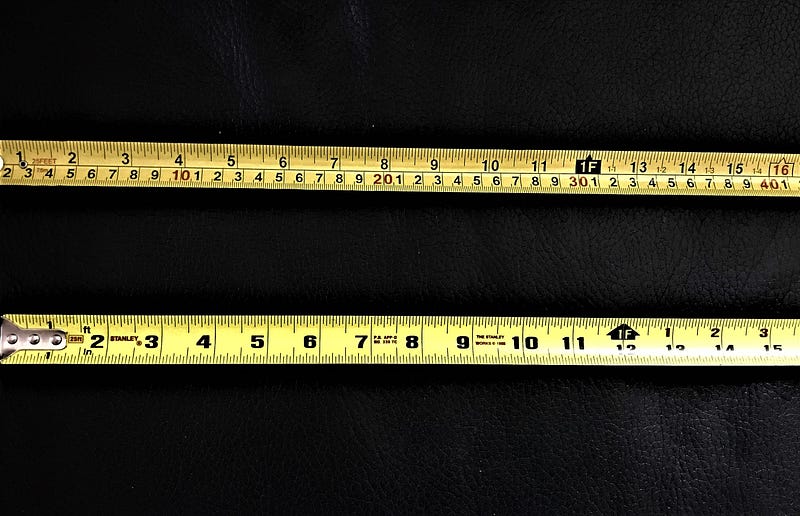
Those young carpenters in training have never looked at a metric tape and an American Standard English tape side by side. They haven’t had time to contemplate the real beauty of the A S E carpenter’s tape, they take for granted the rhythm embodied on that tape. This tape blends the two abundant and easily factored bases, 12 for inches and 16 for fractions of an inch, to create a scale with vastly more practical potential than the decimal based metric measuring tapes. I know, rhythm is a weird term to apply to the nail and stud world of construction, but hear me out.
The units of measure on an ASE tape increase in scale to match the scale of your work. If you have to get carpentry precise with your measurements you go inside the inch, “talking teenths”, or eights or quarters in base 16. If you want to measure framing members or divide up feet you have inches, laid out in base twelve. For doors or windows or rooms, you’ve got feet to get close, inches to dial it in and those teenths if you need them. Further the tape holds interactive scales laid out so that you can use them together.
The individual feet are numbered and marked with bold arrow points, the inches are numbered and marked by lines across the tape, with a running total of inches on the bottom edge of the tape and repeating runs of the 12 inches between the foot markers on the top. This makes it easy to measure out 75 inches and also see that you have 6 feet 3 inches.
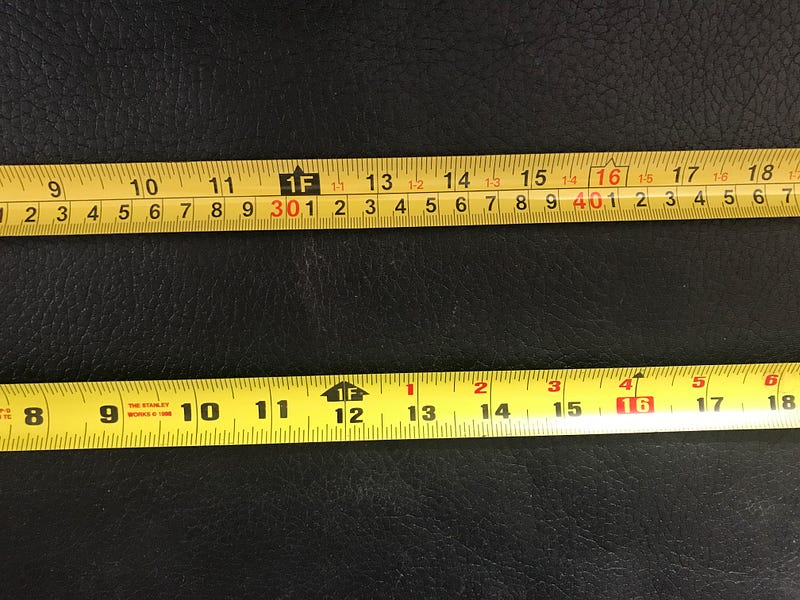
Moving into the fractions of inches, these fall out in size distinctions, half inch marks are tallest, quarter inches shorter, eighth and sixteenth marks respectively shorter still. Unlike the millimeters on the metric tape, which march off in anonymous even ranks like foot soldiers to an inevitable European war, each fraction stands distinct and easily identifiable.
The units in ASE were developed over time, through practical use, unlike the unwieldy and entirely arbitrary meter, which is the heart of the metric system. If you can believe it, the meter is supposed to be one ten millionth the distance from the Earth’s pole to its equator, and it just doesn’t get more arbitrary than that. In fact it was intentionally chosen to be arbitrary so as not to offend existing measurements;) The metric tape lacks interacting measurements of graduating scales, no inch, no foot (though metric equivalents have been cobbled together) and no easily factored numbers on the one scale it does have, a running count of centimeters.
The ASE tape, in contrast, utilizes units of measurement first devised for their practical attributes. The inch, for example, is the approximate width of a man’s thumb (rule of thumb), the foot is the average length of his foot; clever planning or good fortune put twelve inches in a foot, and further good planning laid out the fractions dividing that inch in that easily divided base 16. Combining the base 12 foot with the base 16 inch is most convenient when you want to lay out rooms, windows, cabinets, and need to space them evenly.
Spacing of construction elements, or “layout”, is central to construction. And layout is where the rhythm on the ASE tape really shines. Take a somewhat standard 12 foot by 15 foot room. To lay out windows symmetrically you have to find the center of each wall, which in ASE is pretty easy; half of 12' is 6' and half of 15' is 7 1/2'. Now a similar sized room in metric, about 370 centimeters by 460 centimeters. I could get my calculator or a pencil and pad, but, in my head, half of 300 is 150 and half of 70 is 35, add the two together to get…185. OK then. I lucked out on the 460 centimeters, just drop the zero, half of 46 is 23, add the zero back in again and I get 230.
Now, let’s divide again to place the windows; half of 6' is 3', half of 7' 6" (7 1/2 feet) is 3' 6" plus 3", 3' 9". Back to metric, half of 185? 92.5 which is the last divisible mark on this progression along the tape; half of 230 is 115 and as luck would have it I can divide that number once more before I’m out of even divisions. How far can I take the ASE progression? Half of 3' is 1 1/2 feet, 1' 6", or on the tape 18", half of that is 9", half again is 4 1/2", again 2 1/4" again 1 1/8", again 9/16" at which point you run out of marks on the tape, but drop an inconsequential 1/32 and you’re at 1/4", 1/8" and 1/16, the smallest division on the tape.
Let’s do the other one. First the metric; half of 115 is, I can do this in my head…57.5, and I’m off the tape, no further divisions are possible without estimating. The ASE tape? That’s going to be easiest using the running tally of inches on the tape. 3' 9" is also 45", don’t have to calculate, it’s on the bottom scale of the tape. Half of that is 22 1/2", half again is 11 1/4", again 5 5/8", again, 2 13/16", drop that 32nd and divide to 1 3/8", again to 11/16", add the 32nd back in and divide to 3/8", 3/16", all marked on the tape and probably far enough for our rough purposes.
This process reveals another simplicity of the ASE tape, even when fractions have prime number numerators they are still easily divisible by doubling the denominator, so that half of 7/8 is 7/16, half of 3/8 is 3/16, half of 5/8 is 5/16, and so on, all with discrete marks on the tape.
OK, no doubt you get used to metric, work up some tricks to convert millimeters and centimeters to some sort of larger, useful navigational units. But with an ASE tape you can navigate from the macro to the micro using distinct units scaled to the sizes you want to measure with barely a thought, no mulling over decimal points, no calculators.
Carpentry is done with dimensional lumber, a carpenter quickly learns the dimensions of the framing members and sheet goods (plywood, OSB, drywall) that cover them. These dimensions work together. A “2 x 4” wall is 3 1/2" thick(metric equivalent, 89 mm) and the studs are 1 1/2" thick (equivalent about 38mm). Once again, it’s just less brain damage to deal with 1 1/2 or 3 1/2 then it is to deal with 40 or 90 (we rounded up). Take that 90, you can divide just once, to 45, and then you’re out. These simple units make the calculator a rarely used tool. And believe me, there are plenty of other brain teasers on any job without adding a lot of decimal places and conversions.
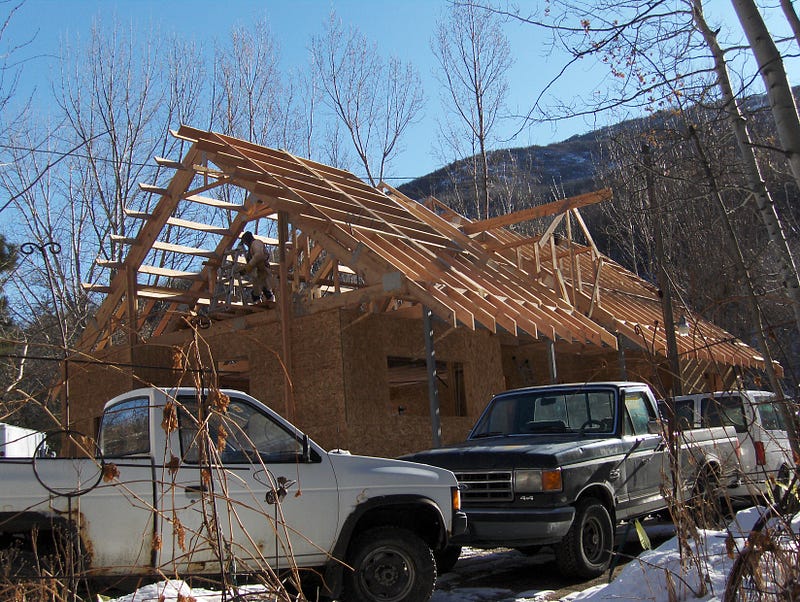
When you cover the framing members with sheet goods you have to “lay out” the members, the studs, rafters and joists which define the structure, so that the 8 foot by 4 foot sheets have framing members supporting them along edges and at predictable intervals. Most layouts are either 24" or 16" spacing, both of which factor evenly into 48" and 96" (4' and 8'). Once again the easy factoring of the base 12 foot is working for you. These layout marks are on the tape, of course, and there’s one other set of layout marks that is never used, 19.2 inches. Guess which fraction of 8' this layout represents? Won’t make you guess, it’s the very decimal 1/5;)
This integration of ASE units continues all the way up to the log, from which all the members and sheets are cut. A cut log is 32' long, 4 units of 8', or 16 units of 2', or even 24 units of 16", and now the “abundance” of both 12 and 16 is working for logger and the mill worker. Paraphrasing the Douzanel Society here, but we have already sacrificed many systems and measurements to the non-abundant, let’s be honest, downright stingy base ten. Doubtful that we can ever go back, the decimal system is deeply ingrained in our culture, our education, and our calculators; not our computers by the way. They utilize base two for calculating and set their operating systems up in sensible factors of the abundant 16, giving us 32 bit systems and 64 bit systems and ignoring the clunky base 10 entirely, except of course to translate into it to accommodate us out of date and indoctrinated humans.