
If I Could, I’d Gift Everyone a Copy of This Book—It’s Legit That Good
I can’t tell you how much new stuff I find every time I read it. Good news: you can read it for FREE.

You can call me a bookworm, but this book will make you one. This book is like one of those fluffy romance novels that you couldn’t keep down while you were in high school, obviously if you like reading then. (Only today I completed reading The Hating Game by Sally Thorne; and yes, I’m a high-schooler. 😉)
Except these two cases can’t be more different—saying from the angle of practicality. And that book is none other than The Almanack of Naval Ravikant.
I might have written half a dozen articles on this book and Naval already but I discover something new every time I read it. And thus, I can write ten more articles in the future; it’s that much a favourite of mine.
Are you ready to discover what a high schooler’s favourite book is all about? Let’s go!
The Almanack of Naval Ravikant by Eric Jorgenson
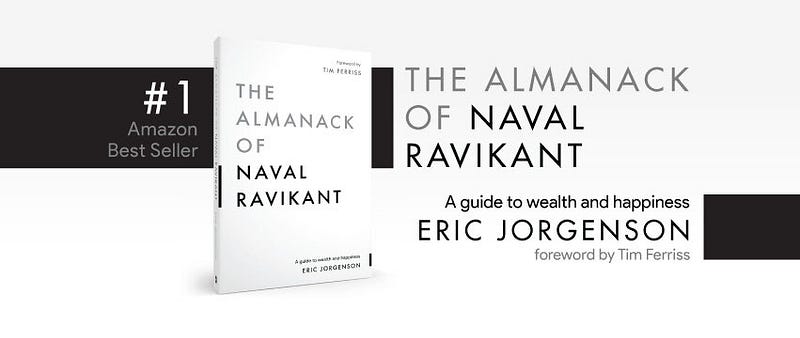
This all-time favourite book of mine is the perfect place for you to start building your foundations in wealth, judgement, happiness, and philosophy.
This book is a compilation of Naval’s tweets and talks he has shared. It’s artistically compiled by Eric Jorgenson, illustrated by Jack Butcher, and with a foreword by Tim Ferriss.
I was 14, as I distinctly remember when I first read it. It completely blew my mind. It challenged everything I knew, every assumption I’ve had, every perspective I thought was right—it inspired me to question everything and before judging know its roots.
From that time on, I’ve re-read this book several times. If I were to rank books based on how many times I’ve read them, it’d exponentially beat the number second.
Every time I read this book I learn something new. And this amazes me: how can a book be so information and wisdom-dense at the same time?
Maybe you don’t know Naval. Or you’ll dismiss this book by giving it a tag of just another “business book.” But wait before making up your mind.
First of all, who is Naval?

Here’s how the generic introduction goes:
Naval Ravikant is an Indian-American entrepreneur and investor. He was born in New Delhi, India and moved to Queens, NY when he was 9. He is the co-founder and former CEO of AngelList. He is also an early investor in billion-dollar companies like Uber, FourSquare, Twitter, Postmates, Notion, and Clubhouse, among many more.
But at his core, he’s a rational optimist who’s curious about philosophy, relationships, happiness and is interested in seeing the bigger picture of life.
He doesn’t shy away from asking bold questions. He likes to back everything up with fundamental principles.
The book
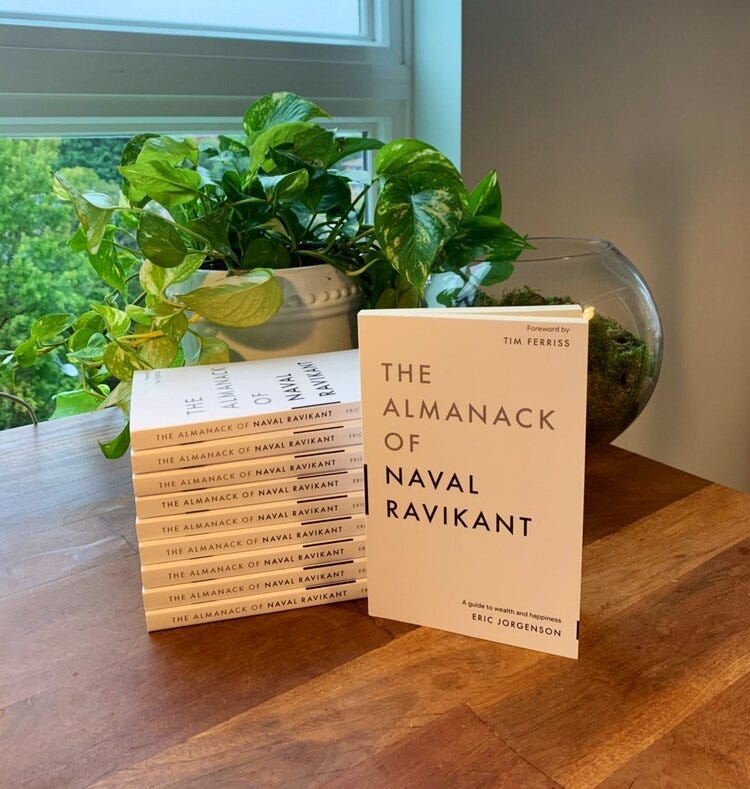
Part I: Wealth and Judgement
This book begins with one of the most controversial topics of all time—wealth creation.
But God, he simplifies it so much you’ll feel like you’re reading something so obvious. That’s the power of knowledge combined with experience.
In 2018, he writes a Twitter thread that takes Silicon Valley by storm. It was titled How to Get Rich (Without Getting Lucky).
This 39-tweet long thread forms the backbone of the first part of the book and in one sense is the summary of it. I encourage you all to give a full read here.
I kid you not, this same thread was my first interaction with Naval. I used Twitter a lot and I randomly landed on his profile. Fortunately, this treasure trove of knowledge was his pinned tweet. And from that time on I continue to be a Naval fanboy.
For setting some context and making sure we’re on the same page, I’ll share a couple of tweets from that thread:
“Seek wealth, not money or status. Wealth is having assets that earn while you sleep. Money is how we transfer wealth. Status is your place in the social hierarchy.”
“Play iterated games. All the returns in life, whether in wealth, relationships, or knowledge, come from compound interest.”
“When you’re finally wealthy, you’ll realise it wasn’t what you were seeking in the first place. But that’s for another day.”

He talks about taking accountability. He talks about competition and how can you escape it.
It’s not any feel-good read or one that promises to make you rich. It’s brutal truth at its core; a picture of the world, nature, and you—and how they interact with one another.
Part II: Happiness
“The three big ones in life are wealth, health, and happiness. We pursue them in that order, but their importance is reverse.” —Naval
Happiness forms the other half of the book. He views happiness as not a thing that we find. Instead, it’s the choices we make.
If we make sane choices without losing our innate peace, we’re happy. And in the same way, comes love and passion, he says.
There is one beautiful line that most of us can resonate with:
Happiness is being satisfied with what you have Success comes from dissatisfaction. Choose.
Now, something like that makes your world go upside down. It makes you question. It’s a contradictory statement to be put in a chapter called Learning Happiness but only after taking a moment to analyse its depth and absorb its context do I find how true that is.
There’s no white or black; it’s mostly grey. There’s no absolute right or wrong; mostly it depends on the situation.
Always searching for happiness is not an ideal path to go. Sometimes dissatisfaction—from the situation, world, or ourselves—takes us far. It’s all subjective.
He then talks about health (diet, meditation, yoga, mental well-being, and exercise) and philosophy. He considers them an important part of our lives. He studies philosophy to quench his thirst for the truth and takes immense care of his health to complement his happiness goal.
“When everyone is sick, we no longer consider it a disease.”
Let that sink in.
Our unhealthy lifestyle has become so common that we don’t consider it a danger to our health anymore. Healthy habits are hard to inculcate in our daily lives but it’s the most fulfilling form of self-care.
Life hack: When in bed, meditate. Either you will have a deep meditation or fall asleep. Victory either way.
The last part of this book is on Philosophy.
To be honest, I’ve never read any philosophy books. On the name of the same, I’ve maybe just opted in for Ryan Holiday’s newsletter on stoicism.
And I’m glad I got this sweet chapter as my introductory lesson. It doesn’t present philosophy as some other-worldly thing—but as an innocent quest for the truth and roots.
He defines wisdom as understanding the long-term consequences of your actions. We often take actions that involve some kind of reward or pleasure in the short term and forget the long-term outcome.
“If wisdom could be imparted through words alone, we’d all be done here.” —Naval
This is a really wonderful book and I keep recommending it to every second person I meet—online or offline.
Though I can’t gift everyone this book, you can read it for free online.
This book has been created as a public service. It is available for free download in pdf and e-reader versions on the book’s official website navalmanack.com.


