
If Bipolar Mania is What it Takes to Make Me Creative, I’ll Pass
The boost in productivity isn’t worth the aftermath
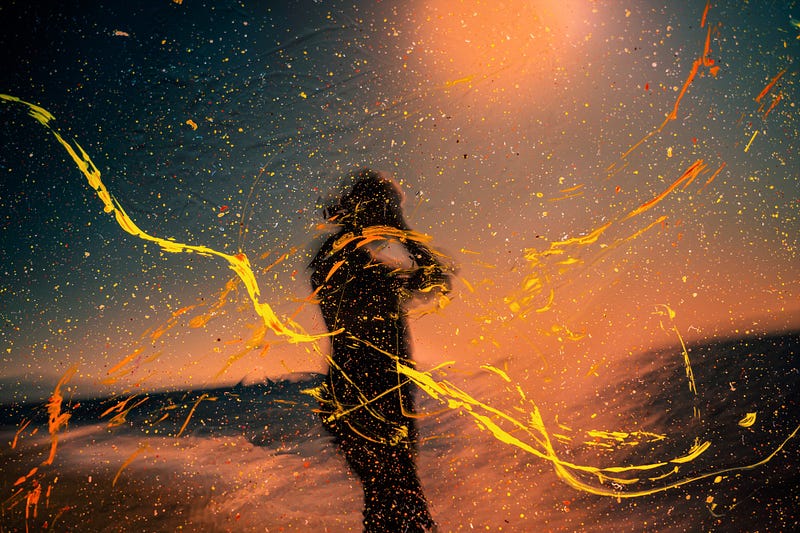
That familiar feeling began to creep over me, like a fever emanating from deep in my bones. A mix-up at my pharmacy forced to miss a few days of my antipsychotic medication, a life-saving drug that has kept mania at bay for seven years.
Life seemed to speed up.
Days and nights blurred into one another as I stayed cemented to my computer, typing up dozens of pages for the book I’m writing. At night, I continually awoke to scribble down a thought or a phrase that could germinate into some project. I dreamed up numerous art projects, like transforming thrift store statues into new masterpieces despite the fact that I paint like a drunk raccoon.
I spent hours bouncing ideas off a friend; our conversation leapt from Indigenous rights to otherkin identities. I’m sure to anyone else, our discussion resembled two misfiring chat bots fed an endless stream of Wikipedia articles.
This is awesome, right? As a writer, there’s no better feeling than having a full queue of work ahead and all the energy in the world to do it. Writing isn’t just work to me: it’s my identity, my vocation, my reason for living. Getting a preternatural boost in my work speed and thought process seems like a dream.
It’s not — at least not for me.
What I was experiencing was a hallmark symptom of hypomania, a milder version of the classic bipolar mania. Racing thoughts are frequently reported by bipolar patients and are one of the criteria to diagnose a manic episode. They can be deeply frustrating and debilitating: as Marcia Purse notes,
Racing thoughts are more than just thinking fast. Rather, they are a rapid succession of thoughts that cannot be quieted and continue without restraint. They can progressively take over a person’s functional consciousness and gallop out of control to a point where daily life can be affected. This symptom can become so severe that it interferes with the ability to sleep.
With racing thoughts, it’s nearly impossible to get anything done. I dream up remarkable ideas, but none of them are completed because I am immediately swept up in some new interest.
I don’t just go down one rabbit hole: I nosedive into the whole burrow and can’t find my way back out. Every entrance has no exit and I’m forced to turn around to seek a new tunnel. It’s an exhausting mental exercise, but occasionally it turns up some truly great gems. Sometimes these discoveries make the struggle seem worthwhile — after all, doesn’t it feel good to triumphantly present some rare thought in a world papered with copycats and imitators?
It sure does. This remarkable phenomenon has been credited with influencing some of the greatest artists of all time. It’s no wonder that people assume that bipolar people must be innovators in their chosen field: it so often turns out to be true.
Mental illness has influenced the work of many creatives
You don’t have to look far throughout history to find bipolar individuals who mastered their craft, pioneering entirely new ways of thinking. Virginia Woolf wrote that “as an experience, madness is terrific I can assure you, and not to be sniffed at; and in its lava I still find most of the things I write about.” She saw her disease as the genesis of her art, something many others have asserted as well.
Woolf’s tortured life, which most likely contributed to her emotional lability, enabled her to create remarkable novels that furthered feminism and illuminated a more expansive vision of women’s role in society. Sounds like an awesome life path — if you forget that she ended her life by walking into the River Ouse.
One of my favorite poets, Sylvia Plath, also famously struggled with mental illness. Her works resonate so deeply because they are raw, oozing wounds, blood-soaked fingers pressed onto the page.
Like many other bipolar individuals, she had tortuously difficult relationships: her husband Ted Hughes was physically and emotionally abusive, beating her until she miscarried and cheating on her with the German poet Assia Wevill. Both Plath and Wevill committed suicide by carbon monoxide poisoning, reflecting how interpersonal issues, combined with neurotransmitter failures, lead to tragic ends.
And it’s not just in the arts where bipolar sparks new ways of thinking and doing: luminaries from all walks of life have also struggled with the razor-tooth seesaw of this illness. Winston Churchill, the British Prime Minister who helped to win World War II, is considered to have suffered from bipolar disorder: he wrote extensively about the “black dog” of depression, while his bursts of mania were responsible for many pivotal decisions in the war. We might even be able to claim Albert Einstein for Team Bipolar, as he was known to experience deep bouts of depression along with periods of intense concentration and insight.
There is at least some evidence that bipolar may have some link with creativity. Work by researchers at Johns Hopkins University acknowledges the high overlap between creative individuals and mood disorders, while Stanford University research suggests that a particular creative temperament may correlate with bipolar tendencies.
This intriguing work offers a number of different hypotheses for this well-recognized phenomenon, but it’s somewhat at odds with the experiences of those of us “on the ground,” those of us either treating bipolar patients or struggling with the disorder ourselves. The reality for most of us is that mania only provides the illusion of creativity.
Bipolar mania is more about quantity than quality
Most artists, no matter their medium, have sought some way to boost their creativity, from drugs to hardcore meditation. Those who struggle with productivity might find themselves jealous that bipolar individuals might simply have to stop their medication in order to experience a rush of creativity.
However, many don’t realize that mania doesn’t actually help you generate great work — just a lot of it. Virginia Woolf pointed out that during mania, the words would emerge, “everything shaped, final, not in mere driblets, as sanity does.” However, she doesn’t state whether it was good work or not. I suspect much of it was relegated to the trash bin when she recovered.
Disorganized thoughts is a hallmark of mania and it deeply affects the quality of work done by those who work with words. Kay Redfield Jamison describes it thus: “for those who are manic, or those who have a history of mania, words move about in all directions possible, in a three-dimensional ‘soup’, making retrieval more fluid, less predictable.”
A 2019 study published in Scientific Reports confirms this observation. In a study that compared the word usage of bipolar individuals across the mood spectrum, those experiencing mania or mixed episodes had greater “flight of ideas,” meaning that their words do not follow any coherent narrative but scatter across the mental landscape like buckshot.
I certainly found this to be true. During my episode of psychosis, I churned out four or five poems every single day; I was working on at least three different novels and raced through nearly a whole manuscript within only a few months. I thought it was all brilliant, that I was a true savant who would soon be famous. One of the novels I was working on was written with an interlaced secret code which could only be deciphered using one particular version of the dictionary. I was sure this book, with its lackluster plot, would cement me in the halls of the greats.
Looking back on the work after recovery, I was aghast at how terrible this work was: not the diamond I expected, but faceted plastic, a cheap child’s toy. It doesn’t take a genius to realize that a novel which is only enjoyed when partnered with a single edition of Webster’s will not be a bestseller. I focused more on the reference book scavenger hunt than creating likeable characters or interesting scenes.
Likewise, the poems were more world salad than ballad, simply a jumble of phrases that sounded nice together but didn’t create a narrative. Just as Weiner et al found, my work had increased phonological association: I was pairing words with complementary sounds. It also demonstrated semantic overaction, where I assigned more meanings to a word than are expected in normal language. Here is an example of a work from that era:
I am the roasted one that toasts to the burnt fragments of myself endlessly, dropping crumbs of my body all along the riverfront for angry ducks to destroy.
Remember when I bewitched squirrels for you, drew dog food from my backpack and fed a hungry animal because I know how the gnaw feels? There was a smile across those gauntlet lips and I thought perhaps I’d won you. Now I know I’m wrong.
Again again I draw myself back and rush over you. Perhaps this version of me, a dumb doll smile wrapped around my weeping face, will seduce you enough that I can take off my bandages and succumb to blood poisoning.
My veins are made of iron; I have a sword for a spine. And as it is the last piece to make it out of me alive, make it a memento and bury me in your well.
In the memorable words of one of my creative writing professors, my work had no plot, more interested in sounding good than being good.
Nearly a decade later, I am still slowly picking through the poetry boulder fields, polishing the pebbles for a new decoupage. While it’s nice to have an enormous backlog of writing to develop, it is also depressing to see how sick I truly was and how little I recognized it. I would give up these thousand lines to get that year of my life back. Each word came at a cost far beyond its value.
Mania is too high a price to pay
If an individual with bipolar gets swept up in the joy of creativity and chooses not to treat their mania, things can go downhill fast. The burst of energy and innovation will be quickly replaced with the other, more disabling symptoms of mania, like irritability, recklessness, and inappropriate behavior.
As I’ve discussed in a previous post on bipolar, the mind plays a cruel trick by reducing an individual’s self-awareness as mania ramps up. This can lead to intense interpersonal issues which the person then justifies through their feelings of creativity and uniqueness. Why does it matter if I made a disgusting joke in front of my new boss? He just doesn’t understand how original I am. I HAVE to spend this money for these rip-off courses if I want to become a great artist! My wife just doesn’t recognize the value of this training when she refuses to give me her credit card.
When the dust settles, many patients find that their entire life has been torn to pieces by the tornado of mania. People may lose relationships, jobs, homes, or even their freedom. Like many other problems, a single setback can cause still more, each component of one’s life collapsing like dominos. Loved ones may leave because of verbal abuse or even endangerment. A manic person might lose their job through inappropriate behavior or poor productivity, which can lead them to financial precarity and homelessness. With that poverty comes the inability to access mental health treatment, exacerbating the problem even further. It’s no wonder that bipolar individuals have high rates of homelessness, incarceration, addiction, and suicide.
It’s more than these societal factors, though: mania actually damages the brain. A 2015 study found that bipolar patients who suffered a manic episode had decreased grey matter in their prefrontal cortex, the area of the brain that regulates executive function. With decreased executive function, bipolar patients have difficulty regulating their thoughts and behaviors, accurately recalling information, and remaining on task when achieving a goal.
And these problems are not short-term, either. Longitudinal studies of bipolar patients found that at least a third of patients showed cognitive impairment up to seven years later. While it’s possible some of this may be attributed to heavy-duty medications like lithium, there’s some suggestion that psychiatric medications actually help to protect and repair the brain, meaning that levels of impairment would be far higher without treatment.
Sadly, this damage can lead to quite grim outcomes. Virginia Woolf, who had struggled with bipolar psychosis, wrote to her husband that “I begin to hear voices and I can’t concentrate… You see I can’t even write this properly. I can’t read.” Her degrading sanity and despair soon claimed her life. She piled her pockets with stones and waded into the deep waters near her Lethe home.
It doesn’t have to end this way for any of us today. We can take inspiration from other facets of the bipolar experience: hope, optimism, and recovery.
Bipolar recovery can also enable great art
Let’s be honest and admit that it’s far more enjoyable to watch cars crashing than paint drying. Many of us (yours truly included) are irresistibly drawn to the morbid and bizarre: it’s the reason we sign up for insane asylum tours or marvel at the fever dreams of Hieronymus Bosch. That’s why there has been so much written about the agony of Vincent Van Gogh, but so little about his hope and redemption.
Most biographers of Van Gogh focus on his mental illness, especially his shocking act of cutting off his own ear. But as Jonathan Jones points out in The Guardian, this myopia misses much of what makes Van Gogh so intriguing:
In the months after this mostly self-taught Dutch artist in his mid 30s arrived in Arles in February 1888 he invented a new kind of art that would come to be called expressionism.
In the process he drove himself mad.
That probably sounds like a dangerously Romantic way of putting it to curators of On the Verge of Insanity: Van Gogh and His Illness, an exhibition at the Van Gogh Museum in Amsterdam. This sensational show — how strange to see the rusty gun, found in a field at Auvers-sur-Oise, that the museum is “80% sure” Van Gogh shot himself with, in 1890, at the age of just 37 — is full of fascinating documents that tell a sad story of a man struggling with his declining mental health until finally, in despair of ever getting well or living independently, he chose suicide. It presents a lucid narrative of the final phase of Van Gogh’s life. Yet it is ultimately a pedantic and misleading exhibition whose pursuit of clinical accuracy misses the mystery of Van Gogh’s life and art.
By casting Van Gogh as “insane” and lasering in on his struggle with mental illness, the curators miss one of the most essential parts of his story: that he fought until the end to get control of his disorder, and that he was influenced by depression, mania, and recovery.
Some of his most seminal works, including The Starry Night, were created during his year of voluntary hospitalization at Saint-Rémy de Provence. Just the act of admitting himself to an asylum represents a fierce desire to get well and a willingness to go through great hardship to get there.
He was helped in this pursuit by a rapturous appreciation for nature, spending hours examining the minutiae of flowers, insects, and trees. Another highly recognizable piece from this series is The Irises, which radiates a remarkable serenity. It’s clear from one of my favorite paintings, The Large Plane Trees, that, as Van Gogh wrote to his brother, working outside did him — and the work — great good. Vincent was into ecotherapy way before it was cool.
His work still inspires and cheers millions today, including me. I keep a copy of his Still Life: Vase with Twelve Sunflowers above my desk to remind me of the beauty of life. His writings are also full of joy and encouragement, such as this truly gorgeous summation of life: “the fishermen know that the sea is dangerous and the storm fearsome, but could never see that the dangers were a reason to continue strolling on the beach.”
Imagine how glorious life would be if we all took this idea to heart.
You might wonder why I consider Van Gogh an inspiration to those of us with mental illness, rather than a cautionary tale like Woolf and Plath. After all, didn’t he also end his own life? Well, perhaps not.
After over a hundred years, evidence has emerged that suggested his death may have been manslaughter, not suicide. In 2011, biographers Stephen Naifeh and Gregory White proposed the idea that Van Gogh was accidentally shot by two boys playing with a shotgun.
The authors’ decades-long investigation uncovered contemporaneous reports of the death, noting that “the accepted understanding of what happened in Auvers among the people who knew him was that he was killed accidentally by a couple of boys and he decided to protect them by accepting the blame.”
This revelation took the art world by storm, with historians coming forward to dismiss the idea as fantasy. The Van Gogh Museum, the official keeper of his memory, still contends that it was a self-inflicted gunshot wound.
Naifeh and White’s argument gained more firepower in 2014 when forensic scientist Dr. Vincent Di Mao examined the evidence and stated that “it is my opinion that, in all medical probability, the wound incurred by Van Gogh was not self-inflicted. In other words, he did not shoot himself.”
The theory that he protected the reputation of others is bolstered by a 2020 Architectural Digest article suggesting that Van Gogh had spent his final day working in the wheat fields on the colorful painting Tree Roots. The rich, Gauguinesque composition does not suggest someone who was intent on ending his life, but one who was living in the moment. Like so many of us who have gone through psychosis, he was reveling in the precarious peace that we cherish so deeply.
I refuse to believe that someone who has painted the depths of despair would create such a hopeful piece at a time of suffering. The idea that he was sheltering a young man from his mistakes corresponds much more closely with the man he was: a gentle soul whose pain had abraded away any attachment to the world, who accepted death with peace.
Van Gogh’s prodigious work during his stay at Saint-Rémy demonstrates that there is nothing more powerful for creativity than healing the mind, even if cultural representations of mental illness refuse to accept this reality. But even if treatment dulls the mind, it lets that mind keep living to create another day — isn’t that is what most important?
Mental health leads to more success
I frequently wonder how many cultural sea changes never arose because its creator died before their inception. How many more books could Virginia Woolf have written had she been able to access the medications we have today? Sylvia Plath was only 30, and as I approach that same age, I consider how many poems died with her. I have a similarly-sized portfolio at the moment, and it chills me to think of all my ideas burning to cinders with my brain.
These writers could have done so much more if they lived in the modern era, where antipsychotics and mood stabilizers enable millions of bipolar individuals to lead happy, productive lives. Some remarkable authors live with bipolar today, and with treatment they have created miles-long bibliographies that are just as wonderful.
These women were ones of comparative privilege and influence: their publications were enabled by familial support that protected them from more barbaric interventions. Woolf took several “rest cures” throughout her life, something that wouldn’t have been possible for the majority of women struggling with mood disorders. Instead, these marginalized women were often placed in asylums, spending their time vomiting from “therapeutic” emetic drugs or being lobotomized and shocked.
I recognize that while I am not similarly talented, I am similarly privileged. I too have only been able to publish poetry and study writing because I have a loving, supportive family and access to health insurance. So many others are far less fortunate through no fault of their own.
Still today, there are millions of neurodiverse individuals across the world who lack access to basic mental health services. Sometimes the infrastructure to support them is entirely lacking; sometimes it’s tantalizingly out of reach. We are still today facing a mass extinction of creativity, powered purely by the capitalistic idea that mental health care is not a human right. So many people that are more talented than me will never be able to have their name on a bestseller list by the cruel lottery of circumstance.
For all of us struggling with balancing creativity and health, I would urge you to tip the scales toward wholeness. Please, never go off your medication in hopes that you can find some inspiration: continue to follow the treatments prescribed by your physician. If you lack access to healthcare, fight like hell to get it, both for yourself and for our entire society. And when the well run dries, have faith that you will eventually put your fingers to the keys again.
When I realized that my thoughts were a torrent rather than a trickle, I knew that I needed to get back on my medications immediately. I fought with my pharmacy to get them to refill the prescription and, in the meantime, asked my mom to watch me carefully. Within days, I was back to a slow stream of consciousness.
I know it’s essential to stay on top of my treatment plan and to fight against both the “black dog” of depression and the kaleidoscope tiger of mania. Either of these extremes could lead to innumerable tragedies, something I will fend off with all my strength.
After all, if I fill my pockets with stones, there’s no room for a pen.
Not a Medium member yet? Why not?
Only $5 a month gets you unlimited access to millions of articles on any topic imaginable, from poetry to politics.
Click here to directly support my writing when you sign up!
Please consider sharing my link with your friends and family who also appreciate introspective, innovative writing. Thank you so much for your support — it means the world to me.
Follow Clear Yo Mind so you don’t miss a post. 💛 Do you love to write about mental health and wellness, life, life lessons, personal growth and development, and self-improvement? Learn how to be added as a writer here. 💛 ❤️ 😍