
If A Picture Paints A Thousand Words
Veronica Glen and her life-affirming and life-transforming photographs and their profound impact on Jim Jacobson
Jim Jacobson sat quietly at his table at the coffee shop sipping his 4th cup of coffee for the evening with a half-eaten bowl of chicken soup sitting in front of him. Sarah approached him with a pot of coffee.
“Mr. Jacobson, I hate to ask you. but would you like another cup?”
“No, I am sick of the coffee, I’m sick of this soup. I’m sick of every minute of every day I spend in this godforsaken town.”
She didn’t know how to react to what he was saying.
“We have apple pie in the kitchen, just out of the oven. Ice cream, strawberry ice cream.”
“I used to love strawberry ice cream and apple pie,” He told her. “Now I can’t stand them.”
As she shook her head and walked away, Burgess Kingman came into the dining room and approached his table.
“You are as predictable as a clock,” Burgess greeted him.
“Clocks eventually stop working.”
“So I see you are still in this funk. Things could be much worse than you imagine them. You could be stuck in a situation where you have no one to talk to for years.”
“I have a very dark imagination I don’t feel like I belong here.”
“If you don’t belong here, I certainly don’t belong here,” Burgess countered.
Burgess sat down at the table across from him and he noticed immediately the half-eaten bowl of soup.
“I can see you didn’t finish your food again. Are you fasting or has this depression taken your appetite away?”
“I eat. But nothing I eat has any taste anymore.”
Jim finished the cup of coffee.
“How many cups of coffee did you drink today?”
“I don’t know. 10, 11, maybe 12.”
“Should I ask Sarah?” Burgess turned to Sarah who was standing at another table.
“How many cups of coffee did Jim have today?” He asked her.
“12,” she responded.
“12,” Burgess repeated. “Do you have any idea how much damage the caffeine is doing to your kidneys and liver and the neural synapses of your cerebral cortex?”
“Why would that make a difference to me?”
“You have no damn reason to be this depressed. As I said before, things could be a lot worse. You could be stuck in a place you can’t leave with a lunatic.”
He was describing his own prior circumstances.
“I am stuck in a town full of lunatics.”
“Why are you so upset? Because of that girl? Because you are here in this town? Because things didn’t work out the way you thought they would? There is a strong wind coming my friend and things are going to change.”
“So what brings you here, Burge? You didn’t come here to lecture me about my mood.”
“I have a project for us.”
“A project,” Jim responded with a touch of cynicism in his voice. “I know all about your projects. What does Reynolds want this time?”
“This is not from Reynolds. It’s from another completely different source.”
“I don’t like projects. Never liked them in school. Don’t see why I would have to participate.”
“This project you will, because there is something in it for you and because frankly you’re bored out of your mind and it requires very little effort on your part. It’s well within the parameters of your comfort zone.”
“So what is it? This project?”
“No, I can’t tell you here. I have to show you. Pay your bill, and leave Sarah a reasonable tip. How much has he spent today?”
“$12,” she answered.
“Should I say a generous tip? Four dollars. She deserves it. Then come follow me.”
“What time is it?” Jim asked him.
Burgess didn’t answer.
“Jim wants to thank you for serving him,” Burgess told her. He stared intensely at Jim.
“Thank you, Sarah. Could I have my check please?” Jim reluctantly told her.
“Sure,” she seemed surprised.
“He never thanks you! Sees you every day and he never thanks you!”
She nodded her head.
“Shame on you, Jim. I thank you for showing him kindness even with his temperament.”
“You are getting me upset,” Jim snapped back at him
“I am just getting you to try to pay attention to things and learn some manners. He wasn’t always this way. He once had the semblance of a human being. Remember Jim, Everything important in life is in the details.”
She returned a few minutes later with his cheque on a small tray. Jim laid a $20 bill on the tray and then stood up to leave the coffee shop. Burgess likewise stood up and they began to leave.
As they left through the front door, Jim commented. “I don’t appreciate your embarrassing me like that in front of the waitress.”
“The only one embarrassing you is you. My intent is to try to get you to be more courteous to those around you, especially those who obviously like you even with your despondent personality.”
“I wouldn’t characterize myself as despondent,” Jim told him as he pushed open the door. “Cynical maybe. But I have reasons to be cynical. I’m stuck here in this town and I can’t conceive of any way I’ll ever get out of here.”
“What if I told you, you won’t be here forever, would that change your attitude?”
They stepped outside.
“Do you have some crystal ball where you can see the future? Don’t give me that time travel story again. I’m not in the mood for that silly game. I ran the scenarios in my head, unless there is some divine intervention, you know where I stand on that, I am not going anywhere.”
“You can’t possibly know every scenario,” Burgess rebuffed him.”Things happen completely unexpectedly.”
“Usually bad things, “Jim responded as he began to follow Burgess across the street toward the library building near the Carver civic center.
“The library should be closed by now,” Jim told him.
“We are not going to the library.”
“I don’t want to be taken on some wild goose chase into the lesser regions of Hadleyburg.”
“Just shut up a moment and follow me.”
“Going back to your time travel scenario. If you in fact had such a machine, why would you use it to come back and see me? In fact, spend all these years with me? Why wouldn’t you use it to change some historically important event?”
“An end up like Doc Brown and Marty in evil Biff Tannen land!”
“I get your reference to that stupid time travel movie,” Jim mocked.
“I thought you liked that that movie,” Burgess told him.
“This place kind of reminds me of Hill Valley,” Jim observed. “But without Doc Brown, and without any humor or charm at all. And no future.”
“I thought you didn’t want to talk about the future.” Burgess acknowledged.
“I don’t want to talk about my future, which as far as I can tell, involves years more of endless hours of boredom, trying to fill my time with anything to keep from going completely mad.”
“If you could only put as much thought into your stories for the paper as you do in your constant complaining. That was a great sentence.
Burgess began to chuckle a moment.
They both began to walk across Carver Square towards the Civic Center and James stopped a moment when they reached the center of the square. He looked around the square to the gazebo at the southeast corner.
“Who in the hell would put a gazebo on this square?”
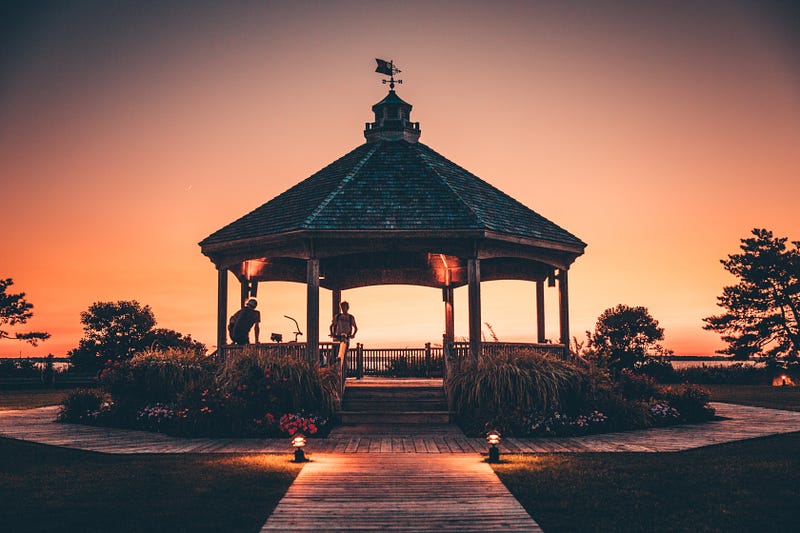
“They put gazebos in squares. Engelbert MacGyver put the gazebo in the square in 1941 at the same time he created the William Hadley Museum.”
“Why would you even care about this? It’s like you’re a tour guide for this stupid town.”
Burgess was contemplating how he might respond, when Jim noted, “It was a rhetorical question. I don’t need to have an answer.”
“That’s your problem, Jim. You don’t want answers. They could be yelling at the top of their lungs for your attention and you would just ignore them.”
Burgess was leading him to a three-story brick building across the street from the civic center. On the first floor was a doctor's office and there was a travel agency next to that office. There was a metal door leading to a staircase upstairs. Burgess opened the lock on the door and pushed the door open.
“I’ve never seen you in this building,” Jim told him.
“You haven’t seen a lot of things, my friend.”
Burgess turned on the light and began to climb the stairs. Jim reluctantly began to follow him upstairs.
“You’re not going to tell me what this is all about?”
“No patience at all!”
“I have plenty of patience. Look how long I’ve endured this town.”
When they reached the top landing, Burgess took out his keys again and opened another locked door. On this door were the words, ‘Anderson’s Antediluvian Apothecary.”
Jim had no idea who this Anderson might be or whether it was a first or last name. He didn’t have the desire to explore it any further. All around him were clues to a great mystery, but he had no inclination to pursue any of them.
“This is not some kind of an esoteric drug store, is it? Antediluvian, pre-flood? Do you own this store?”
“What would make you think I would own this store? I’m just borrowing space here.”
“I have this idea running around in my head that you’re some eccentric billionaire or oligarch hiding out here in oblivion town.”
Burgess turned on the light and it looked like a vitamin shop inside. In the northwest corner of the room was a wooden door and gestured for Jim to follow him to the door.
“You not going to lock me in the room and experiment on me with herbs, are you?”
“Don’t tempt me. Not hardly.”
Burgess unlocked the third door and pushed it open.
“Everything important comes in threes,” he said whimsically.
Inside was a room filled with boxes along the edges of the open space in the center was a table with two chairs and stacks of large manila envelopes and pens set on opposite sides of the table.
“So what are we doing?”
“We are stuffing envelopes.”
“I am not stuffing envelopes.”
“This task you will do, because there is money in for both of us and because what we’re sending out is important.”
“How much money?”
“$50 each for about three hours of work,” Burgess answered.
“That takes us till after midnight.”
“You have been up to after midnight most nights. Tonight we’re doing something important.”
Jim was convinced this was another one of Burgess’ hoaxes. But something unexpected would sometimes break his indefatigable boredom. He didn’t mind spending time with Burgess. He was one of the few people he could talk to and otherwise, he would be spending his time alone sipping coffee and thinking about all the things that had gone wrong in his life.
Burgess gestured for him to sit down and handed him a stack of what looked like magazines.
“What are these?” He asked.
“It’s a photograph collection. We are mailing them out.”
Jim read the cover, “Retrospective works of Veronica Glen,’ Compiled by her mentor, Michael Bouvier.’”
“How did you get this project?”
“I was at the post office this afternoon his man named Anderson was talking about it.”(Jim wondered if this was the Anderson of the shop.) “I knew you needed some extra money, so I volunteered us.” He paused. “You should take a few moments to look at the book. Her photographs are amazing.”
“Let’s just get through this,” Jim answered. “I do need the money.”
Jim began to place the magazines and envelopes and put address labels on the centre of every envelope period he noticed the addresses were scattered across the country with some even overseas. On the left upper corner of the envelopes, the return address read ‘OMEGA Photography, A division of OMEGA Industries.’ He didn’t keep track of how many he was doing. But when he had finished nearly thirty of them, he noticed that Burgess, who was sitting beside him, was working faster and had completed, more than a third more. Where do you stop the moment and opened one of the magazines.,
“I know how stubborn you are, generally, but you have to take a look at the photographs. There are even pictures in the magazine of landmarks from here in Hadleyburg.”
“Why would this woman come to this town and take photographs?”
“Some people actually like this town,” Burgess told him.
“Five minutes and then we can resume. I’ll time us.”
Burgess told a small digital clock about 1 1/4 inch in length and 3 inches in width and started its stopwatch function.
“Why would you carry that pocket clock?” Jim asked him.
“I want to know what time it is,” Burgess answered. There was an even deeper meaning to his statement.
“It’s entirely arbitrary. I don’t even think time exists,” Jim told him.
“That’s apparent. You’re never on time for anything.”
“So what?” Jim retorted.
“The clock is ticking.”
Jim begrudgingly took the magazine and began to review its contents.
The photographs were unexpected, personal, and filled with details, as though small glimpses of larger palettes of color and light. On the first pages were landscapes and what appeared to be sunsets and sunrises in assorted locales. Jim recognized Chicago and Paris and London, but the others he did know, with deserts and mountains and rivers. He saw a photograph of a river that looked like the Amazon surrounded by jungle at the edges. There were two flying fish, captured in the air two feet above the water. He saw photographs of children and families of various ethnic origins, some in traditional dress and others in western-style clothing, some smiling and laughing, some crying. When Jim saw all of these photographs, it was as though the person who took them was not simply observing at a distance, but intimately connected to the subjects observed, as though the emotions of the photographer were deeply visible in every pixel of the photograph.
Jim had become fully captivated by these pictures, unlike so many of the other aspects of his life, where he had only glanced at them. But these photographs seemed to seize the eyes, demanding to be recognized, to be acknowledged in their full meaning. There was a photograph of a boy, 11 or 12 years old, carrying what looked like a wounded lamb in his arms, with tears running down each of the boy’s cheeks. Jim could feel in his gut the emotions this boy had been feeling.
“How did she do this?” He asked Burgess, “Capture more than what was passing before her eyes?”
“Because she was paying attention. The best photographs are yet to come. Please continue.”
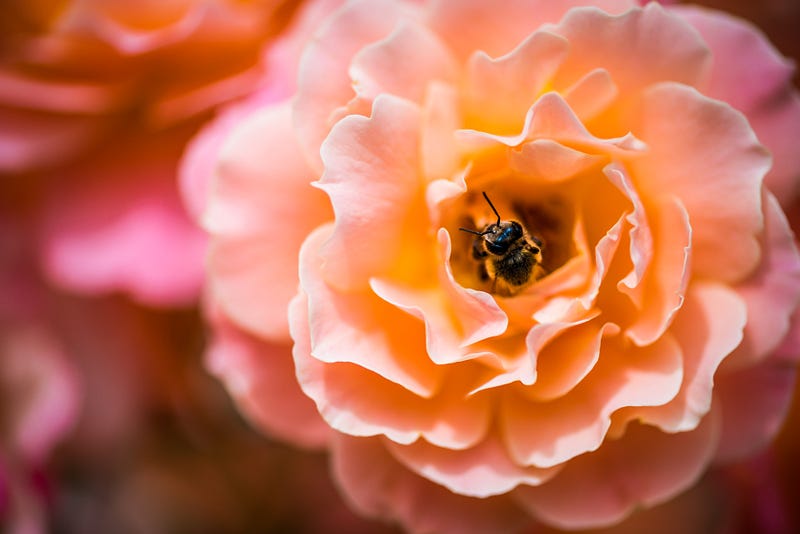
Nine minutes had passed on the clock, and it seemed like half an hour. On the next page was the photograph of a honeybee hovering near the open orange, yellow and red flower with the hairs on its legs and body covered with pollen. Like the previous photograph of the fish, he was puzzled about how she had taken his photograph. It seemed to have stopped time itself and had frozen for a pose.
“You know I had this beehive when I was a boy and kept it on our patio,” Jim told him.
“I remember. We talked about it once.”
On the next page was a photograph from Hadleyburg of the gazebo that Jim had come to hate, with what looked like a slightly younger Engelbert MaGyver sitting in the gazebo’s steps. He turned the next page and found two more photographs with profound images of Lake Gibraltar and the two rivers which fed into it. There was even a photograph of William Hadley’s uncompleted observatory. At the bottom of this page was a 4 x 7” photograph of the strawberry festival. Jim could see many familiar faces around the crowd, including Reynolds, and Sarah was staring at a freshly baked strawberry pie from a vending table near the gazebo.
Jim snickered a moment and then began to turn the page.
“This is a very intriguing photograph,” Burgess told him and reached over and stopped Jim from turning the page. “I think you should spend a little more time looking at it.”
“I’m not interested in studying these photographs.”
Jim flipped over the last page of the booklet. This picture was truly disturbing. It was a self-portrait of Veronica Glen in the last days of cancer with her face pale and gaunt, and dark circles under her eyes. It was like an image he remembered vividly from his own mother, of an illness taking the life from her in small increments. In Veronica’s eyes, he could see both pain and compassion simultaneously, and he felt something powerfully visceral in her physiognomy. Beneath her picture in Times New Roman font 24 points with the words, “Have the courage to feel everything.” Her self-portrait was the only photograph that captured his complete attention, and it had truly captured him because as much as he wanted to close the booklet and continue with his letter stuffing, he could not take his eyes away.
“I know, It kind of captures you, doesn’t it?” Burgess told him. “This was the woman who captured and held this treasury of glimpses.”
“That’s kind of poetic,” Jim responded. “Comes as a surprise from you.”
At first, Burgess didn’t respond to this sarcastic remark. He just began to work on his envelopes again. But then he turned to Jim and told him, “Maybe one day He’ll tell you everything.”
Jim pondered who this “he” would be. But then Burgess never spoke plainly and simply about anything.
“We went over our five minutes,” He said and put the small clock back into his pocket.
“I have other photographs from Veronica Glen,” Burgess observed. “This booklet really piqued my interest.”
“I don’t think there is anything that could pique my interest at this time of my life,” Jim lamented.
Burgess shook his head.
“There is one other thing I want to point out to you.”
Burgess took the booklet from him a moment and turned the pages to a section from Saint Paul Minnesota.
“This is my favorite photograph in the collection.”
It was a portrait of a woman approximately 40 in the center of the page, surrounded by smaller photographs of landmarks of Saint Paul. The photograph was taken at an angle and the woman had her open hands laid gently on her lap, with her auburn hair pinned behind her ears and her lips curled slightly at the corners with a modest smile. Her countenance revealed gentleness and compassion.
“How do you do that?” Burgess asked. “How do you capture a glimpse of the essence of who this woman was? I’ve taken hundreds of photographs and I feel like a complete amateur.”
“It’s just a portrait,” Jim responded. “You tell a person where to sit and press the shutter.”
For other reasons that Burgess wouldn’t speak about, this photo had even greater significance.
“You were in Saint Paul once, if I remember,” Burgess told him.
“Once,” Jim responded. “It was okay.”
In fact, Jim had spent three days in Saint Paul in March 1997 at an Independent Newspapers Association symposium on behalf of the Hadleyburg Times. The second time he had left Hadleyburg was for another symposium in Pittsburgh in December 1999. Those had been the only times he had left Hadleyburg in over four years. It would be the Pittsburgh symposium that had changed everything.
They worked for three hours more, sitting beside each other, hardly speaking a word when Jim stopped a moment and turned to his friend.
“I know I must be a horrible person to deal with every day. I don’t want to be this way.”
“Don’t you think everyone here can see that? I’m sorry that Julie treated you so badly, that you and your father are not close. Very few of us go through our lives without tragedy. I believe things will get better.”
“I just wish you would give me one answer as to where you came from, one concrete fact, something I could tell people that makes some sense,” Jim told his friend. “When you showed up at the newspaper in Chicago you told them I went to school with you and I lied for you. I even told Julie we went to school together.” He paused. “I even told my father we went to school together. Just give me one honest detail about your past, something I can hang my hat on.”
“I was in Arizona, working in a laboratory for 10 years prior to coming to Chicago. As I told you before I am here to see what happens. I wish I could tell you more. But I don’t want to screw things up any more than I have.”


