
Identitarianism to Universalism: the Five Degrees of Social Identity
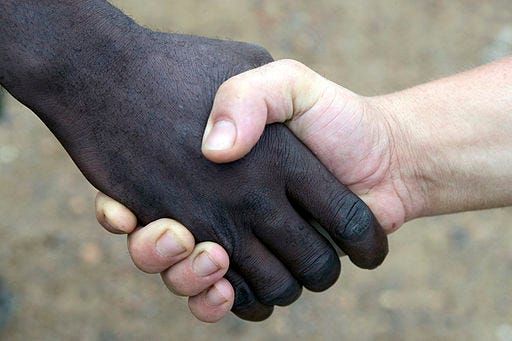
When people tell you what they think human nature is, they reveal more about themselves than humanity. The human race has many natures. We’re greedy and generous, suspicious and trusting, terrified of change and in love with novelty. We’re also identitarians and universalists—we divide ourselves into social identities like race, gender, and tribe, and we unite in our common humanity.
When talking about anything that suggests a binary division, the old joke applies: there are two kinds of people, those who divide people into two kinds and those who don’t. Identitarianism and universalism are points on a spectrum that can be roughly divided like this:
- Genocidists want to exterminate the groups they hate.
- Segregationists want to isolate the groups they hate.
- Conservative identitarians want other groups to succeed or fail without anyone’s interference.
- Liberal identitarians want to help some groups in the hope of turning our current economic hierarchy into one that is perfectly proportionate in terms of race and gender.
- Universalists want to end all forms of poverty and privilege to make a world that provides equal opportunity to everyone.
Humanity’s social divisions began for practical reasons. Gender roles helped families address matters of survival. Tribal markers like language and clothing helped people know if strangers were like them and were therefore more likely to be friendly. Based on studies of modern hunter-gatherer tribes, we believe those first manifestations of gender and tribe were fundamentally egalitarian. But the development of agriculture and cities gave rise to gender inequality, class systems, and a worldview that saw outsiders as barbarians, inferior strangers whose incomprehensible language sounded like they were babbling bar-bar-bar.
For most of recorded history, the division between identitarians and universalists was simple. Identitarians supported the current social structures in which one tribe, one class, and one sex ruled. Universalists believed all humans are equals, as the texts of several religions reveal:
The Bible, Galatians 3:28. There is neither Jew nor Gentile, neither slave nor free, nor is there male and female, for you are all one in Christ Jesus.
The Qur’an 49:13. O mankind! We created you from a single (pair) of a male and a female, and made you into nations and tribes, that ye may know each other (not that ye may despise (each other). Verily the most honoured of you in the sight of Allah is (he who is) the most righteous of you. And Allah has full knowledge and is well acquainted (with all things).
The great social divisions of tribe, class, and gender added a fourth, race, around 1680, when the first “white people” are mentioned in the British colonial records. From then until the middle of the 20th century, the most influential identitarians throughout the English-speaking world were rich white Anglo-Saxon Protestant men, and their most famous opponents were universalists who were inspired by religion (like William Lloyd Garrison and Frederick Douglass), socialism (like W.E.B. Du Bois and Eugene Debs), or a combination of both (like Martin Luther King and, after he left the Nation of Islam, Malcolm X).
The great tragedy of identitarianism is it is often passed on to its victims. White and male identitarians inspired black and female identitarians. John Allen Muhammad, a member of the Nation of Islam who became known as the Washington Sniper, killed strangers in the hope of starting a race war. Valerie Solanas, the author of “SCUM Manifesto” who argued for killing all men, shot Andy Warhol and left him for dead. Black nationalists like Marcus Garvey and feminist separatists like Roxanne Dunbar-Ortiz demanded places of their own. Social media has numerous examples of calls to “kill all men” and “kill all white people”, which, in some cases, are only calls for an end to the social constructs of maleness or whiteness, but in others are deadly serious. If you think these are examples of reverse racism and sexism because they’re reactions to white racism and male sexism, they’re not. They’re simply examples of the insidious logic of racism and sexism.
Science suggests we are born universalists:
…by this age — three months — many babies start to prefer faces of people from their own race to those of another race. This early favoritism may represent the first glimmers of racial prejudice, psychologists say.
But don’t start fretting about racist babies yet. On the bright side, the researchers also found that babies raised with frequent exposure to people of other races don’t develop this early bias.
The writer’s colloquial use of “race” is misleading because babies see physical differences when they’re around three months old, but they don’t interpret those differences in racial ways for several years, as the same article notes:
…Typically, “by the age of 4 to 6 years, children already display racial stereotyping and prejudice in a variety of contexts.”
What three-month-old babies see is tribe, the differences between the kinds of people they know and the kinds of people they don’t. Turning tribal markers into racial markers is a process that was described in a 1949 Broadway song:
How do we unlearn what we’ve been taught? Albert Einstein explains the basic principle as well as anyone:
“A human being is a part of the whole, called by us “Universe,’ a part limited in time and space. He experiences himself, his thoughts and feelings as something separated from the rest — a kind of optical delnsion of his consciousness. This delusion is a kind of prison for us, restricting us to our personal desires and to affection for a few persons near est to us. Our task must be to free ourselves from this prison by widening our circle of compassion to embrace all living creatures and the whole nature in its beauty.” — Albert Einstein


