
Idea Songlines.
Writing Stories as Idea Songlines.
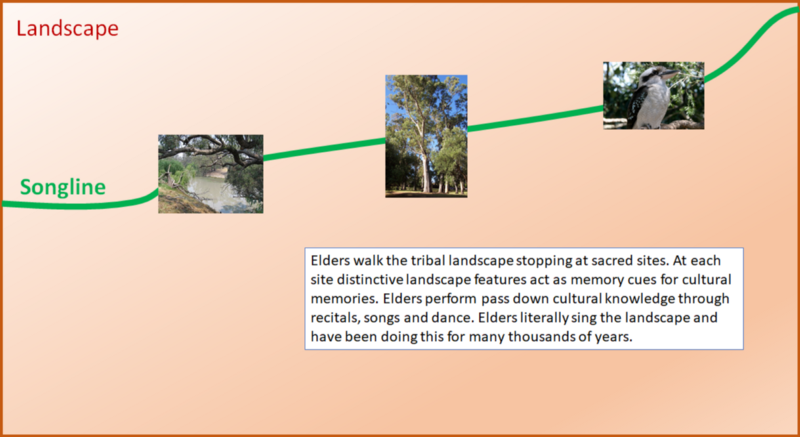
Songlines Explained
In her wonderful book, “The Memory Code”, Lynne Kelly described Songlines (or Dreaming Tracks) as “pathways through the landscape connecting a large number of significant locations in a fixed order”. Each location hosts performances of pertinent cultural knowledge. Songlines are carefully timed to coincide with changes in seasons. A songline is “sung as a long sequence of short verses, which together form a sung chart of the ancestral being’s creative journey”. Tribal elders, literally sing the landscape.
Songlines are an elegant way of thinking about knowledge, connections and relationships. Australian Aboriginals have the world’s oldest continuous culture. They have preserved and passed down their cultural identity by performing their songlines for over 65,000 years.
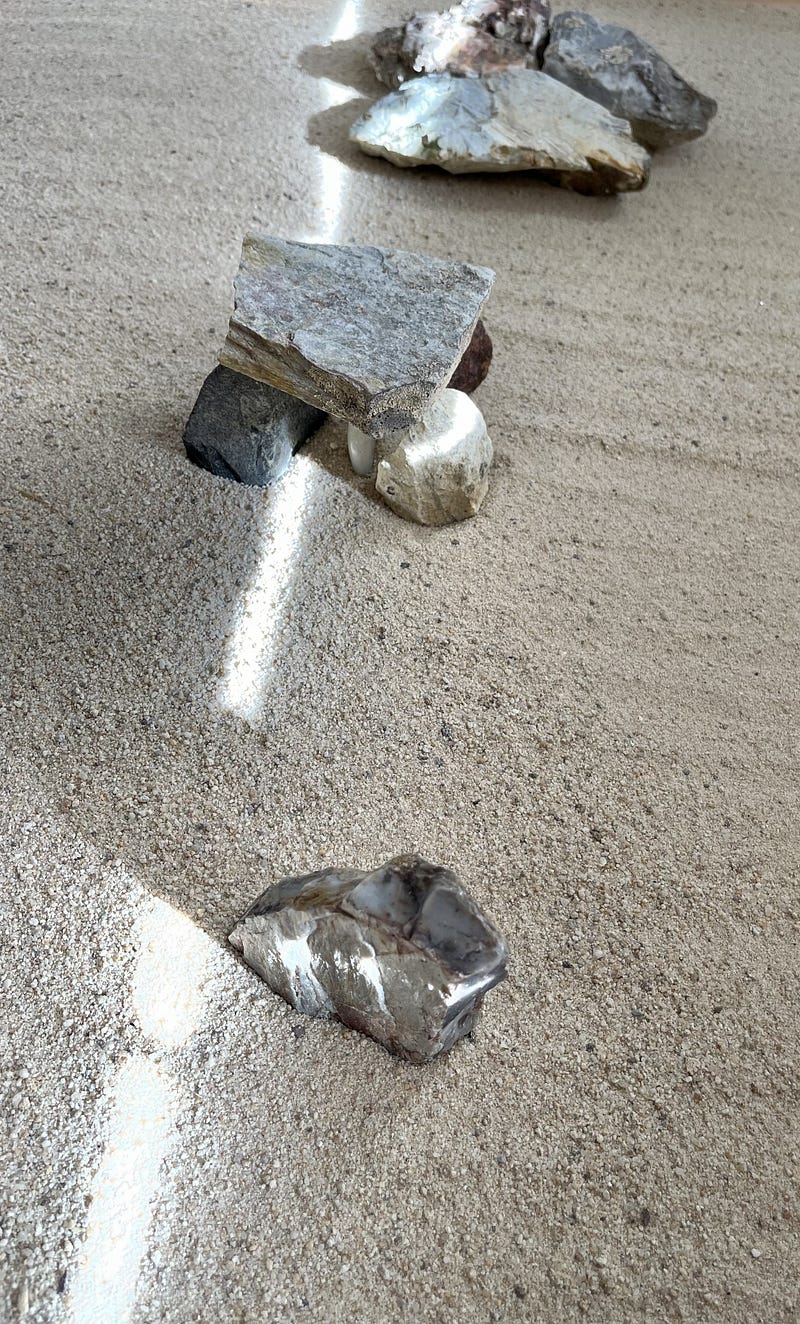
My art in rock, sand and light show how I visualise a songline. The sand canvas is the landscape. Stones represent various significant locations, such as caves, cliffs, mountain tops, river bends and billabongs.
The beam of sunlight represents my trek across the landscape and therefore the order of visiting each location. The sunlight moves and I use that as a metaphor for seasonal change. My art helps me to contemplate a songline as a series of linked ideas in a mental landscape.
Given the volume of professional publications on thinking. I decided that my first task is to explain what I understand by thinking, thoughts and ideas.

Thinking
Rudolf Steiner eloquently summed things up. “Thinking … is no more and no less an organ of perception than the eye or ear. Just as the eye perceives colors and the ear sounds, so thinking perceives ideas.”
Ideas and Thoughts
Thought’s old English origin means “to conceive of in the mind, consider”. So what is the difference between a thought and an idea?
In common usage and philosophy, ideas are the results of thought. Put another way, an idea is the product of a thought process.
An idea can be the result of multiple thought processes in the same manner that a house is the product of a number of building processes.
Thought processes can, and in our minds do, combine and manipulate multiple ideas to create new ideas.
The function of our mind is to think. Thinking is complex and made up of many interacting thought processes with complex feedback loops. An epiphany is where we produce an idea that can change both our worldview and thought processes. In turn, an epiphany leads to the emergence of entirely new ideas.
Thought processes exist only within the mind, but we can socialise our ideas through writing, talking, reciting and performing.
Idea Songlines.
My mind is metaphorical garden, Thought processes potter around nurturing and tending pruning and growing shaping and arranging flowering ideas into beautiful songlines ready for socialising through writing and publishing.
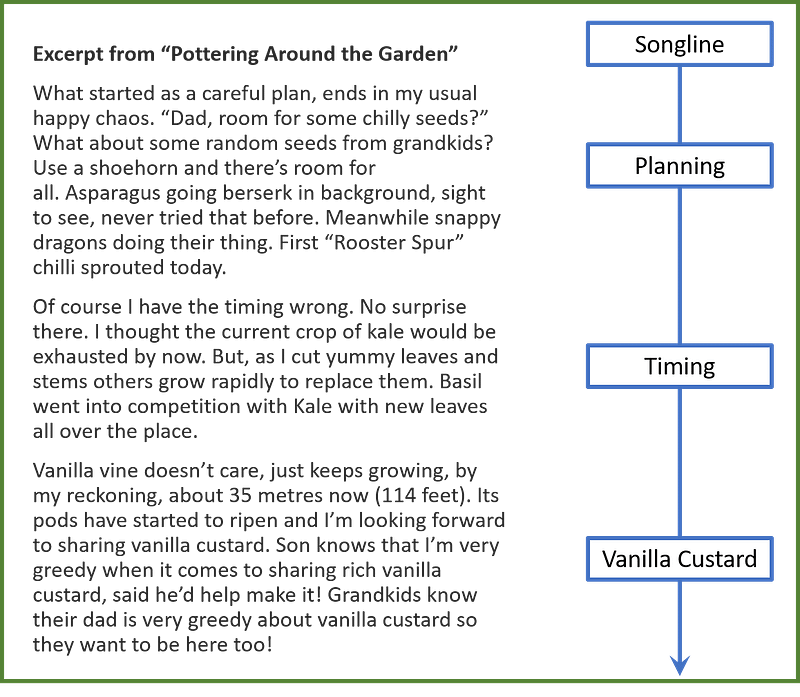
This all sounds horribly simple, in fact, it’s deceptively simple. The songline provides a narrative structure to the story. When paragraphs (or stanzas) are edited, revised and stuffed with nuanced words they have to make sense in the narrative’s context. Check, agonise and correct!
Deleting a paragraph creates a broken songline. But, deletion is a poor description. The ideas within the deleted paragraph are not lost. They return to the mind’s garden soil, where thought processes may encounter them and give them new purpose in another songline.
Sometimes the narrative needs changing. This means changes, additions and deletions of locations within the songline. Change begets change. At some stage a judgement call is required: “Enough is enough! Magles, peck the publish button! Right now!”. Magles, my magpie henchman, loves this because he knows the mayhem that follows, but that is another songline!
Blessed be.


