
Idaho teachers dress up as Trump’s wall, and the outrage… and excuses begin
This is exactly what racism looks like.
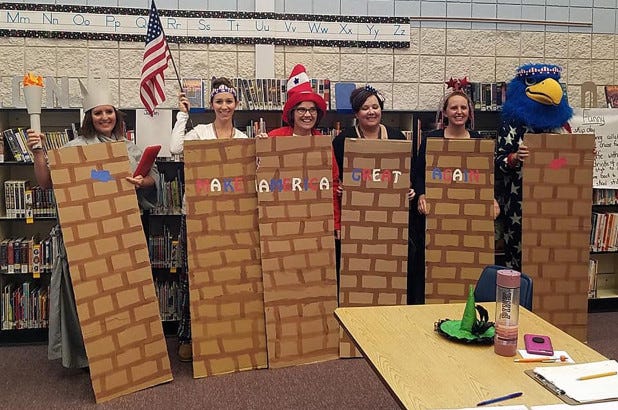
By now you’ve heard about the Idaho middle school teachers who dressed up both as Trump’s wall and “Mexicans” for Halloween. At school. So many things to say because the racism and stupidity is so real here.
If you look at the photo, this wasn’t a spontaneous decision. Much thought went into making the wall, dressing up as the Statue of Liberty, finding matching ponchos, maracas, mustaches and sombreros. So they must have met at least a few times to talk about these costumes. What they obviously didn’t talk about — or care about — was the pain this would cause the Hispanic community and the children who attend this school.
So this wasn’t a misstep. It wasn’t just them being insensitive. And who cares if they didn’t have “malicious intent”? This was racism. It was disgusting, white supremacist racism. Make no mistake about it. They didn’t have any malicious intent? It doesn’t matter. The impact — their harm — to the Hispanic people in that community will be immeasurable. How can those parents and their children trust anyone at that school ever again?
The teachers were suspended. That means either they will return to that same elementary school or get hired elsewhere. Either way, they will continue to spread their racist ideology and oppress more children of color. This is nothing new, so why are white people in disbelief that teachers would do such a thing? Easy. Teachers are just as likely as any other white person of being racist and upholding white supremacy.
Let’s move away from the blatantly racist behavior teachers can exhibit and talk about the more subtle ways they perpetuate racism and uphold white supremacy. The Everyday Feminism article “10 Ways Well-Meaning White Teachers Bring Racism into our Classrooms” spells it out:
- Lowering expectations. I witnessed this first-hand throughout my education. Numerous times teachers — and later on professors — assumed I was capable of keeping up academically. Once they realized I was one of the smartest students in the class, that created other problems. While I received my share of praise, I also received criticism for speaking my mind — as if I didn’t know my place.
- Being race neutral. The old “I don’t see color” speech. We all see color. So stop saying this as if it’s something to be proud of. The problem isn’t that you see color. The problem is seeing color, then treating that person as less than you. Try being culturally responsive. Learn about other races and ethnicities. Share those lessons with your children. Talk to your friends and family about it. Don’t just claim you’re not a racist. Be an anti-racist.
- Using racially coded language. Don’t use stereotypical language to describe black and brown people. Also, we aren’t your charity cases. So stop sharing stories with your friends about the poor little black boy in your class you helped with lunch money that week. Do the good deed, but if you’re only doing it for cookies or to have a fun story to tell, don’t bother. You’re part of the problem.
- Mispronouncing names. We love to give our children unusual names. Don’t know how to pronounce a name? Ask the child and then write it down phonetically. And get it right from then on out. Those children don’t need you humiliating them with your half-ass attempts at saying their name. You’re there to teach, not judge.
- Unevenly giving out discipline. In a 2018 article, Vox reported black students are four times more likely to be disciplined — by suspension or referral to law enforcement — than students of any other race. It didn’t matter the type of suspension. It didn’t matter the type of school — traditional, charter, magnet. Black students still lead the way in disciplines.
- Prioritizing whiteness in lessons. I want the white people to think about this. What if you went your entire K-12 education being taught with examples you can’t relate to in your real life? What if everything you learned was taught through a white European lens? I learned so little of black history until I went to college. I was horrified. I knew some of Malcolm X, but I learned nothing about Ida B. Wells or Mary Bethune. The amount of conscious erasing of black history by educators is so complete, we have to learn that history on our own. White people don’t share this burden.
- Tokenizing student’s culture. I just want to say this loud and clear: NEVER NEVER NEVER talk “black” or “street” to a black person. It’s insulting and you look stupid doing it. Yes, that’s part of our culture, but not every black person speaks in the same vernacular. We aren’t a monolith, not even close. We come in a myriad of personalities, cultures, experiences and histories. Don’t pigeonhole us in an attempt to make us one-dimensional and easier for you to understand. Instead, take the time to find out who we are. After all, we’ve been learning about you our entire lives.
- Wearing cultural attire. Just don’t be a Rachel Dolezal. Don’t get cornrows. Don’t get grills. Don’t walk around in your African attire. Appreciate the culture without stealing it.
- Ignoring non-teacher, people of color advise. You should expect parents to have opinions about your curriculum and how you teach their children. Listen to them. They have had experiences in the classroom they don’t want repeated with their own children. As a teacher, you should understand learning is a lifetime endeavor. So if you only listen to other teachers/academics, you’re missing out on the wisdom of parents, community activists and church leaders.
- Not advocating for a diverse teaching staff. Can you imagine going through your formative years rarely having a teacher who looks like you? It’s isolating. It’s uncomfortable. And that child is already at a disadvantage. As a white teacher, you will either consciously or unconsciously favor those white children for all the reasons stated above. In addition, diversity means checks and balances. That’s why those teachers thought it was okay to dress up as the Trump wall. No one else who heard about it spoke up.
Follow me on Twitter:@LeciaMichelle