
I’d Love To Be A Responsible Consumer, As Tricky As It Can Be
Are we ready to take action and be a shift for the planet and society? We’ll see
Thirty years ago, I used to have a friend who was extremely conscious of all her actions as a consumer. Not drinking coffee because of fair trade reasons, or the aggressive procedures companies were using to obtain decaf. Only reading progressive and exclusive newspapers and magazines, not buying clothes from some brands because they were suspicious of using child labor in developing countries. At that moment, I thought she was a bit of a slave to her ideas, and that she was probably paying a lot more for the same goods, besides spending a lot of time searching and discerning was worth buying and what was not.
In the 1990s, environmental issues were not mainstream, at least in most of the countries. Though that is not so long ago, it was a completely different world. Recycling your garbage was not an issue. Half of the population were smokers in many countries, and they were allowed to light a cigarette virtually anywhere. Corporate Social Responsibility was just a yearbook with beautiful pictures. The gender pay gap was an issue, just like it is unfortunately still today, but no one cared or talked about it. Gay marriage was a utopia that only started to walk after the first legislation legalizing same-sex marriage took effect in the Netherlands on 1 April 2001. The list is long, but you know what a mean.
The first step was to care, but not doing anything. Equal opportunities came up in some corners of the media in Europe, and governments passed several regulations. Nordic countries have always been quite ahead in terms of Welfare State and social rights, but they became the point of reference in many senses. Being on that side of the story was cool, and besides, it was easy to align with these ideas and be inside a mirage of the new 21st Century paradigm.
With the financial crisis, everything polarised. On the one side, many of the developments achieved during the first half of the 2000s froze. In times of difficulties, there’s only room for surviving, and all the rest is postponed. But on the other side, after holding our breath during the most frightening years of the financial crisis, several Springs popped up here and there. 2011 was a hectic year in Spain, for example, and in many Arab countries, while Occupy Wall Street (OWS) caught the attention saying, “America needs its own Tahrir.”
The crisis was severe, and the backlash has been bitter and overpowering in social and political terms. The Seattle Times published a few months ago an interesting timeline:
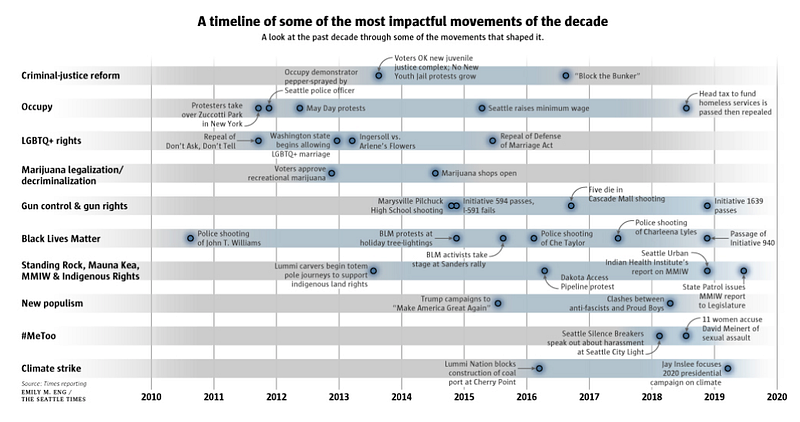
The result? Today, 2020, amidst the COVID and George Floyd, it is impossible to turn a blind eye to a reality that is becoming beyond uncomfortable. In many of the spheres of our life, some issues that used to be inconvenient are no longer avoidable. Society requires, urges, implores, action, as Erika Walker, Asst. Dean at Berkeley Haas School of Business wrote a few days ago:
Agreeing is no longer enough, and the situations cannot be postponed, avoiding to take active involvement. The question is: can we afford to be responsible? Is it enough to make small steps and contributions, or we need to go all the way or nothing? I wish I could become a different citizen right away, but to be honest, I’m not sure to what extent I can effectively be coherent and consistent. Being exemplary may be difficult and sometimes overwhelming, leaving aside how expensive, time consuming, and challenging it can turn out to be.
In my case, becoming a full-time activist is not an option. I am sorry, but I think my life today is not ready to meet Greta Thunberg standards. Should I? Probably I should start thinking about it, as the Environmental Emergency is something already hot in our heels:
It’s not only global warming, but also micro-plastics, Amazonia, or collapsing ice walls. As a consumer, there is a long list of things that are in my hands. They are quite easy ones that would almost make no impact on my everyday life. Some would require only tiny changes in my habits: of course, recycle, but also stop using any short-lived plastic (bags, food trays, envelopes, etc.), not buying out-of-season food that grew far away and traveled long distances to be in the corner shop. I could take care to avoid that food full of pesticides and other harmful additives. I definitely could try to eat healthier, and live aside foodstuff I know for sure has questionable ingredients, for myself and the whole system. Maybe I could try to get information about the animals I eat (if I eat any, but that’s another question) and the conditions in which they grew (antibiotics, space, etc.).
That would be “Responsibility Stage One.” Easy to say and doable, reasonable to accomplish with just a bit of time searching, and a will to change and build better habits.
There’s a “Responsibility Stage Two”, that anyone could accomplish with a little more effort. It has to do mainly with two parts of our consumption that could build a significant impact: choosing only renewable energy, and stop binge-buying. There are many options in the market to make sure your energy consumption comes from renewable sources. That’s the easy part, to which you can also contribute with some saving tips (with your air conditioning, with your lights, etc.). The second part is a bit more complicated: we need to stop continually piling and replacing our clothes, electronic equipment, gadgets, whatever. The economy needs our contribution, but that much? Someone told me a few days ago that Circular Economy was like returning to our grandparent’s habits, and I thought that was an excellent point.
“Responsibility Stage Two” takes a little more engagement, but it’s also no big deal. When things get tough is when you want to go for what we could call “Responsibility Stage Three.” The mastery of responsibility would have to do fundamentally with mobility and human and animal rights. This can imply radical changes in your lifestyle, a fair amount of your time, some degree of obsession, and you can also make many mistakes, or be caught in many contradictions. Should we stop taking planes? Should we sell our car and go only for clean mobility? Should we boycott some brands, shops, or services?
We can get into a slippery slope very easily, just like those who want to, for example, “ensure your money isn’t going to cause you to oppose using this app to scan product bar codes to see what causes the company is donating to.” We can extend our “Stage Three” responsible action to almost any economic sector or product. That would take us to the question which concerns me the most: are we being responsible, or just using it to promote our ideas and turn them into the winning perspective? As it is said in many “responsible consumer guides,” “Pledge to only buy products that support your values, and survey which stores/online retailers offer them.”
I consider myself to be part of the population with the best access to information and the resources to make some responsible decisions. I believe that time for action has come in many fields, but I’m also afraid that this whole thing doesn’t become an “against” exercise, tearing us apart instead of gathering us around a just cause for the planet. We’ll need to be careful.