
Iago, The Death Of Hercules Poirot And The “Raindrop” Prelude by Chopin
‘Curtain: Poirot’s Last Case’
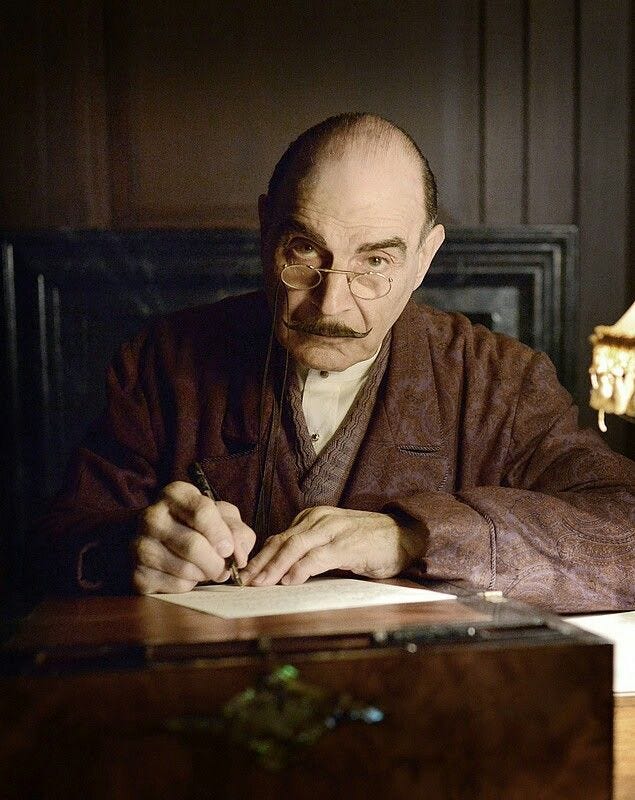
“Now you must realize this, Hastings. Everyone is a potential murderer. In everyone there arises from time to time the wish to kill — though not the will to kill. How often have you not felt or heard others say: ‘She made me so furious” ― Agatha Christie, Curtain
“O, beware, my lord, of jealousy: It is the green-eyed monster which doth mock The meat it feeds on.” — Iago, Act 3 Scene 3, Othello
Last Saturday I was in heaven. For a large part of Saturday afternoon, I was thoroughly entertained by ITV3 by showing the classic ITV film-length episodes of Poirot starring David Suchet (see above). The finale was the finale as it finished with Curtain: Poirot’s Last Case. And his death.
I had never seen the last episode and the last Christie-penned story of Poirot that was first shown in 2013 — a decade ago. However, I had read the book and could never really find it in me, to say, a final “Au revoir” to the magnificent Hercules Poirot — a fictional character I have come to love.
Although I knew he would die in this story and not pretend he was dead as he did in The Big Four, it is distinctly harder to experience the death of a much-loved character on screen than in the book. There is no going back to a state of forgetfulness once the act is shown on film. It is The End. Finit. N’est-ce Pas?
But the film plays on this — as Christie does in her book — as Poirot does return after his death to explain to Hastings and us about the intervention he made to prevent a murder — about to be committed by Hastings — the murder he solved of Barbara Franklin and Poirot’s final action of murderous justice — an “execution” he undertook against a modern-day Iago he refers to as X. It is one of the most brilliant finales in literature — and on the screen — and has always been completely underrated in my opinion.
And the perfect accompaniment that parallels this whole story of life, murder, and death is the piano music that begins the film and finishes it — Prelude Op.28, №15 by Chopin. It is known as the “Raindrop” Prelude. Whoever chose this — I assume the director — is a genius. It is one of Chopin’s most famous works. Please listen to it.
It is noted for its repeating A♭, which appears throughout the piece and sounds like raindrops to many listeners but those raindrops are overwhelmed by a darker motif within the piece that rises to a darker vision — a storm perhaps, or for me a foreshadowing of murder and death.
This fits the themes of the book and the film to perfection as an evil modern-day Iago relentlessly repeats his poisonous infiltration into the minds of the vulnerable — here are those “raindrops” not of water but of evil.
The climax of Chopin’s masterpiece is death. It was written in 1838 whilst staying at a monastery in Mallorca with his lover, George Sand (born [Amantine] Aurore [Lucile] Dupin), and her son. The two had visited Parma and on returning in a thunderous rainstorm found Chopin in a distraught state of mind who exclaimed to them,
“Ah! I knew well that you were dead.”
Forget those raindrops as once heard the abiding feeling is of impending death and perhaps a resurrection. Perhaps my love of Poirot clouds my judgment but I see the musical motif clearly in Poirot’s fear of eternal damnation for the murder he commits or rather the execution of X in his last days on Earth. Poirot’s conscience and moral compass are as filled with dark worries as the Chopin prelude is.
And this time Captain Hastings is directly involved in the machinations of X. Poirot only knows who X is once his trusted friend arrives at Styles Court and begins to interact with the motley crew at Styles Court which includes his strong-willed daughter.
Hastings manages to alienate her even further after the death of his wife and her mother. Hastings is the catalyst as Poirot observes and listens. Yet Hastings becomes directly involved in the sinister machinations of a Machiavellian individual who is a modern-day reprise of Iago from Othello by Shakespeare. Poirot’s little grey cells have met their mirror image in the murderous distortion of X. X does not kill directly he creates the mind — of another — prepared, primed, and willing to kill.
How do you stop not the actual killer but the person responsible for creating the psychological determination by removing the inhibitions of strict moral prohibitions to murder both ethical and religious? An accessory to murder must be physically involved. X is involved only psychologically and his words are not of themselves directly forcing the act but with subtlety and deceptive reticence emboldening the would-be murderer. For X is Stephen Norton a grey-haired man of quiet disposition, who uses binoculars for birdwatching — and female human targets — and is our 20th-century Iago.
Poirot meets with this force of evil and it confirms his plan of action and answers to the Problem of X. In discussing The Tragedy of Othello, scholars have long debated Iago’s role — highlighting the complexity of his character and manipulativeness. But we are not in Othello so this is for Poirot the Problem of X or Norton who is more than an Iago because he is a serial killer with blood not on his hands but in the malevolence and marrow of his being. Poirot must stop him. Poirot is the only one who knows how dangerous a force X/Norton/Iago is for humanity.
Poirot is the unique detective, the jury, the judge, and now the executioner. Norton must die. Yet no crime has been committed. Poirot is faced with his greatest moral dilemma since Murder on The Orient Express. He cannot allow this ‘killer’ to go free. And so he must be what those passengers were on the Orient Express. The executioner. But it is a problem for his devout Catholicism. He must reject God for Humanity. And die in mortal sin. For us.
Christie had written Curtain: Poirot’s Last Case during World War Two and had provided an insight into both a psychopath and a sociopath decades before these terms became mainstream in our understanding of psychopathy. It was only published in 1975.
I think this was very fortunate as the resonances are so modern. They could well have been completely missed as the time was not yet right for such a profound exploration of murder, death, psychopathy, and the vigilante justice of one of the greatest fictional detectives and moral characters in literature.
“Merci, cher ami.”