
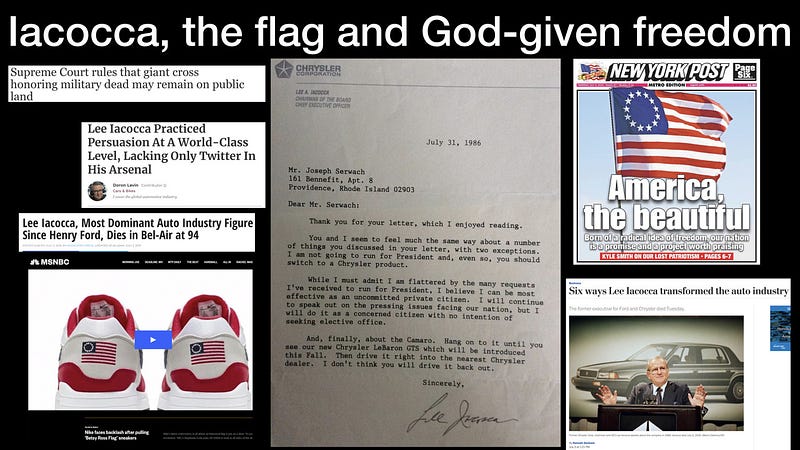
Iacocca, the Flag and Freedom
Providential? Lee Iacocca, the greatest “Made in America” champion, died on the 243rd anniversary of Congress approving our Declaration of Independence just as shoe manufacturer Nike rebuked America’s first flag.
Iacocca ran Ford then saved Chrysler in a time when Americans were overwhelmingly pro-American, regularly advocating for American workers and their work. He was the father of the Mustang and the minivan, merged Chrysler with American Motors to acquire the purely American Jeep and oversaw efforts to restore the Statue of Liberty
Throughout 1986, Americans of all parties (myself included) asked Iacocca to run for President in 1988. When U.S. Sen. John Heinz died in an April 4, 1991 plane crash, Pennsylvania Gov. Robert P. Casey offered Iacocca the open Senate seat.
A song about Iacocca’s hometown (“Allentown’’ by Billy Joel) summarizes his passion: Iacocca regularly made the patriotic case for buying American-made cars. He audaciously and defiantly claimed in ads that American Chryslers were better than a German-built BMW or a Japanese-built Honda .
Hours before his death, Gallup reported only half of us are “extremely proud to be Americans” (76 percent of Republicans and 22 percent of Democrats). Despite the partisan divide, the same poll found 70 percent feeling some level of American pride.
That morning, Nike bowed to a claim the 13-star flag created by Betsy Ross to symbolize freedom was actually from an age when Americans permitted (but vociferously debated) slavery. Slavery has existed throughout history (persisting to this day) while America is dedicated to the idea of oppressed peoples overthrowing tyrants to free themselves.
Why are displays of the cross, statues of Americans and now even the American flag so often opposed, feared and attacked? Because we have a higher freedom that terrifies our attackers — a God-given freedom that leaps out in a single Biblical passage:
“For freedom Christ set us free; so stand firm and do not submit again to the yoke of slavery… For the whole law is fulfilled in one statement, namely, You shall love your neighbor as yourself. But if you go on biting and devouring one another, beware that you are not consumed by one another… But if you are guided by the Spirit, you are not under the law.’’ (2 GAL 5:1, 13–18).
Not under the law? Above the law? Who are we to think laws don’t apply to us? The Declaration of Independence answers that question by referencing God four times, most notably, arguing the “laws of nature and of nature’s God” entitled the United States to independence and that men are “endowed by their Creator with certain unalienable rights.”
If you make your emperor, king, leader, president or any false idol your ultimate ruler and highest authority, that force becomes your “god.’’ And the laws of the tyrant’s government (and the weakest link in its chains) become binding.
But when you make Jesus your king there is always a higher authority allowing you to imagine yourself being “above the law’’ and therefore, above any all-powerful king or ruler on earth.
St. John Paul the Great explained: “Freedom is not the ability to do anything we want, whenever we want. Rather, freedom is the ability to live responsibly the truth of our relationship with God and with one another.’’
In his visits to America, St. John Paul also taught practicing religion was itself an act of freedom, where “a human being directly sets his course towards God. No merely human power can either command or prohibit acts of this kind.”
Yet, despots continually try to suppress our freedom to love God and share His truth. Living “above the law’’ but under the authority of God doesn’t mean ignoring human laws. But if we prioritize God (who is both love and truth itself) it does mean we recognize that miracles are always possible as long we first submit to a higher authority, the author of the Universe itself.
If we are focused on following God’s Way, we don’t even have to worry about the laws or whims of the strongest powers surrounding us. This explains why Joseph Stalin and Adolf Hitler wanted crosses removed and replaced with portraits of themselves: Because we gain greater power and confidence from holding the cross above us.
This explains why the enemies of God-given freedom want to burn or remove American flags. Because our flag symbolizes “the American Way,’’ of freedom from oppression, which is based on the norms set out by our faith’s founder, who said 2,000 years ago, “I am the way, the truth and the life.’’
This explains why the secular world to this day goes to court demanding that crosses be removed or destroyed (the U.S. Supreme Court in June voted 7–3 to save Maryland’s Peace Cross that has stood for a century).
This is why they fear Christianity. Because we lovers of God-given freedom are a threat to all-powerful supreme governments. Because we do not believe their loud denunciations or small-minded rulers are the ultimate authority.
President Trump, who continues the Iacocca legacy of advocating for building American products in America, has a new applause line he frequently repeats: “We don’t worship government, we worship God.’’
Originally published at https://www.linkedin.com.


