
I Worked at the New MoMA. Is it All That New?
I was there when one of the world’s most frequented art museums shut down. To the outside world, that is.
Between June and October 2019, The Museum of Modern Art in New York closed to the public to complete a long-awaited expansion that would put on full display MoMA’s reconceptualized, more progressive model for what a modern art museum should be.
As an intern in the photography department, I spent the better portion of my three months there observing the complete and total strip-down of the Museum to the barest of her bones: artless walls being repainted, the emptying of the infamous sculpture garden of its temporary bronze and stone residents, and the tearing down of Warhol’s pink cow wallpaper (months later, I can proudly confess that I stole a rather large scrap.) I was suddenly privy to the culmination of two decades’ worth of closed-door debates, held in the cushy homes of the one percent, on how a museum that has, at various times, been referred to as the Vatican, Kremlin, and Valhalla of modernism, arrived at its new model of presenting the history of modern and contemporary art.
This was a long time coming.
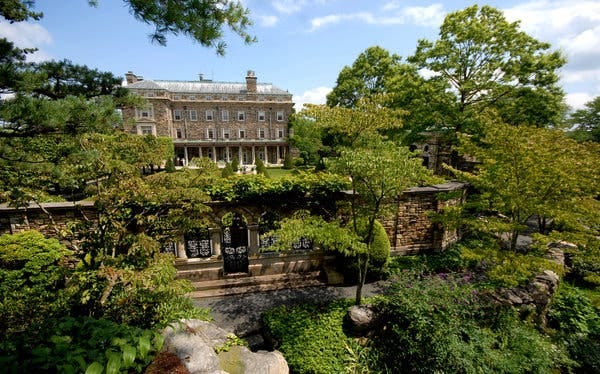
In October 1996, the Pocantico Center in Tarrytown, New York, seemed as good a place as any to host a series of private conversations on the future expansion of one the most prominent modern art museums in the world. For one, the site — gated, isolated, and situated but twenty miles from Manhattan — boasts a glorious view of the Hudson, as well as luscious green gardens of the 40-room, ivory-covered Kykuit Estate. But it is neither the sprawling landscape design nor the architecture of the Rockefeller Brothers Fund-owned property that made Pocantico an appropriate haven for debating the presentation of modernism at the Museum of Modern Art in New York; rather, it was the name of the estate’s owners. It was, after all, Abby Aldrich Rockefeller, the daughter-in-law of America’s wealthiest-ever citizen, who co-founded the Museum’s earliest incarnation in 1929 on a principal collection of eight prints and a single drawing.[2]
On the occasion of the Museum’s ninetieth anniversary, the self-prescribed new MoMA reopened after a five-month closure. Looking beyond its $450 million facelift, which has added an additional 40,000 square feet and twenty-four new galleries, the profound rehang has drawn both loud applause and poignant criticism.[3] In order to make meaning of the debates and dialogues that have emerged since its October grand reveal, it is worth returning to Pocantico, where then-relatively new director Glenn Lowry assembled influential museum insiders and outsiders — curators, architects, critics, scholars, journalists, museum administrators and trustees — to make the case that “the strength of the Museum of Modern Art has been its ability over the years to reinvent itself.”[4] The time for such a reinvention, in Lowry’s view, was fast approaching.
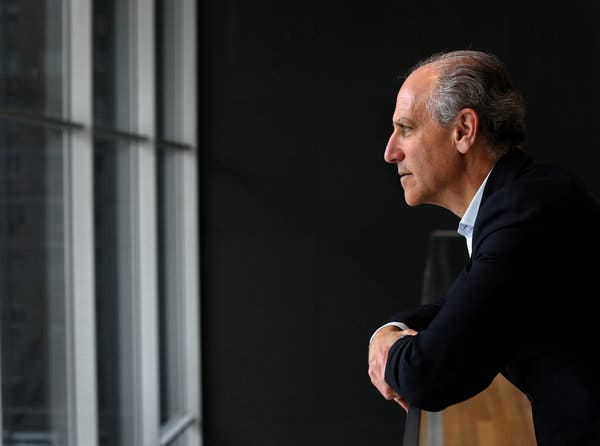
An ambitious director, Lowry’s goals were exactly what the Museum needed if MoMA was to share the New York scene with the much-Instagrammed Museum of Ice Cream and The Egg House (“Now in LA!”), spaces that draw young people into colorful, senseless utopias: more effective distractions from America’s troubling times, perhaps, than an art museum two blocks from Trump Tower. His timing, however, was off, for it would take another decade and a half to fully realize the director’s plans for MoMA’s previous twenty-first century aggrandizement, which debuted in 2004.
At their core, the debates can be examined through a dichotomy that emerged at Pocantico over what story the Museum was to tell, if any at all. On the one hand, Kirk Varnedoe, Hal Foster, and Rosalind Krauss (among many others) advocated for a “spine” model, arguing that the museum should present a clear and structured chronological narrative that honors the development of modern art across the 19th and 20th centuries, positing contemporary art as just the latest chain to a much longer sequence of events. On the other hand, Glenn Lowry and an ensemble of prominent architects championed the “sponge” or “web” model, which called for an open-ended and reconfigurable museum realigned to the interests of the moment. At times compared to plasma or an eclectic quilt, this model would present the history of modernism through the lens of contemporary issues; extending a loudspeaker to a more diverse body of voices, it would break away from a linear narrative in favor of a looser, more complex set of associations so that, as Lowry put it, “you don’t have to go through 150 years of history to find contemporary art.”[5]
Ultimately, it was the latter model that won over the hearts of the Museum’s trustees and fell onto the work desks of its curators and staff. If the previous expansion gestured towards a spine going through a sponge, then the 2019 expansion brought the fully realized sponge (and its problems) to the fore of contemporary discourse and criticism. The stakes of these debates on the history of modern and contemporary art cannot be understated if one agrees with Hal Foster’s assessment that when MoMA “makes a major move, such as the recent expansion [the] entire field shifts with it.”[6] When such a titan claims to shed the skin of tradition in favor of an allegedly radical transformation, the reverberations will inevitably be loud: such a major rehang will have profound implications on whether future generations can digest and grapple with the virtues and vices of modern art in an age where bold dissension has overtaken the avant-garde, and Instagrammable exhibition programming seems to render the museum space a spectacle of populist accessibility rather than the vanguard of any art historical canon.
In the debates over how to tell the best story of modern art, the chief point of contention surrounded how the Museum could balance its debt to history, while pursuing its commitment to the present and future.[7] The overwhelming consensus at Pocantico (and thereafter) was that some sense of narrative and chronology was needed with the exception of James Cuno, then-director of the Fogg Art Museum at Harvard, who expressed concern “over this ancient idea that museums need to tell stories.”[8]
Defenders of the spine model, led by Varnedoe, championed a stricter, more linear chronological story of modern art, which would couple with the pre-existing vertical structure separating time periods by floor. [9] Simply put, the story they wished to convey was the history of modernism such as it is: self-contained and shielded from contemporary issues. Some influential voices, notably Silvia Kolbowski, defended the notion that museums should have “edges” so long as they also form critical relationships between contemporary discourses with those of the past, but most argued that the existing linear model would be sufficiently legible, comprehensive, and most critically, would provide a sense of continuity. Its sponge model alternative, as Rosalind Krauss feared, would be read as scattered and inaccessible: the tempting pitch of inclusivity quickly devolving into unnecessary eclecticism.[10]
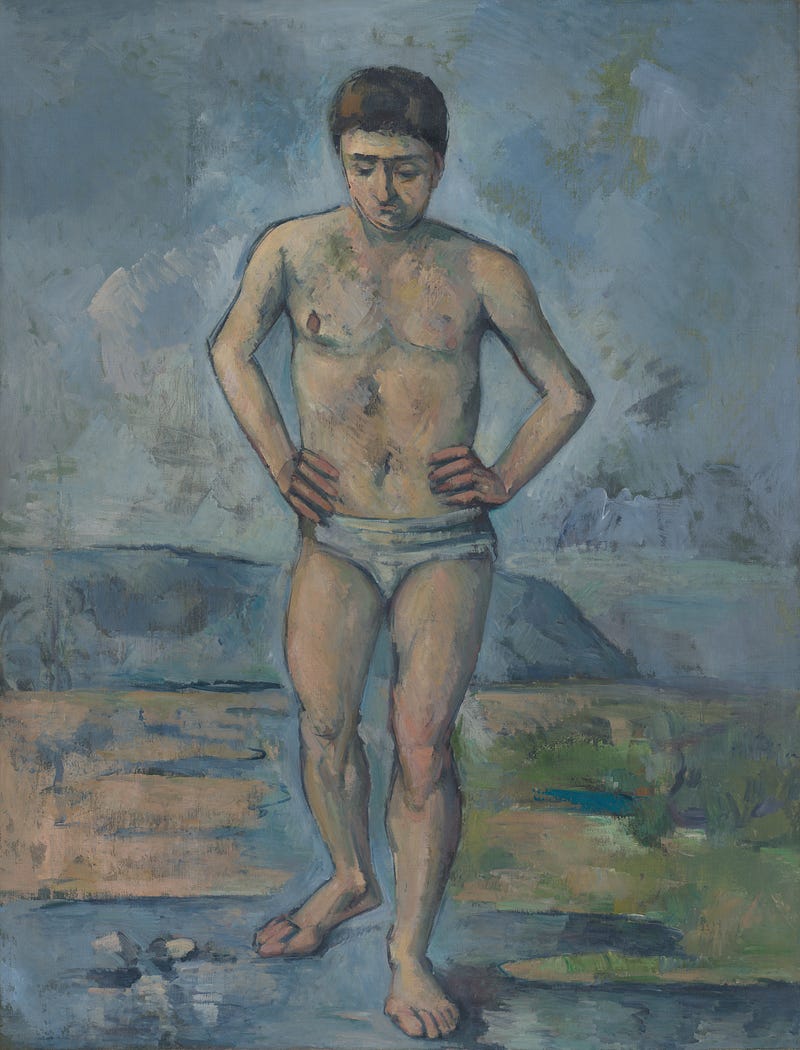
Referring to the painting which once heralded viewers at the gates of his department, Varnedoe maintained that “when you walk in at that Cézanne Bather on any given day in the painting and sculpture collection, you can walk out the other end with a synoptic view of developments in the history of art from Post-Impressionism to roughly the present.”[11] The New Yorker’s Adam Gopnik also raised “two cheers for the status quo,” doubling down on the importance of a clear narrative. [12] Unsurprisingly, the author cited an oft-quoted notion that humans love a good story; Gopnik argued that if one takes into consideration that most of the Museum’s visitors frequent its galleries two to five times a year, it becomes imperative that MoMA’s story be palatable verging on textbook.
The architect Jean-Louis Cohen further added to Gopnik’s case, asserting that such visitors return expecting to see the same masterworks, in the same place they have always hung. It is this consistency and clarity, Cohen believes, that shepherds in millions of visitors a year. When confronted with the criticism that such a rigid presentation of modernism would only further promote the long-dullified names of the mainstream, those championing the spine maintained that as guardians of modernism — especially with a collection as rich as MoMA’s — museums must assert a degree of authority on the historical narrative they present, without fear of any “hypnotic power over the masses entering your museum, who will then exit, repeating to themselves, ‘Cézanne, Cubism, Richard Serra.’”[13]
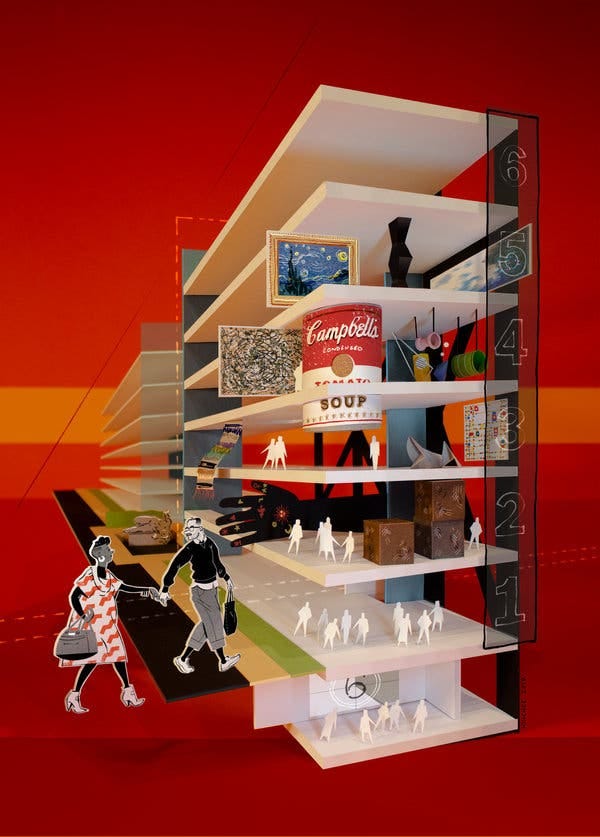
Those pushing for a sponge model did not disagree with their colleagues on the importance of structure, chronology, and narrative in the museum space. As the architect Peter Eisenman and then-Museums Association director Mark Taylor affirm, the sponge or web remains chronological, being that the floors are still divided, just as the sponge contains its own logic, albeit one which does not conform to the existing one. Although the galleries — anthropomorphized as the sponge’s “cells” — would offer viewers myriad possible linkages and configurations, the architect Bernard Tschumi hinted that there would nevertheless be some semblances of a spine, suggesting that “there are bubbles or cells that are bigger than others […] because the tissue is porous, there’s an infinite sort of passing of information from one cell to another.”[14]
There the concessions ceased.
Although Lowry admitted that the natural course of history demands that some events transpire before others, his grand plan for the revamped modernist Valhalla over which he presided was to return to the utopian vision of Alfred Barr, the Museum’s first director. Specifically, he stressed the radicality of MoMA being a street museum that would function as one great experiment or work in progress. [15] [16] As social and political currents on the street changed and made their mark on the canvas, lens, cutting board, stone, metal, and the old reliable sheet of paper (this is being conservative), so too the chameleon MoMA would reassess its exhibition program, and realign itself to the moment.
Paradoxically, to better understand the defense of the sponge model, one can turn to none other than Kirk Varnedoe, one of its fiercest critics. The curator was selected as commencement speaker of Stanford’s 1992 graduating class. At his alma mater, he recounted that “modern art, in fact, began by negating the privileges of established education. It ignored traditional text, snubbed respected skills, and side-stepped familiar standards of quality. It required people to make judgements without the comforts of stable rules and categories.”[17] Nearly a century after its founding, however, MoMA has become the Establishment, whose comfortable rules and categories Lowry wished to side-step, and effectively did. The sponge’s galleries would no longer be subservient to the traditional “-isms” of the history of art, but would follow more nuanced rubrics such as “Abstraction and Utopia” and “Design for Modern Life,” “Paris in the 1920s” and “In and around Harlem.”[18] The graphic designer Sheila Levrant de Bretteville insisted that this model would offer a living, working, breathing museum space where “I’d rather wander,” for “getting lost provides much more [opportunity] for chance encounters than knowing things.”[19]
Perhaps the sponge’s greatest strength, however, is, as Tschumi suggested, the integration of art history’s “misfits:” the plethora of overlooked artists belonging to familiar movements, such as the Abstract Expressionists Lee Krasner and Joan Mitchell, and a significantly more global perspective that pays long-earned due to women, artists of color, and those across the LGBTQ+ spectrum.[20] Praise for the diversity of voices now heard at the reopened museum echoed in Peter Schjeldahl’s review of the new MoMA: “we will have a diverse cosmopolitan culture or none worth bothering about.”[21] This ambitious goal, set by many institutions and realized almost always half-heartedly, earned its share of criticism from those in the “spine” aisle. Hal Foster, for one, presses for a stronger emphasis on modernism. Pointing to awkward juxtapositions in the rehang, he suggests that there are numerous other institutions better suited for contemporary art, especially when these juxtapositions are one-sided (modernism somehow barely manages to seep into the contemporary galleries.) If the Museum submits to what he determined is populist condescension to the perceived elitism of modern art, then its accessibility becomes an oversimplified spectacle that prevents modernism from challenging and engaging audiences.[22] So too Kolbowski posited that it was impossible for MoMA to be reconfigurable to the moment, for it can neither accommodate everything that comes up, nor anticipate what might.[23]
Schjeldahl’s argument, however, seems more persuasive. If MoMA is to align itself with the present moment, and the present moment, as the critic suggests, necessitates that the museum has not only a narrative duty, but an obligation to entertain, then the flexibility of its new sponge model is an immense success. He concedes to Foster that some level of “populism” has indeed penetrated the walls which traditionally cave only to wealthy trustees; he admits, “popular engagement has become a necessary face, or fate, of any current art-making that isn’t adjudicated by a plutocratic market.”[24] However, without an accessible museum that juxtaposes time periods and media to reflect the discourse of the day, “contemporary art is a buyer’s club.”
An urban analogy raised by Gopnik and Varnedoe might serve as a useful digestif to these critical debates: if the spine model is Philadelphia — a gridded city lined with main streets and grand avenues, flanked by the occasional side street offering an alternative route — then the sponge model is almost certainly Venice. Predictably, as in the wake of any number of monumental transitions, some critics suggest that the new MoMA reflects the current state of the city it is said to be analogous to: that is, underwater. Critics like Foster, Chloe Wyma (Artforum), and William Smith (Art in America) attack the institution’s polished corporate exoskeleton and its self-indulgent ambitions verging on a Bilbao-esque spectacle, that were well-intended but drowned in a disjointed ensemble of “goofy anachronisms, amorphous thematics, and over-curated set pieces.”[25]
But where is the optimism demanded of progress? After all is said and done, the Museum has made a lion’s share of progress in distancing itself from the “unquestioned greatness of the anointed”[26] and broadening the voices that comprise its permanent collection, in exposing spectators to its own problematic history, and ultimately, by admitting that this is but the first step in a longer redefinition of the modern art museum. Even Wyma cannot help but point out MoMA’s latest subway ads, which defend this message vicariously through the words of Robert Rauschenberg: “Make space for the new mistakes.”[27] Literally. Let us then heed the counsel of Roberta Smith; let us “give the curators a gold-plated A+ for effort — they have set a new path for their successors — and wait for the next installment,” she predicts, “this is only the beginning of a new beginning.”[28]
For the curious, I offer you my list of references:
[1] Kirk Varnedoe, Stanford University Commencement Address (speech, Palo Alto, California, June 14, 1992), Web. Date accessed: November 14, 2019. https://www.youtube.com/watch?v=R8ff5x4EigA
[2] Jacqueline Cardinal, Laurent Lapierre, “Glenn D. Lowry and MoMA,” International Journal of Arts Management Vol. 7, №1(Fall 2004): 72.
[3] William S. Smith, “Dissident Modernism Meets Peak Philanthropy at the New MoMA,” Art in America Magazine, October 25, 2019.
[4] John Elderfield et al., Imagining the Future of the Museum of Modern Art, (New York: The Museum of Modern Art, 1998), 30.
[5] Elderfield, Imagining the Future, 10.
[6] Hal Foster, “Change at MoMA,” London Review of Books Vol. 41, №21 (November 2019).
[7] Elderfield, Imagining the Future, 41.
[8] Ibid 49.
[9] Varnedoe was then Chief Curator of the Department of Painting and Sculpture at MoMA, 1988–2001.
[10] Hal Foster et al., “The MOMA Expansion: A Conversation with Terence Riley,” October Vol. 84 (Spring, 1998): 6.
[11] Elderfield, Imagining the Future, 32.
[12] Ibid 48.
[13] Ibid 49.
[14] Ibid 48.
[15] Myriad directors of MoMA since Barr have pinpointed MoMA’s radical accessibility to it being a “street museum,” in other words: on street-level, lacking the grandiose staircase of the Met, and located in a busy neighborhood, thereby integrating with the public.
[16] Hal Foster, “Change at MoMA,” 2019.
[17] Kirk Varnedoe, Commencement address, 1992.
[18] Hal Foster, “Change at MoMA,” 2019.
[19] Elderfield, Imagining the Future, 61.
[20] Ibid 42.
[21] Peter Schjeldahl, “The Exuberance of MOMA’s Expansion,” The New Yorker, October 14, 2019.
[22] Foster et al., “The MOMA Expansion,” 11; 20.
[23] Ibid 10.
[24] Schjeldahl, “The Exuberance of MOMA’s Expansion,” 2019.
[25] Chloe Wyma, “Loose Canon,” Artforum, October 21, 2019.
[26] Roberta Smith, “MoMA’s Art Treasure, No Longer Buried,” The New York Times, October 17, 2019.
[27] Wyma, “Loose Canon,” 2019.
[28] Smith, “MoMA’s Art Treasure,” 2019.