
I Worked At A WeWork For Four Months In 2016, And It Was The Worst
There’s a new doc about the coworking startup that gave me flashbacks
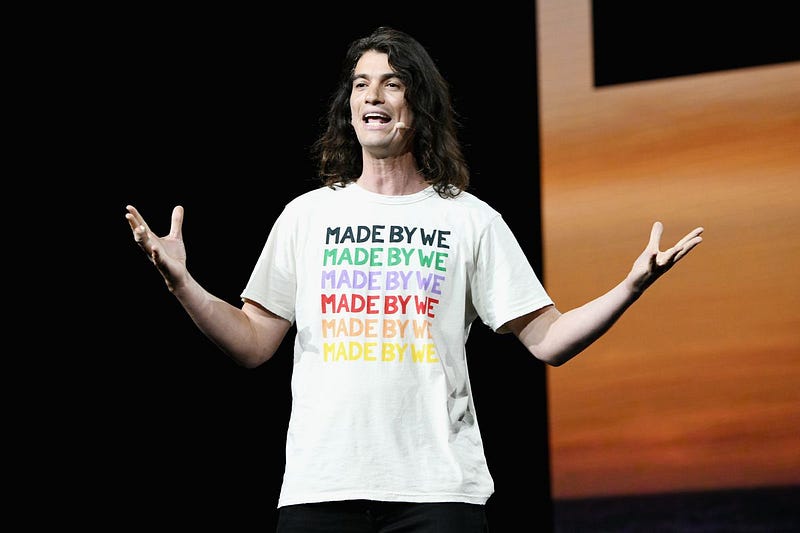
The new Hulu documentary WeWork: Or The Making And Breaking Of A$47 Billion Unicorn wants to expose the coworking startup as a fraud, much like billion-dollar biotech company Theranos. But unlike that notorious startup — which was run by charismatic charlatan Elizabeth Holmes who lied to investors repeatedly about a breakthrough device that could analyze blood — the controversy at the center of WeWork is co-founder and former CEO Adam Neumann, a touchy-feely bullshit artist whose main crime was getting high on his own supply.
He was a dude addicted to the sound of his own pitch; a skilled salesman who truly believed in Silicon Valley-style hippie-capitalism; an obnoxious two-headed cyclops that wants to make all the money and save the world. Only, the head for business is always poking out the eye of the head that just wants to help.
There’s a moment in the documentary when a smug business professor explains Neumann with the following rehearsed quip: “If you tell a thirtysomething male that he’s Jesus Christ, he’s inclined to believe you,”
In WeWork: Or The Making And Breaking Of A$47 Billion Unicorn, Adam Neumann dies for the sins of every shiny startup that sold its armies of young employees a dream of limitless growth and free beer. WeWork was part of a hard-partying corporate culture that called their workers family, but unlike a family, would lay them off in a heartbeat while leadership made out like bandits.
The documentary charts WeWork’s rise and fall—especially the fall—as investors realized that sometimes a coworking space is just a coworking space and not a new utopia. WeWork was a business where freelancers and nobodies could feel like they belonged to something bigger. WeWork sold belonging to freelancers. For a healthy monthly fee, hard-working hustlers could show up to a hip office and dream about an IPO. They could be part of something bigger, the whole startup scene. WeWork was a boring ol’ real estate subletting company dressed up as Steve Jobs. But the company touched a nerve, though. At one point, it was worth $47 billion dollars — as the documentary title trumpets — making it the most unicorn of that generation of unicorn startups.
A “unicorn” is what venture capitalists call a startup valued at over a billion dollars. WeWork definitely fits that description, even if the buzzword doesn’t make sense. One of the more insufferable aspects of Silicon Valley culture is their love of cute jargon. A startup worth a billion bucks is rare. A unicorn isn’t rare. There is no such thing as a unicorn. They don’t exist. I guess, in a way, neither did WeWork. Now narwhals? Those are real and rare. But nobody asked me.
I didn’t know as much about Adam Neumann, but for a few years there WeWork was a mass hallucination, and it was a hallucination that started in and spread from Neumann’s head to thousands of others. I thought the documentary was superficial, to be honest. But it was still triggering.
For four months in 2016, I worked at a WeWork office for a website. The job was a fairly standard clickbait content factory. I had just been laid off from a wannabe-unicorn startup where I was the oldest person on staff and the lunches were catered. This new digital editorial gig was simple: manage a staff of young bloggers whose sole goal was getting some poor sap to click on a Facebook post titled, “Is He Cheating On You? Yes And Maybe.”
It is existential work if you can get it.
The WeWork itself was a maze of narrow hallways and glass offices, and inside each glass office were fresh-faced entrepreneurs scribbling important gibberish on whiteboards. Every morning I’d walk past tableau after tableau of fashionable capitalists intensely pointing at figures on a whiteboard or thoughtfully studying a circled word on a whiteboard, as if they were trapped in a futuristic animal shelter frequently toured by angel investors peering through the glass, waiting to throw millions at whoever looked the part of a leader, a captain of industry, an undiscovered genius calculating a new algorithm on the spot in black magic marker.
The walls of WeWork were decorated with uplifting quotes like ‘Don’t Count The Days, Make The Days Count’ and ‘Do What You Love.’
The offices were so cramped I felt like I was working underneath a coworkers standing desk. The bathrooms were clean, but also crowded. The closest I ever came to living the book Lord of the Flies happened one Thursday afternoon when the WiFi went out — I watched a mob of once-cheerful go-getters, including a couple of dudes launching “Uber for Hats” or something like that, gather around the common area beer tap and plot a revolt. The beer tap was like a statue of a god at the center of a temple: The culture of WeWork seemed to revolve around it and I made sure to be out the door before the drinking started, which it did every day around five or so.
The walls of the WeWork were decorated with uplifting quotes like “Don’t Count The Days Make The Days Count” and “Do What You Love.” These were like verses from a holy text read by those who work hard and play hard. By the end of my time at WeWork, that last line started to really make my brain twitch. If I were to honestly do what I love then I’d be senior vice president of Eating Chipotle and Watching Netflix.
WeWork: Or The Making And Breaking Of A $47 Billion Unicorn is mostly interviews with ex-employees, and media and business experts who all opine and pour out their hearts, and I’d like to point out again that Elizabeth Holmes looked power brokers from politics and finance and tech directly in the eye and told them her machine could test blood quickly and cheaply and then took their money (meanwhile the machine was literally a box of junk). I will never get over her monumental grift.
WeWork, however, was not a scam. The moment I walked into that building I smelled the desperation. There is a market for affordable, clean, trendy rent-a-desk businesses, but WeWork wanted to rebuild society. Office space just wasn’t sexy enough for them.
For example, there should be an entire documentary on WeLive, WeWork’s communal living business which sells furnished rooms with shared amenities for days, weeks, or months. There are two WeLive locations, NYC and DC, and they look like reality TV sets. It’s almost dystopian, these sleek corporate beehives full of lonely hopefuls who want to live in a dormitory.
I think Neumann’s big idea was to turn WeWork into a nation-state?
But WeWork: Or The Making And Breaking Of A $47 Billion Unicorn is mostly concerned with Neumann, cult leader. So was WeWork a cult? I mean, capitalism is a cult. Any social structure that demands something for nothing, that requires blind loyalty and constant toil by masses of have-nots, any hierarchy where a single person looks down on many like a weary but kindly king and promises them bright tomorrows and Jell-O shots is a cult.
The documentary is bookended by outtakes of Adam Neumann struggling to read a teleprompter for an important investor video. By this point, Wall Street has lost confidence in him—and Wall Street is secretly powered by smiling men asking you to trust them. He’s likable enough, but unfocused, unable to recite off a teleprompter the kind of inspirational blather he once improvised before crowds of thousands at mandatory corporate retreats/bacchanalias.
This is the most interesting footage in the whole doc, because it’s the only Oz moment, a real peek behind the proverbial curtain. Neumann was a greedy nerd and he got in over his head. There will be more people like him.
I have been laid off so many times that maybe I should be more outraged that during the battle to save WeWork from its co-founder, Neumann was paid over a billion dollars while 6,000 employees were unceremoniously shown the door. I just naturally assume every time I lost a job some executive was given a large bag with a giant dollar sign on it. I guess I shouldn’t accept this as the laws of nature.
Maybe I should get angrier next time.