
THE WIND PHONE
I Wondered What Was Wrong With Me, Why I Wasn’t Crying Over My Dead Father
That weekend, I learned all about anticipatory grief
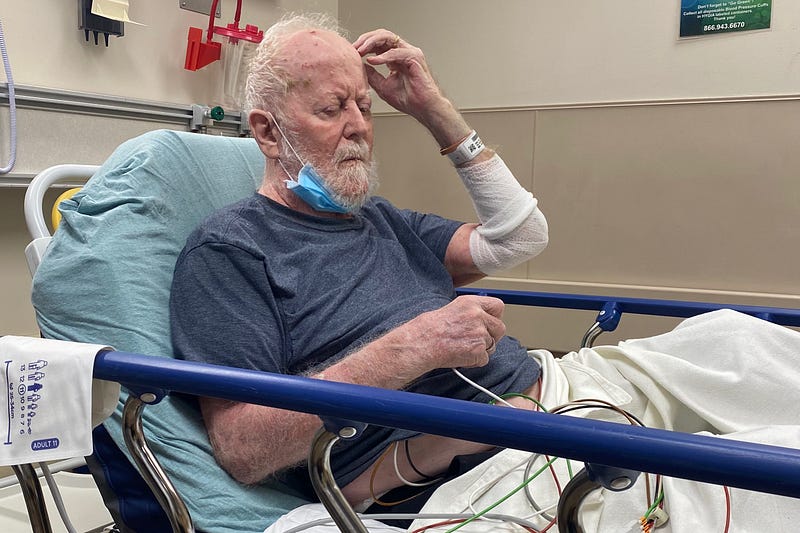
For years, I slept with the ringer on so as not to miss those dreadful calls.
“He hit his head again,” the caller would tell me. “We have to send him out to have it checked.”
“Ok, thank you,” I’d say, and then rush down to the emergency room to sit at his bedside until the doctor said I could take him home.
Each of those was a prelude to the truly dreadful call I knew would one day come. It was early on a Friday morning in April when it finally did.
“Hello, Mr. Tuohy, this is the nurse at St. Martin’s. Your father is unresponsive.”
“Oh, Jesus. Ok, we’ll be right there.”
My husband, Michael, was already pulling on his jeans when my sister answered my call.
“Niamh, it’s Dad,” I said. “We gotta get over there right now.”
Within half an hour, Michael and I were standing in the doorway of my parents’ memory care unit apartment. Mom was sitting on the far side of the bed in her nightgown, her short white hair slightly mussed.
“Oh, you’re here,” she said, smiling up at us. “The nice men are in there looking after Dad.”
We could see my father supine on the bathroom floor. He was naked, save for several pads stuck to his chest and some monstrous apparatus affixed over his scraggly white beard.
The EMTs crouching beside him looked up at us, shaking their heads.
I felt a knot swell up in my gut and a hotness in my eyes. Just then, Niamh came in with her eldest son and knew right away. We hugged each other tightly. Briefly. And then we rushed over to our mother.
But our mother seemed numb when we told her.
“Is he really dead?” she said, as if she were lost in a dream.
Even when Fr. Bill arrived and sat with us on the bed and prayed, Mom scarcely seemed to grasp what had happened.
It had been her poor health that drove them from their home to independent living eight years earlier. But as Dad’s Alzheimer’s began to progress, by some miracle, she rallied herself and devoted herself to caring for him. And when his disease progressed beyond what the independent living staff could handle, she moved with him to this locked memory care unit, though she could have remained in their old place just one building over.
Niamh and I took to our phones to reschedule work obligations and then decided we’d head to our homes to shower. Michael and I would prepare our guest room for Mom. Then he would go on to work, and Niamh would return to collect Mom and meet me at the funeral home, where Dad’s body would soon be sent.
As Michael drove us out through the iron gates into the growing rush hour busyness, I wondered why I wasn’t in floods of tears.
“What’s wrong with me?” I said.
He told me about anticipatory grief, how when a loved one has been ill for a very long time, one often moves through the rawest stages of grief before the death finally arrives. As a palliative care doctor, he speaks with grieving families every day. And just a few years earlier, his own father died after a long illness.
“It’s like being on call,” he said. “You can’t ever really relax. And when that call comes in, you spring into action and do what is required.”
The floods would come for me eventually. In the meantime, there was just so much to do.
Johns Ridout’s Funeral Home looks like a proper church. It’s a series of redbrick buildings connected by an arcade and seated on well-maintained grounds along University Boulevard.
At its main entrance, Niamh and I steadied Mom behind her walker before pushing open the large wooden doors to find two men in suits sitting on leather furniture.
“Can we help you?” said one.
He was tall and severe, and I began rolling the word funereal around in my mind.
We introduced ourselves and told him our father wouldn’t need a casket or a viewing, just a cremation, that he already had a columbarium plot reserved at St. Andrew’s Episcopal Church, where he served as a priest in the 1980s. That was our father’s first assignment as a Protestant minister, one he took ten years after the Catholic Church excommunicated him on account of marrying our mother, the former Sister Marion Margherita.
Both from Ireland, our parents met at a Catholic church in Gadsden, Alabama, where our mother was one of five Sisters of Mercy teaching at the parish school when Fr. Tuohy arrived in September 1963. That Christmas Eve, as the new priest stood before the congregation singing O Holy Night, the young nun received the terrifying epiphany that she was in love with him. The priest soon discovered his own forbidden feelings for her, but several agonizing years would pass before either dared to mention any such feelings to the other.
The funeral director led us into a wood-paneled room and seated us around an enormous conference table. As he set stacks of paper before us, I wondered if Mom thought about the story she used to tell about this place, one that happened many years ago when she called over to inquire about a service.
“Hello, is this John Rid-outs?” she asked, pronouncing the first syllable with a short i.
“This … is … Johns … RIDE-outs,” said a grave and clearly offended voice on the other end.
Mom got lots of mileage out of that story at her frequent dinner parties, each time putting on a comically stern voice.
“This…is…Johns…RIIIIIIDE-outs,” she’d say before bursting into fits of laughter.
Those dinner parties were famous. Half the University of Alabama at Birmingham’s English department would be there, along with the Irish Catholic priests who stood by them when they left, and many other good-timing friends met along the way.
Mom would prepare a gourmet meal, usually lamb or beef, always with loads of floury spuds slathered in butter. When the plates were cleared, Dad would take a seat by the fireplace, hoist his glossy silver piano accordion around his shoulders, and belt out a few lively chords, the sure sign it was time for the party pieces to begin.
It’s an Irish tradition that every party guest must provide some sort of entertainment — play an instrument, sing a song, recite a poem, or tell a joke or story, and Dad anchored these sessions by playing and singing all the old Irish ballads and drinking songs interspersed with whimsical nursery rhymes that would have everyone parading around the house in a Congo line.
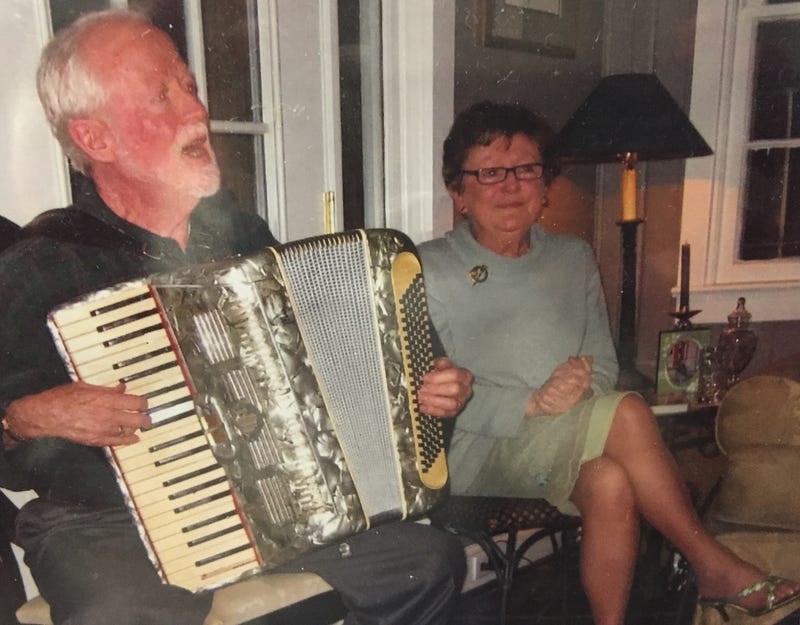
If Niamh were home, she’d accompany him on her violin. And whenever Dad started to play a reel, he’d shout, “Come on, Elma!” and Mom would feign some reluctance (“Oh Jim, not now!”) before kicking off her heels and dancing a jig, her back as straight as a board as everyone hooted and hollered.
Dad was still in Roman Catholic seminary when he bought that accordion with money he’d saved working summers playing in London piano bars. With it, he brought joy to countless thousands, lugging the unwieldy contraption to birthdays, weddings, and funerals. He played for the guests at the soup kitchen he helped found at St. Andrew’s. He played with The Chieftains when they came to town. And every March, the pubs would be fighting over who’d get him to headline their St. Patrick’s Day celebrations.
When a problematic shoulder surgery ended his playing, he showed no bitterness.
“Getting’ old ain’t for wimps,” he said with a smile and then gave me the accordion, should I ever decide to take it up.
When we finished the paperwork, the funeral director led us down a hall to a large room where families and friends would gather for viewings. The room was empty, save for us standing at the door and my father’s body at the far end laid out on a narrow table, a sheet pulled up to his neck.
Mom pushed her walker forward, and when she reached the table, she touched her hand to his face.
“Oh, Jim,” she said. “You’re so cold.”
Niamh and I joined her and put our hands on him too. We said a prayer. And then we told him goodbye.
From the funeral home, it was a five-minute drive to my house, and once we had Mom inside, I returned to the car for the bag of clothes and toiletries Niamh had packed her.
When I came back in, I found Mom standing in my living room staring at Dad’s accordion.
“Ah, look at that,” I said.
But she began shaking her head.
“No, no, I can’t,” she said. “Please … put it away.”
Her face squinched up. Her hands trembled, clutching the walker, shaking its rubber feet noisily against the hardwoods. I wrapped my arms around her to keep her from falling, and as she pressed her face into my shoulder, I could feel the warm dampness, I could feel it grow and spread as the torrents of hot tears flowed from her eyes, flowing faster with each convulsive sob.
Three days later, on Monday morning, Niamh came over to rehearse the music we’d perform together at the funeral. This was the last big task before the next day’s service, and I’d scarcely looked it as the weekend had been so full of preparations.
Most of Saturday, I spent on the obituary, finding the challenge to be not in the writing but in the condensing. There was just so much good material. But I managed to cut and cut and get it below the word limit and into the Birmingham News just in time for the Sunday print.
The next morning, I collected the paper from the front steps, and when Mom awakened, I presented her with a copy along with her toast and cup of tea.
Throughout her reading, the landscape of her face changed, her brows raising and relaxing, smiles forming and dissolving, tears welling in her eyes and streaming down rivulets in her lined face.
She put the paper down, looked up at me, and spoke.
“He was a man, take him for all in all, I shall not look upon his like again.”
“What’s that from?” I said.
“Hamlet,” she said. “His favorite play.”
That’s perfect, I thought, and so I included the line in the eulogy, which I spent most of that day writing. I finished around 3:15 in the afternoon and opened my email to discover a church down the road was set to perform the Faure Requiem. I took Mom, and she cried through the whole thing, and though I could feel the hotness growing in my eyes, they remained dry.
The next morning, Niamh came over with her violin to rehearse the music I would sing while she played. The text was an old prayer our mother translated from the original Irish and gave to our father before they were married.
Ag Críost an Síol (Christ’s is the seed) is very Irish in its sensibility and reverence for nature and is very hopeful in its conclusion: In the paradise of Christ, may we all be found.
After four or five run-throughs, we agreed we were good to go, and I asked Niamh if I could run through the eulogy with her one time before she left.
“Of course,” she said and then sat down on the sofa beside Mom.
I took out the pages I’d printed off that morning and stood before them, cleared my throat, and began.
“An Irish American friend told me her father used to say, ‘When God made the Irish, he put their bladders close to their eyes.’ I can attest to the veracity of that statement, but I hope I can manage to say a few words about my father before the incontinence ensues.”
There was a twinge in my eye, but I pushed through the next few paragraphs of welcomes and exposition before reaching the first remembrance.
“One evening in the mid-1980s, when Niamh and I were very young, our parents sat us down in the living room of our house on Conroy Road and gave us a message we’d never forget.”
I looked at Niamh and saw her head tilted in curiosity.
“‘Niamh and Fergus,’ our parents said to us that evening. ‘We want you both to know that if you ever get in trouble, you can always come to us. Do not be afraid. And if you are gay, you can always come to us. Do not be afraid. We love you no matter what. Unconditionally. No matter what.’”
I looked at Niamh and saw a blush spreading over her face and a glistening in her eyes.
And just then, a wave of convulsions sprung from my gut. My mouth puckered. My eyes crossed and contorted and felt hot. I looked again at Mom and Niamh, but the love on their faces was just jet fuel on this fire building within me, and suddenly my face exploded into a cyclone of snorts and honks and thick mucousy strings and hurricanes of hot, salty torrents of tears and……aahhhhhhhhh…it was so very good.