
I Was WRONG about the M2 MacBook Air
It’s time to own up!
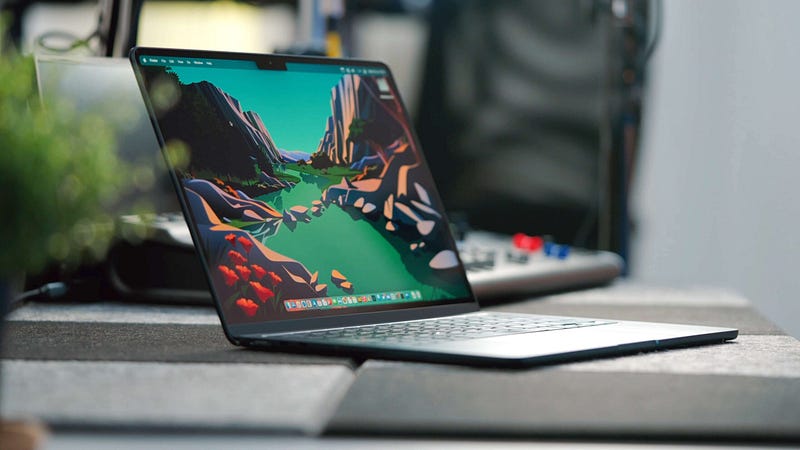
I’ve always believed that you should admit when you’ve made a mistake.
That’s fun for me because I’ve made loads while running this business. I publicly denounced the Apple TV as being an utter waste of time, suggested that ad tracking really isn’t anything worth getting upset about and have mispronounced the names of about 84% of the products I’ve reviewed.
Hopefully, I’ve remembered to put my hand up at some stage after each of those events to say “sorry — I got that wrong”. But I am human and, like so many content creators, I’m effectively running a full production business on my own. So, mistakes will inevitably happen. That’s my excuse, anyway.
My most recent mistake, however, is quite a big one.
Since returning from London last week following my Final Cut Pro editing test between the M1 and M2 MacBook Airs, I’ve been troubled by my initial coverage of the latter.
It’s time to own up.
The M2 MacBook Air NAND controversy
I got very defensive over the M2 MacBook Air when it was first released.
This was my first mistake.
For those who aren’t aware, when Apple launched the latest and completely redesigned version of its cult classic, manilla envelope-friendly laptop, it received some pretty bad press.
This followed strenuous testing undertaken by the likes of Max Tech. Under their critical, laser-focused eyes, the M2 MacBook Air failed miserably when compared to its predecessor.
The tests focused on the base model, which — just like the M1 version — has just 8GB of unified memory. Without regurgitating the numbers today, Max Tech and friends revealed that the M2 chip throttled quicker than the M1 chip, and struggled to achieve the same impressive performance that made the M1 MacBook Air such a hit.
This, they concluded, was the result of the memory configuration within the laptop. Unlike the base model M1 MacBook Air, the M2 version uses a single NAND chip for its 256GB of SSD storage which was pinpointed as the main culprit for the dip in performance. Curiously, if you opted instead for anything above 256GB of storage (i.e. 512GB and upwards), the problem disappeared.
I’m not going to pretend to understand why this is the case. I don’t really care, to be honest — but that might be why I’ve got this one so wrong.
My original M2 MacBook Air review
When my base model M2 MacBook Air arrived, I decided to run a comparative test between it and my beloved M1 MacBook Air.
As you might expect, this test wasn’t something Max Tech would be proud of. It consisted of me exporting a 10-minute piece of 4K footage from Final Cut Pro.
I timed the process on both laptops. The M2 MacBook Air was 29 seconds slower than the M1 version at exporting said footage when other apps were running in the background, but with just Final Cut Pro open, they performed identically.
More importantly, I discovered that, under the multitasking environment, both laptops were as responsive as you’d hope they’d be — a key concern Max Tech had about the base model M2 MacBook Air.
I left it at that, although not before suggesting that everyone was setting their hair on fire for absolutely no reason at all. This stance resulted in a barrage of comments informing me that I was wrong and that Apple should be ashamed of itself for duping customers.
I dived in. I responded to pretty much every single comment that was tossed my way. I argued, gave as good as I received, and lost subscribers over it.
As I mentioned back then — it all got a bit silly.
So, what’s changed?
I headed to London recently with the M2 MacBook Air. The plan was to use it as my sole device for the trip and finally put it to task with some proper video editing.
It failed, massively. In fact, it ballsed up so comprehensively that I had to abandon the video edit and do something else entirely. This wasn’t ideal; the edit was an important one, and I had limited time to undertake it elsewhere.
It also revealed, for the first time since buying it, that the base model M2 MacBook Air is flawed. Something isn’t right with that laptop at all.
I should preface this by confirming that up until that trip to London, my M2 MacBook Air had been a solid performer. Using it as the main do-it-all (bar production stuff) laptop for my business, it felt just as capable, quick, and battery efficient as the M1 version. I loved it.
The difference this time is that I actually put the M2 MacBook Air to proper work. Rather than running the aforementioned and entirely unscientific Final Cut Pro export ‘benchmark’, I attempted to undertake some proper 4K video editing.
That was the test I should have carried out originally because it revealed that the likes of Max Tech really did hit on something. Although, I should note at this juncture that I never disbelieved those guys — I just wasn’t particularly keen on the hyperbolic reporting.
Yet, they were right. This isn’t good enough.
The lesson (it’s a big one)
I’m not going to change my review process because of this. We’re not about to head into an era for Mark Ellis Reviews where I undertake highly detailed, multi-day benchmarks and stress tests. I still cannot be bothered with that kind of thing.
However, I’m definitely going to investigate a little more deeply when there are reports of poor performance from those who dive in far more deeply than I do. Clearly, I shouldn’t have dismissed the base model M2 MacBook Air grumbles, because if anyone buys one of those machines with the goal of regularly editing 4K footage on it, they’re probably going to encounter a fair degree of buyer’s remorse.
3 Reasons Why the M2 MacBook Air Runs My Business
Number 2 is probably the most important
medium.com
Despite all of this, it should still be noted that the base model M2 MacBook Air isn’t for serious video editing — particularly if you’re up against the clock. That’s why no one who undertakes that task for a living is considering this laptop — it wouldn’t make sense at all as a business purchase.
Regardless, that doesn’t make it ok. It’s not right at all that the base model M2 MacBook Air is a worse computer than the M1 MacBook Air. If you’re a hobbyist video editor (or love to get your hands dirty with any other form of creative computing, for that matter), you should expect at least the same performance from the latest base model MacBook Air as the outgoing version.
I’m genuinely sorry for suggesting that the base model M2 MacBook Air controversy was ‘hot air’ — that clearly isn’t the case. It’s a big lesson learned — I promise.
Before you go
Join my behind-the-scenes mailing list
If you enjoy my writing, it’s only a snippet of what’s on Medium. I’m a paying member myself and highly recommend joining. Click here to join (a portion of your membership fee will be sent my way and therefore directly support my work!).
Originally published at https://markellisreviews.com on December 6, 2022.


