
I Was Cancelled in 2016. Then My Career Took Off.
I once had a Sports Illustrated byline. On the morning of July 8, 2016, I wrote tweets that ended my nine-year sportswriting career. Over six years later, I’m finally ready to address it all.
It was not even 10 a.m. After a late night of playing music at a downtown Austin dive bar, I was hungover as all hell, and not even halfway through my day’s first medium coffee.
I remember IM’ing the head of social media for the global tech conglomerate that had signed my checks for the four years up until then. If you need to know which global tech conglomerate, I suppose I can tell you it was Dell. That company was always beyond good to me, and I’m pretty sure that I was more than good enough for them — at least, other than that one time, I feel like always gave them my absolute best. I IM’d:
“So, ummmmm … just as a heads up …”
At the time, I was decent friends with the person I reached out to. By the end of my tenure at the company, I’d become friends with just about everyone in any kind of marketing or comms leadership capacity—but I probably wouldn’t have said anything had I not also run a corporate Twitter account. She wrote back:
— “John, we know.”
“Aw dammit, already?”
It had been less than 90 minutes since those tweets happened, but I should not have been surprised that she already knew. After I took a casual 20-minute commute-lengthed break from Twitter, I noticed over five hundred notifications when I logged into my personal account on the platform. In that kind of short span, I was used to about five. That kind of attention wasn’t just unusual, it was unprecedented.
At first, I thought something had gone wonderfully right. By the time I saw what I saw, I realized I was horribly wrong.
One Night in Dallas
The evening before those messages—in Dallas, a three-hour drive up the road from Austin, where I lived and worked and still do — Army Reserve Afghanistan War veteran Micah Xavier Johnson ambushed a group of police officers.
Johnson killed five law officers and injured nine others, wounding two civilians, as well. The violence marked the deadliest day for U.S. law enforcement since the terrorist attacks on September 11, 2001, and the second-deadliest day for LEOs in U.S. history.
Police followed Johnson to a building on the campus of nearby El Centro College, and a standoff ensued. Johnson was killed with a bomb attached to a remote control bomb bot, marking the first time U.S. law enforcement had ever used a robot to kill a suspect in any sort of crime.
The killings occurred at the tail end of an organized protest — one of several across the country — over the recent fatal shootings of unarmed Black men: Alton Sterling in Baton Rouge, Louisiana, and Philando Castile in Falcon Heights, Minnesota.
A coworker of Johnson’s said, “he seemed ‘very affected’ by recent police shootings of Black men.” Also a former member of Black Nationalist organizations and an avowed pan-Africanist, Johnson cited state-sanctioned violence as motivation for his retaliatory bullet barrage. Prior to his shooting spree, he would repeatedly watch a video of the 1991 police beatings of Rodney King. The attack in Dallas was planned, calculated, and executed with deadly efficiency and efficacy.
The story I am about to tell is not at all about that, nor is the story I am about to tell you a tale on par with either the centuries of violence against Black Americans or a tale on par with the undeserved deaths of the officers slain that night.
My Sports Media Career, in 19 Paragraphs
Two things about my youth are indisputable truths: One, my mom subscribed to Sports Illustrated every week and I read it from cover to cover, and two, I watched ESPN every morning and every night.
As I grew up, I wanted to be a Sportscenter anchor. Dan Patrick and Keith Olbermann were my gods, Stuart Scott (RIP) and Rich Eisen were my popes. Those desires absolutely never came true; I was told that I had “a face for radio and a voice for print” by the powers that be at Syracuse University. (Pulitzer winner Eli Saslow lived in the next dorm room over. None of his talents rubbed off on me.)
Dropping that career, for reasons I’ve yet to understand or process, launched me into the kind of anxious depression I’d never fully recover from — no matter how my fortunes waxed or waned over time, no matter which or how many meds they prescribed me. The seeds for my chronic upset were probably sowed long before; they don’t explain or justify anything about my life, they only add some color — and none of the colors you or I would want to look at. Let’s look in color now.
I (barely) graduated college — I scraped the dean’s list three times and landed on academic probation twice — then became a bartender because being a local weatherman didn’t pay as well. Yet I figured since I got a degree, a restaurant was no place I should be. I felt compelled to have an “office” job, and eventually, I took a telemarketing gig for nine dollars per hour while slinging drinks at night.
In the fall of 2007, at age 25 and with absolutely zero formal training, I started writing about sports. I had no idea I ever wanted to write — again, I wanted Sportscenter! — but a friend convinced me that since I was witty and I loved sports and therefore I should. So I did.
I wrote for, then became managing editor of, a blog — The Love of Sports — long since shuttered from the internet. You can still find embers of what it used to be in dead links on Deadspin and Sports Illustrated, among other outlets. While that humble site lived, the blog garnered a couple of million page views in just a shade over 18 months online. It shuttered due to a lack of funding.
In those long-ago, halcyon days, I used to regularly, happily, email SI stalwart Jimmy Traina and future The Ringer powerhouse — and fellow Syracuse Orange! — Mallory Rubin, to get my words featured on their Extra Mustard link dumps. I often did. Deadspin/Gawker alum and fellow/former Medium essayists Will Leitch and Drew Magary also read and reposted my work. Yes, things looked good for the upstart outlet until they abruptly went way south. By spring of 2009, my writing joint closed shop — only to be remembered in a binder my mom was so gracious to make for me featuring every column for them I’d ever written.
In 2010, I re-partnered with one of the co-founders of The Love of Sports to launch a new site that received the same level of popularity and acclaim. That outlet, Gossip Sports, ran until 2012, and in its abbreviated run continued to do about 100,000 pageviews monthly or so in traffic. The second site, just as the first, shut down the way sites always shut down: money ran out, and scaling was — and remains — expensive without a little extra cash from deeper pockets than the dreamers possessed.
While I wrote sports, I garnered press creds for NCAA basketball games and industry conferences. For me, a deadweight rust-belt gutter-punk who graduated university with a (charitably) 2.5 GPA, and by the end of the oughts only worked a $30K-a-year day job as a traffic manager for a boutique marketing agency, I began to salivate at a starlit avenue unfolding in front of me, as I walked blindly down that pristine road. Hey, I could write sports. Yet, I never made a dime … I just loved doing what I did.
In those first five years, I’d edited or written with some of the most brilliant people in media today, local or national: Sarah Spain, E. Spencer Kyte, Tyler R. Tynes, Gerrit Ritt, and Rachel Ann Moore, among so many others.
Even my own work (to that point), now long gone from the Internet except in archival form, was retweeted and reshared by people like Mark Cuban, Keith Olbermann, Bomani Jones, Desmond Howard, Gregg Doyel, Richelle Carey, and a gazillion — a very rough estimate — other folks with Wikipedia pages. Many of the names of the friends I’d made escaped — and still escape — me because that was over ten years and 10,000 beers ago.
After Gossip Sports shuttered, I retreated from scribbling on the Internet, and instead, I parlayed all that writing into an entry-level career as a copywriter at Dell. I’ve told you that story before. I had no home for most of it.
For my first three weeks at my new gig, I lived in my car as I learned the ropes. For seven weeks more, I lived at a Red Roof Inn that was not immune to violence or hard drug dealing. My surreal story about those fateful months went semi-viral twice — once in 2015 when I first released it in eight-part serial form, and again in 2018 when I compiled it all together and took a (finally!) giant editing brush to it.
The 2015 version(s) were the first real story I’d published on the Internet since Gossip Sports shut down. A couple of holdovers from my sports “media” days immersed themselves within it. After that moderate success, I decided to push my chips into the table and try my hand once more at writing sports. I decided to do so on — you guessed it — Medium.
I was already a Medium writer, I found the platform’s resident sports pub The Cauldron, a burgeoning outlet that was part The Player’s Tribune, part Grantland, part Deadspin, and emailed the editor — whose name at the time I did not know — with the not-so-subtle subject line, “I Want to Write for The Cauldron.” I sent samples. I was accepted and welcomed into the fold.
For my opening piece, I wrote a thoughtful meditation about LeBron James. Then, I wrote well-received essays about Serena Williams and Arian Foster. But the real coup-de-grace came when I wrote a piece I wrote about ESPN, which was circulated via company-wide email with — if memory serves — the accompanying text, “This is what it looks like when you do a good job.” I was told about this through well-connected sources who were also friends. It really happened; I was over the moon.
Former ESPN host and all-around dope human Prim Siripipat, and the high priest Scott Van Fucking Pelt, retweeted the essay with glowing words. I think I could best sum up how I felt about the matter with the words, “what the everliving fuck is happening with my life right now”. That was July 25, 2015, less than three years since I last stole produce from my local H-E-B to feed myself in the back of a rental Jeep at a Walmart parking lot.
In August, The Cauldron entered into a distribution partnership with Sports Illustrated. As part and parcel of the deal, SI dangled a delicious carrot to Jamie O’Grady — the site’s founder and editor-in-chief — “send us your best writers and we’ll publish them.”
The Cauldron did not lack talent. On a masthead that included — and I’m hoping I remember this right — Andy Glockner, Jeff Pearlman, DJ Gallo, Jim Cavan, Alexander Goot, CJ Fogler, Tyler Duffy, Nathaniel Friedman, Royce White, Lindsay Gibbs, Julie DiCaro, Shane Ryan, Chris Kluwe, NFL wide receiver Josh Gordon, Jay Busbee, future first-ballot NHL Hall-of-Famer Sidney Crosby, Ari Temkin, Justin Wise, ex-NBA semi-star JR Smith, Robert Klemko, and Emma Span (among a truckload of other even more famous names I grew up wishing I was who I’m sure I’m forgetting) little old me was forwarded along. Staring in August 2015, I was allowed to throw my words at a publication I’d been voraciously reading for 25 years.
And so, every couple of weeks or so, in addition to working nine-to-five at Dell and in utter astonishment as to where my life had taken me, I logged op-eds as a real journo would. I did it for no money, but I did it because I loved it. For months, the fabled SI.com ran my actual analysis of the NFL. Holy fuck … this was real. Mama, I’d made it.
Then I got artistic.
That autumn, I pitched a column about a 37-year-old San Antonio single mother of two, who somehow qualified for the U.S. Olympic Trials and decided to train for them. I was told for weeks that no one would read it. Then, I submitted a draft.
“Oh, this is good.” Later that year, they ran it, and it became the most popular piece I’d ever written to that point. According to the story’s subject, the piece caught the attention of producers at The Ellen Show — man, that flex hasn’t aged well — and also of a documentary crew who turned her story into a vignette in a feature-length film. (That last part definitely happened.) I cackled; holy god, I’m really doing this. I can really do this.
When David Bowie died in January 2016, I scribbled 600 words comparing his final album Blackstar to Joe Carter winning the 1993 World Series for my beloved Toronto Blue Jays … while literally sitting on the toilet. I casually hit “publish”, an editor from the Cauldron asked to run it, and they reposted it under the SI umbrella. That dispatch scored me the single-most views I’d ever done about “sports” to that point. Touch ’em all, Gorman, you’ll never hit a bigger one in your life.
By then I ran out of ideas, and I had other passion projects. Speaking of music, I’d spent a good chunk of my life until then singing and writing songs. In 2016, I was an established singer-songwriter in Austin — fresh off an album release, some SXSW showcases, and playing gigs four nights a week, all while working my 9-to-5 at Dell, and by now I was a senior brand copywriter and the global lead for brand voice at the company who dragged me out of months-long poverty. Meanwhile, The Cauldron simmered on the back burner. (Okay, I’m proud of that sentence.)
I figured I’d just come back to writing sports once I got too old to be what music media in my hometown once called, “John Mayer on even more mushrooms and cocaine.” Though, let’s be clear: You’re never too old to be John Mayer on even more mushrooms and cocaine.
A Thin Blue Line Between Love and Hate
My family, while interesting aside from my Nazi-fighting (and Nazi-imprisoned) great-grandfather, wasn’t particularly radical. My dad’s dad was Deputy Chief of the Niagara Falls (New York) Police Department, and his nightstick rested in my closet while I was a little boy. (Spoiler: At barely 5'6, I’m still pretty little.) In the months and years after Grandpa G’s passing on New Year’s Day, 1990, I occasionally held his badge in my hands. He was not the only cop in my family: My deceased uncle — who died in a car accident in 1978 — was also an officer. My cousin — who unwittingly killed a woman in a car accident in 1994 — was an officer, too. The Irish sliver of my family — Gorman, Gaelic for the color blue — bleeds thin blue lines. Naturally, so did I.
And yet, since Rodney King, I had always been hopping mad about police who took their badges and used them for ills and deadly aims. My childhood naivete, which eroded later into adult cynicism, believed strongly that this is not how policing should work. Lives should not end at the errant pull of a trigger. Black lives should never end at the intentional pull of a trigger. After George Zimmerman cut a swift end to Trayvon Martin’s fragile young life, I grew exponentially more enraged.
Zimmerman’s bloodlust took place some five years deep into my writing career — at the time, I was pretty apolitical and writing mostly about sports — and I felt my priorities take a hard, sharp turn. I wrote a heartfelt but mid-quality blog post about what I felt was not just wrong, but evil. In the days and weeks later, I protested furiously on my city’s own streets. I was not shy about how I felt, and media members I’d become friends with took note.
Among the note-takers was Michael Tillery, a Black man and a Philadelphia sportswriter and radio- podcast host, whom I hold in the highest regard. While we’ve mostly fallen out of touch, he is someone I still credit (and will credit to anyone who asks) with teaching me how to cover seachange events with the reverence and nuance they deserve.
Mr. Tillery invited me on his podcast after a jury in Ferguson, Missouri acquitted police officer Darren Wilson in the 2014 death of Michael Brown. Chuck D-owned RAP Radio hosted the podcast. I got to (happily and willingly) play the token white guy, talk about things, and act as a proxy for the hosts to vent their justified anger and frustration. Before then, “We are a walking human rights violation” constituted my only public comment.
I’ll be frank: by the hour of the recording, it was after 11 p.m. Central, and I was three-quarters into the bag. Still, the moment was too big for me not to meet it, no matter what shape Chuck D followed me on Twitter not long thereafter, so I’ve got to assume I acquitted myself better than poorly. I was in. I think I made sense, but I’m hesitant to relisten.
While I was then, and still am, no one’s idea of a social justice warrior, at that moment I’d unwittingly entered myself into a war in which I’d refuse to relent, and in which I’d eventually and spectacularly emerge as one helluva loser. For me, the real cops were coming; they were not family, they were definitely not dead, and their sirens screamed, “Saturdays Are For The Boys.”
A Gathering Storm at the End of the Bar(Stool)
For as well as one outpost of Black-owned media welcomed me in 2014, by 2016, a very specific white-owned and white-frequented media was far from welcoming to The Cauldron — that outlet was Barstool Sports.
Long a haven for aggrieved white men with too many axes to grind and not enough wood, Barstool Sports had it out for The Cauldron ever since Cauldron writer and current Deadspin editor-in-chief Julie DiCaro first fingered them for organizing brutal harassment campaigns against her — and other sportswriters who lacked y-chromosomes and landed too dark on the melanin continuum. Her stories were, and are, as valid and true as they are specific to her. From a slightly more distant view, Will Leitch, Robert Silverman, and others posted pieces that mined similar territory.
Nick Stellini took it even further with “How Barstool Sports Uses Social Media As A Weapon.” This piece ran in The Cauldron and caught the undivided attention of Barstool Sports head honcho Dave Portnoy. Never one to relent or let things roll over, Portnoy held special animosity towards O’Grady — holding The Cauldron’s editor up as Portnoy’s personal punching bag. Dave Portnoy declared war and spared no collateral. This included O’Grady’s wife — then a friend of mine and always a corporate branding peer (scratch that … luminary) — and his kids.
Naturally, the enemy combatants also unwittingly included anyone with any affiliation with The Cauldron. Thus, this included me. For most of early 2016, hell descended upon us by the buckets, and the Barstool soldiers invaded by the hundreds of thousands. I didn’t get it nearly as bad as anyone else, but everyone got a little something.
As months and years passed, Barstool Sports emerged to be as Teflon as future (and now former) President — and Portnoy favorite — Donald Trump. A magazine of hellfire from journo watchdog Media Matters, while absolutely damning, did next to nothing to dampen enthusiasm for Portnoy’s little shop of horrors. Maybe that’s a testament to Barstool’s appeal; maybe that’s an indictment of who we are as a culture.
As the feud boiled over in the spring and summer of 2016, Donald Trump secured the Republican nomination for President. By then it became clear — maybe not to everyone, but certainly to a select few among us who could read the poisoned tea leaves — that the United States was headed for a collapse into fascist and anti-intellectual authoritarianism. Meanwhile, Black men kept dying at the hands of police, and white-on-nonwhite (along with antisemitic) hate crimes ticked worrisomely upward.
As it all unfurled, the Barstool empire kept laughing all the way to the bank — expanding and enhancing their ire at anyone they found to be on their opposite side. In an eerie and underreported redux of Gamergate, women who wrote sports came to dread their Twitter feeds. As The Cauldron continued to chug along, Portnoy and his minions never yielded in their harassment of that site in particular, its editor specifically, or those who wrote for his site in general.
Not much of a contributor to The Cauldron since I’d written the Bowie piece, I played some music deep into the night of July 7, 2016. The half-empty bar enjoyed their many, many drinks. The half-empty bar bought me many, many more. July 7 turned to July 8. By set’s end, I was beyond seeing double, and I was due to work in less than eight hours.
The evening of July 7 was calm, quiet, and — by the standards of the day — normal. Sports Illustrated ran a cover of LeBron James finally bringing a title home to Cleveland. The Cauldron ran a story about Klay Thompson. I occasionally checked and updated my Twitter—saying nothing of consequence, per usual, to my roughly 1,500 whole followers — and Brexit was fresh on the world’s minds.
At 3 a.m., I grabbed my guitar out of my friend’s car, lugged it up the stairs to my condo, and went to sleep without remembering how I arrived home. Then, a protest ended with violence at a protest in Dallas … I was dead asleep and wouldn’t see until hours later.
July 8, 2016
It was roughly 8 a.m. I’d like to think it was 8 a.m. I woke up. I opened Twitter. Five dead.
I must admit: I never considered it’d be a Black man behind the gun — that’s not what happens in the United States. It was almost always white people who kill people at protests. In following years and starker terms, Kyle Rittenhouse and January 6 would reinforce those beliefs.
Yet, the mug shot of Mr. Johnson emerged and his motives were immediately clear; the score wasn’t hard to suss out. The man who’d served his country had enough of his country, and he took out his rage in the most violent and reprehensible way possible.
Twitter, as you’ve by now come to expect, was ablaze. Twitter was, and is, always ablaze. The takes were flying.
Many actively cheered on death. Many others dropped racial epithets and thinly veiled hatred towards not just Johnson but anyone who didn’t share a common skin tone or nationalistic fervor. The kindest of snippets read, “if you don’t like this country, you can leave,” which was then and has always been code for white folks showing nonwhite folks the door with all the extra mustard and some relish on the side.
I took it all in. I lay in bed. I raged. It was almost nine. And then I, well … what follows is what my half-witted, angry, chronically anxious and depressed, son of some cops, allegedly elegant, Sports Illustrated writer and global voice of a Fortune-500 and soon-to-be 100 billion-dollar technology brand decided to fire off into the world — in public, in full view of Barstool Sports and their readers and all of media and my bosses at Dell and The Cauldron and industry peers and white people and Black people and all people, and, well … you can read for yourself:
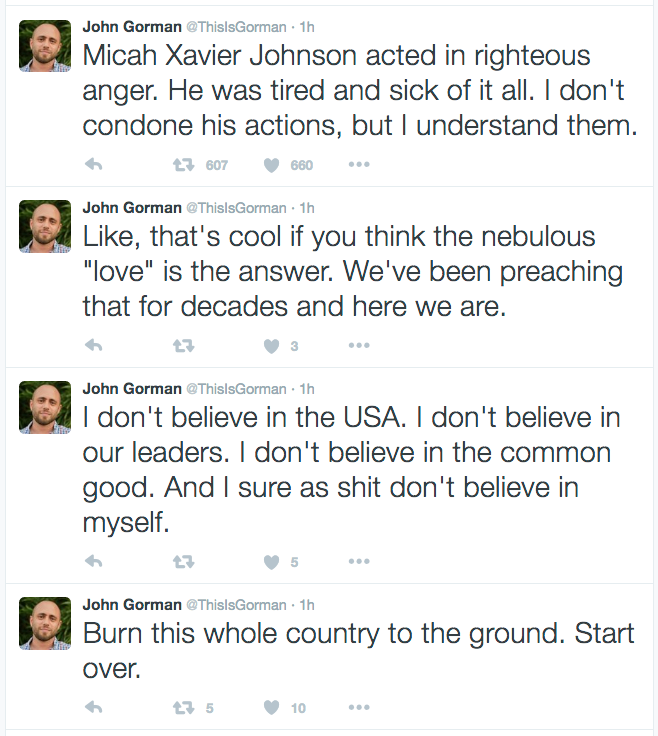
And while I never stopped thinking about the events of the night before, I thought nothing else about what I had said. I closed the tab and got ready for work, showered, started my car, and blared some Butch Walker tunes, thinking I’d said nothing consequence. After all, my barely noticeable Twitter was never a hotbed for vital information or definitive takes, very few people followed me, and almost nothing I’d ever said made it past the walls of people who immediately knew who I was.
No, until July 8, 2016 — and really in all the years before and after — my Twitter was, overwhelmingly, just a testing lab for bad jokes I’d later massage into slightly less-bad jokes, to then work into aggressively okay essays.
I arrived at the office. Between getting ready for work, my commute, and sipping my coffee, I’d maybe had Twitter closed for 20 minutes or less. I opened up my app to first check my corporate account, and I was a bit taken aback.
At that moment, I saw my Twitter handle and my corporate account handle, and billionaire CEO Michael Dell in the same mentions. And very quickly, I thought:
“Oh! Cool! Did someone find out I w — “
Before looking too hard or too long, I switched accounts to my own.
Oh, no. Oh, no no no no no no. Fuck.
My heart throbbed through my throat, spilling shrapnel-spiked blood all over my desktop and my monitor.
Fuck. Fuck fuck fuck fuck.
I tried to parse through it all. I read flame-emoji-lined DMs from friends congratulating me on how hard I went. Mostly, I saw I had been tagged by strangers ripping me apart — perhaps deservedly so, definitely deservingly so.
I didn’t know the specific complainants, but as I sussed the endless scroll, I saw they had a common point of origin: Barstool Sports. DavePortnoy.
The smoldering wildfire burned hotter, harder, and faster than anything I’d ever seen in my life before … or anything I’d see again. No matter how many people had read anything I’d written, it didn’t hold a storm-soaked candle against the tweets heard ‘round the world.
I quivered. I shut down the app. It was not even 10 a.m. After a late night of playing music at a downtown Austin dive bar, I was hungover as all hell, and not even halfway through my day’s first medium coffee.
I remember IM’ing the head of social media for the global tech conglomerate that had signed my checks for the four years up until then.
“So, ummmmm … just as a heads up …”
— “John, we know.”
“Aw dammit, already?”
I alerted my boss, who welcomed me into the conference room they bring you into just so they can fire you. To my surprise and eternal gratitude, my boss didn’t. No, she just told me to go home … well, that and she took the keys away from my corporate Twitter account, shut it down, told me to make my personal account private, and encouraged me to think really hard about what I’d said. I don’t think she’d ever know just how hard, or long, I’d think about it.
O’Grady — again, editor of The Cauldron — forwarded me an email from the SI editor he reported to, the body of the message consisting of little more than the screenshot you just saw and the words: “Who the fuck is this guy?”
Jamie called me on the phone for the first time since he told me SI wanted some words from me — we’d become pretty good friends by then but you know little friendships require voice-time nowadays and even in 2016 — to tell me nobody had any use for my words anymore, but also that he still thought I was a good person and a good writer and I’d just made a stupid mistake and that also the Barstool Sports people sucked. I was already driving home from Dell by the time our call hung up. He released a statement and so did Sports Illustrated; It was just past 11 a.m. My coffee was barely cold.
And yet, the hits kept coming. Every music venue I was scheduled to play at through the end of July told me they were canceling me due to bomb threats and death threats and boycotts and just the whole “not wanting to be associated with me” thing.
In the meantime, I got harassing texts from numbers I didn’t recognize, people who eerily knew exactly where I was at any given moment but somehow didn’t have a clue that I wasn’t Jewish. (I’m second-generation American, raised Catholic, and my ancestry reads like the Roman Empire in 111 A.D.) Apparently, people try to out you as “a Jew” if you say things they don’t agree with but you’re not Black, Latinx, or anything resembling Asian.
It was now almost noon. Scared to hell, I left my home to a not-as-nice-as-this-sounds third-floor balcony bar — a place I would never go to, and never would go to again, to grab lunch and cheap cava with my partner at the time. We played some Bocce, too, to try and take my mind off things.
Yet after continued, incessant, perpetual notifications that made my phone feel and sound more like a fritzing-out sex toy, and less like a constructive communication device, I chucked that reminder of my impossible stupidity over the balcony’s edge.
Sadly, it did not break — Otter cases! They work! —so I reluctantly picked up my phone and headed home to continue to drown my sorrows and pass the out. Media people called for comments; I gave polite, short answers.
Still, the pile-on kept running up the conservative opinion ecosystem’s flagpole. Soon, I’d entered the crosshairs of Michelle Malkin, then Ann Coulter, then Rush Limbaugh, among what I’d assume were dozens of other right-wing firebrands. By day’s end, I’d earn some cursory and deservedly unflattering mentions on national talk radio.
The hardest words came after 2. My father — nice guy, really, even abstained from voting for Trump but listened to a lot of right-wing media at that time — rang me and said, and I quote, “So, you’ve had an interesting day, haven’t you?”
I had zero clue what to say to that besides, “Yup.” And I just vomited words I’ll never remember in his general and empathetic direction. As my words began to slur, and my eyes began to shut, I called my day a night in the middle of the afternoon. That was it; that was all.
The Fallout and the Freezeout
I walked into Dell on July 9, 2016. I apologized to everyone for failing to protect the brand. I even retrofitted the appropriate Michael Jordan line, stuttering, “Republicans buy laptops, too”. They graciously, silently, let me go on with my work. Still, I didn’t feel right in the office for a while.
As for the general public, well, the hardened corners of the Internet had their fun, too.
It was all over by the following day. The mentions disappeared. The texts subsided. There was a new enemy of the state, a new trending topic, and a new non-Jewish person to loudly brand a Jew.
As for The Cauldron? The site was dropped as a distribution partner from Sports Illustrated and that pub’s parent company, Time Inc., on February 1, 2017. By that day, The Cauldron hadn’t even published a story for over a week. I suppose neither party got what they wanted out of the relationship.
I don’t need to rehash in full what happened to The Cauldron after their relationship with SI went south — Jamie O’Grady did that work himself, and he did so in a painstakingly detailed fashion on this platform, quoting a too-ridiculous-to-be-believed story from Yahoo about what I can’t even classify as a site-sinking Ponzi scheme but is somehow worse and weirder.
So, why did The Cauldron fold? I suppose it’s the same story I told earlier, just with an overseas Ponzi Scheme, bigger names, and hella weirder players involved: money ran out, and scaling was — and is — expensive without outside funding.
A nefarious group called Chat Sports allegedly offered $2.5M in operational money. Yet that money wasn’t really real and that organization’s tactics rendered it a Boiler Room. I suppose that read of things is kind at best.
In Bartstool’s short, snide quasi-eulogy for The Cauldron, the author made it a special point to mention me: “There was some notable drama around the site as well, though, particularly when it came to O’Grady’s public feuds with Barstool, Vice, and Deadspin and to freelancer John Gorman’s tweets about the Dallas police shootings.”
A paragraph later, they eloquently stated: “hahaha hahaha hahaha bye Cauldron.” I kinda get it. I licked my wounds; I went away. The tail end of 2016 was hard.
By 2017, I gave up playing music altogether. At Dell — or anywhere — I never ran, nor wanted to run, a corporate Twitter account again. On my personal Twitter, I mostly just tweeted benign jokes about NFL Network programming. I unfollowed just about everyone sports-related that I knew at that time and started fresh.
Deservedly so, I assume, I became radioactive to sports media — no one with any kind of reputable byline would have me again. Truth be told, I made peace with that long before I empirically knew that was a fact.
As a result, I retreated — tail between my limping legs — to my personal Medium. At that point, the space was practically virgin Internet territory. I decided without deciding, “Well, I suppose I’ll write about music. I do like music, after all, and I’m not sure I’ll play it anymore.”
My first column of any kind after the godawful and brutal tweet-hurricane was a writeup of both Frank Ocean’s Blonde release and The Tragically Hip’s final concert with dying singer Gord Downie.
I somehow picked up exactly where I left off; the essay instantly became one of my most-read pieces ever. How did it find its way around the Internet? Why … with glowing praise on, of all places, Twitter. It had been barely a month since all hell broke me, and I’m not sure a single person even connected the two dots. Man, I wish I was there to see it. Incredibly, not a soul reading about music that day ever wondered out loud if I was the same disgraced idiot who used to write about sports.
I got a lot of emails from random folks — kind emails, this time. They talked about crying while reading the piece. About their parents dying of cancer. About how I put into words what only they felt. The Huffington Post and the CBC sent me emails asking if they could repost it. But of course. Still, I never made a dime … I just loved doing what I did.
Aside from two specific essays done by request, I’ve never written sports again. Oh sure, I’d write the occasional missive about sports-adjacent TV programming — and I’d drop references to Russell Westbrook, the Philadelphia 76ers, Rick Ankiel, and a whole galaxy of other athletic references and metaphors — but I gave up on my dream that I’d ever write ball again.
In general, I’d barely write for months. Hell, had it not been for the Frank Ocean / Tragically Hip essay — written so late at night and so drunk that I could barely make out the text — I sincerely thought I’d give up writing under my own name altogether. I didn’t, but there was a form of writing I’d give up for good — in 2019, I ghosted Twitter, despite having barely touched it in the nearly three years between my DumbCon1 and the day I let the clock run out.
A Pivot, A Phoenix, But Not Quite a Redemption
After July 8, 2016, I wasn’t even close to the same person. Frankly, it’s a good thing the woman I was seeing at the time of my meltdown had the good sense to break up with me. She did so without warning in March of 2017. She probably did so later than she should have or even wanted to. That day, I came home from work, and half of what was in my place had disappeared.
I texted my former boss at Dell, who had left the company just before he saw me step on the spikiest rake possible. I asked him, “what the hell do I do?” He said, “write it out.”
At first, I didn’t consider it. I was too burned by the Internet to even attempt to put a public dispatch about my personal life. Out there? Do you have any idea how much can go wrong?
And yet I listened. Weeks later, I gave in to his hunch … and I turned it into a goddamned story. (Conveniently, I tagged the 22-minute read as “fiction”, so as not to draw her attention, or anyone else's. I drew attention, anyway. The tale became the №1 story on Medium for a couple of days in Mid-April, 2017.)
And so I pivoted. No more sports. Music writing would be sparse, spare submissions to the Medium music publication Cuepoint. I’d snag some sweet press work for South By Southwest. But, really, I was now qualified to write nothing other than my own life — unfiltered and ultra-ribbed for no one’s pleasure but my own.
Just as when I once wrote sports, the readers started pouring in. They — you, really — did so in volume and enthusiasm as they (again … you, really) never had in the heady days of The Love of Sports, Gossip Sports, The Cauldron, and Sports Illustrated.
Suddenly, I had a new mission. I could spill my words and say:
“Please don’t do what I did. Please don’t think how I think. Please just read. I’m warning you. Don’t be me, and don’t be the people who tried to ruin me.”
I hammered this message — in plain sight, without the explanation you deserved or I felt comfortable giving — over, and over, and over. Every essay became a skyscraping dance around the elephant in the bathtub.
Still, you kept coming. Hundreds of thousands of readers … every single month. Not to read my sports takes, or to read other people’s work that I edited, or to read me because they got lost on their way to other better SI columnists. No … just to read me give Ikea instructions on how not to live. Taken all together, I promise you: This is how not to build a career … still, I built a career, anyway.
When People Hate You, Go Where You’re Liked (I Suppose)
After quickly and ignominiously ruining my rep amongst the right, I leaned hard into progressive politics. I started ghostwriting and copywriting for congressional candidates. Would you believe me if I told you that my first crack was for a certain bartender from the Bronx who decided to run for U.S. House? (Spoiler: Non-new readers will already know the answer.)
Imagine my delight when I saw this vignette play at the Paramount Theatre in Austin, during the award-winning documentary Knock Down The House, during a South by Southwest I was covering, as I sat in the front row as a special guest of the film, next to my plus-one from the company that still signed my checks — all not even two years post-Twitter meltdown — mere months after the subject of said documentary won her primary.
All of the above actually happened and I really wrote words for her. A lot of words … you can read many of them, still, on her website.
I wrote many of them before she ever won her primary. When I found out she’d won, well, I was hanging out at a bar watching my friends’ band … and I got to play one little song during their set. Not bad. At the same time, my dad — who’d been injured within a whisker of his life just over a week earlier, awoke from his coma. His first words to me were, “I’m proud of you.” My first words to him were … lord, who the hell knows.
I made it a point to do right by AOC. After South by Southwest, I had the honor of penning 14 pages of Green New Deal messaging … the kind of top-level early-stage messaging you don’t get to read before you get to read it. (Like most of the very few things I don’t give much detail about, those words are not public, but I assure you, those words are real and I wrote them.)
In August 2019, I even got to watch Rep. Ocasio-Cortez call out the Dave Portnoy for being … the Dave Portnoy. Don’t take my word for it … take the word of the company that will likely never let me write for them again. For the briefest of moments, I felt like I was at least watching the good guys if I couldn’t be one of the good guys.
By the time she gave Portnoy her piece, I’d mostly made my peace — since early 2018, political writing had become my go-to outlet to channel my displeasure into something useful … and I did not stop with Rep Ocasio-Cortez. I’ve written dozens of speeches, ads, and marketing for over ten congressional candidates all across the country, including at least two more who will almost definitely serve in the next legislative session. Sure, that’s what I do just to do it, but I suppose in the deepest recesses of my soul, I also do all this to acquit myself of who I’ve been before.
As for my money-making endeavors? Well, yes, I would, eventually, recover and rehabilitate my reputation at the office at One Dell Way in Round Rock.
I stayed on at the company until 2019, leaving a (and I’m playing fast and loose with this word) legacy that — apart from maybe the most ill-received and ill-conceived tweets ever shot into the bowels of the internet (outside of that chick who smiled in a selfie outside of Auschwitz)— remains fairly spotless.
At Dell, I did about as well and as much there as any brand-level writer ever had over seven years. I was — and maybe still am — exactly that good. No, I can’t take full credit for the metamorphosis, but I’d like to take a couple of percentage points worth; I think they’re justified. I would like to think I redeemed myself enough to have left a model of excellence inside their halls and walls for years to come. I would like to think so, anyway. At the very least, I know I named the conference rooms.
In the Spring of 2019, my boss asked me sincerely “what are you still doing here,” when I talked to her about the success of my Medium page and how she told me it 10x’d the traffic of the corporate webpage. This was, if you’re not new, right around the time I was getting shot up with enough ketamine to make a pony find god in a bale of hay. Thus, turning me off from daily drinking, and turning my anxiety and depression into a periodic nuisance rather than a constant nagging.
By the Fall of 2019, I’d decided to answer her question with a “nothing, anymore”, and figured I could make a go of it on my name alone. I put in my four-week notice. I would go out into the world and not even into sports media. Just … I would go out into the world.
And by “the world,” I mean I’d move to Portugal to do it, too. Visa in the works. Exit date: June 1, 2020. Why Portugal? Well, ha! America, as you probably guessed, didn’t exactly get much better after July 8, 2016. And yet. And yet. We don’t get what we want; we get … we just get.
A Life On Hold, A Career In Reverse
I suppose maybe 2020 was a bad year to try anything big. While waiting to ship off to Lisbon, and while I still had a couple of months left in Austin, and at the urging of someone I’d met via Medium who saw me play a surprise guest open-mic appearance, I decided I’d try my hand at music again.
On March 7, 2020, I played my first real singing gig in 30 months. An hour before my downbeat, they canceled South By Southwest. Something called the Coronavirus was bearing down on us. Maybe you’re familiar.
No one came to the show, understandably — and not just because it was I who was playing — and that’s not even the ten-millionth most tragic tragedy about that entire pandemic ordeal.
Still, I put on my best face — who the hell knew what was about to come? (I was pessimistic, documented here, but not that pessimistic) — and played for two solid hours with no rehearsal, no practice, no setlist, and no idea what I was doing or when I would do it again. And then that was it.
My new post-Dell “day job”? LOL. Things didn’t go much better. I was stiffed by a sociopathic billionaire — they’ll go unnamed because they have billionaire lawyers and I have middle-class lawyers — after sinking hundreds of hours and a disaster-piece theater of a branding project, and an ultra-doomed trip to her fortified Calabasas compound to write thousands of words she never used.
At the same time, I started editing a compilation book penned by 30 women with Wikipedia pages, and sunk dozens of hours into that, too. Right around the time I realized it’d be a long time — if ever — before I got paid for this, either, I abruptly ghosted … without a dime to my name. I don’t hold the story compiler responsible; I hold myself responsible. I should’ve been smarter about what I asked for and for getting things up front in writing.
Yeah, 2020 was sure rough. (Who wasn’t it rough for? I’m not even going to pretend like I had it roughest.) I lost out on about $50,000 in three months and made way less than $50K over nine months immediately after. The pandemic came and wiped all my new business off the books. Though, at least this time when my career died, it was polite enough to die quietly.
My writing under my own name dried up, too. The best I could do, career-wise, was anonymous non-byline work in pubs for maybe 200 to 500 a pop. Almost all of the money I made, I made writing as other people. Not even the politicians. Like … crypto-bros and startup-bros and doctor-bros and corporate shills and then eventually some steady work doing all the cannabis software marketing communications you never knew existed.
Sure, I righted the ship — financially, anyway — in 2021 and made a pretty good living. Still, in 2022, I decided I’d had enough of all that, too. All of this. All the hiding. All the shrinking. All the doing less than what I want to do. I’m scared to pitch media. Still. I’m scared to actually write what I want to write. Deathly afraid, even … everyone already knows who I am, except for the people who know who I am.
I still wonder what if. I still wonder if I could make a go of it as … well … me. On top of that, I have zero clue how many hiring managers for jobs at which I’ve applied— corporate gigs in high positions commensurate with my experience — did a cursory Google of my name, scrolled past the 12 other John Gormans with Wikipedia pages, saw what I Tweeted, and said, “Well, he’s out.” I don’t think that number is zero; I don’t know that number’s not all. Either way, after six years and some change, it could be a pretty sizable chunk.
I often scoff at myself. I scoff at who I was then and scoff at who I’ve become today — I never moved past July 8, 2016, I just worked around it. No matter how well I worked around it, none of this has acceptably substituted for working it all through.
No, I don’t even have (or want) a Twitter anymore. No, I don’t talk like that anymore. Hell, I don’t even play music or drink double-digits worth of free shots in dive bars anymore.
All that said, I still don’t know if the letter or spirit of my message was right. Donald Trump already came and went as president. Thousands of domestic terrorists invaded the Capitol 18 months ago. The pandemic and collapse of civil and civic societies already happened. It already burned. I don’t know to what degree I fanned the flames, but I don’t love how I contributed to the discourse on that one day I can’t seem to forget, no matter how selfish I feel for centering myself as the main character — even though on that one day I was the main character before “main character” was the name we gave to them.
I still don’t think I’d say it again. I still loathe every word of what was saved for posterity … and it hasn’t been until now that I’d even bothered to reread it.
Now? Post-everything? I’m just a man who makes a good and (I hope!) honest living, means well enough, and has spent long enough thinking — lord, have I ever thought for a long enough time — about what I said, and how all that’s happened since has come to pass. On July 8, 2016, I sure as hell wasn’t right — and “out of turn” isn’t even strong enough— yet in retrospect, I still sometimes feel I was just early. I don’t think I was more wrong than all the people who’ve done all the killing. (I still think I was wrong. Probably. Definitely. Abhorrently.)
Aside from a resolution to global tumult and an end to a meltdown of the highest order here in the U.S. — and those are very clear №1s and №2s — I just want to come back.
So, Is It Safe to Come Out Now?
It doesn’t sound like it — at all, really, or else why would I bother with 10,000 words about tweets you likely forgot about if you ever knew about them at all — yet I long ago forgave myself for the 800-or-so words I angrily and clumsily C4'd onto the web over six years ago. I processed it, pivoted, and made my hay another way.
No, I don’t love that I did it; and, yes, I turned out okay even if it didn’t turn out anything close to what I expected, in the way I expected. And while I’m centering myself in this story, my story — and, make no mistake, this piece is my story — is not the story.
And yet — and yet! — I want to feel confident enough and comfortable enough to pitch a place and not feel like “they already know.”
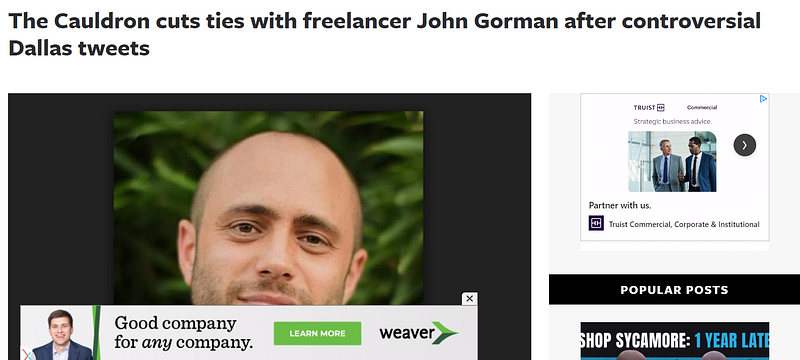
I want to feel confident enough and comfortable enough in my own body of work outside of those tweets to know that those tweets don’t define me anymore. I don’t want them to be the first line of my own Wikipedia page — should I ever have one — nor do I want them to be the top Google result when I, or you, or future employers, google my name. I keep writing to push them further down the list … yet maybe all I really should’ve done was own them. Face them. Learn from them. That’s why that picture is the header on this piece. That’s why that headshot hasn’t changed in the six years since that picture ran.
I’ve worn these tweets, silently and maybe even foolishly, like a scarlet letter long enough. I think I’m finally ready to erase the whole alphabet, no matter which shade of red I was when I wrote those tweets; no matter which shade of red I’ve felt when I’ve thought or felt about them in the many months and years since.
I was upset at the time I wrote them. I was wrong to do so. I’d never do it again; I’d write something thoughtful instead … just like I did and have the other 99.99999% I ever had something burning that I wanted to say. I think I’m writing this essay so you know this … but I know I’m writing this essay because somewhere deep in my heart that I know this. Maybe. I mean … after all life’s been since all those years ago, what do I know?
Well, I (obviously) know that Micah Xavier Johnson fatally sniping five cops and injuring nine more that night in Dallas was wrong. I (again, obviously) know the uniquely American brutality against Black men that led to those tragic deaths is also wrong.
I know what led to my exit from the sports media segment of the public sphere felt weird at the time. I know what happened in the immediate aftermath of those tweets felt like the right decision, even if it felt more wrong the longer that decision gamed itself out. I do know I’ve felt wrong taking up public space ever since, and yet I continue to take up just enough space in places where I don’t feel too wrong for doing so. I also know it feels wrong to have been away for this long — yet I don’t know how long is long enough? How long is too long to wait? When can I even ask? For better or worse … I’m asking now.
The End, Or The Beginning
It’s now September 2022. I’m not a young kid anymore; I turn 40 next month. I’m not a dreamer and not some hungry up-and-comer … I’m a talented, aging, softening, coarsening, yet fundamentally decent person. While I’ve made mistakes — and I’ve made so many! — and done a sparse bit of unsavory things, I think — I hope! — I’ve demonstrated enough results on my terms, with my guile, guts, and sweat-equity. I don’t know if I’m right about any of this or anything really at all … but I will never know if I don’t try to stick the goddamned landing. I haven’t attempted a jump, at all, since I was told to shut up and stand still.
The odds are excellent that I’m talking about something nobody remembers anymore. Maybe I’m thrusting my arm into the wasps’ nest one more time, with feeling, for good measure. Maybe I’m a masochist. The odds are even better that maybe you won’t even make it all the way down here. Maybe I shouldn’t have made it all the way down here and just shoulda clicked “close tab.” Maybe that’s a metaphor.
Maybe the fact that I’m dragging this out of the darkness multiple years after it stopped being a concern to anyone but me, the families of the law officers who died, or the families of the Black men who never deserved to die, has all the potential in the world to backfire every bit as bad as what I’ve spent all this time talking about.
Maybe none of this was a burden that was mine to carry. I don’t know; I carried it. I got so used to it that I forgot it was in my hands. I’m setting it down now.
There is a real story here, somewhere — and it probably isn’t this one — but I only have mine, and in this case, my story is likely the only one I’m qualified to tell. I think I finally had to tell it to stop hiding from it, shrinking from it, living it, and most of all continuing to write it.
Mostly, I think I wrote this to let you know that even if I hid from it, shrank from it, lived it, and wrote it, I’m not sure how the entirety of this story came to be written.
In any case, this is the end … what you do with this small story — my small story — from here likely isn’t up to me. I don’t think any of this ever was. Someone’s always writing a story like this; someone always finds themselves on the wrong page.
I suppose that’s ultimately why I’m writing it: so — for better or worse, but most assuredly different — this page of the story can finally end. Everything should, except for all that ends too soon.
This story’s over, but there’s plenty more to read. You’re welcome to find me on Instagram or LinkedIn, or you can become a Medium member.