
I Was a Teenage Webmaster
On what the web was, is and may yet be
It’s 3.30pm on a Friday afternoon in the early 2000s, and I’m sitting at a computer in my school library.
The school week has finished. I don’t have detention, and homework is the furthest thing from my mind. I should be heading home. However, home means no internet. And that means waiting three days with no access to the project that’s my obsession at this awkward time in my life: my website.
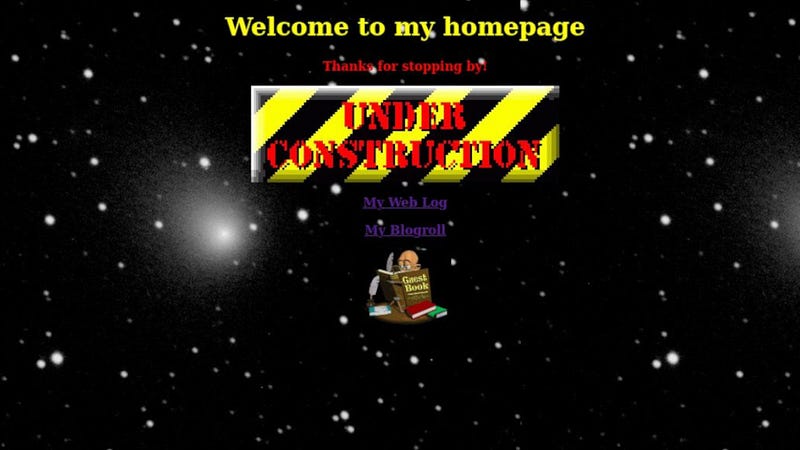
Built upon my own HTML, ill-judged CSS, and stolen pieces of code, this site is an abomination that only a teenage boy’s mind could conceive. Picture green header text on a black background, GIF collections, and pages full of adolescent humor punchlines.
On the bottom of the site’s home page, a mechanical counter informs readers how many visitors have come before them. The thought that the fifth number from the left may soon move to a ‘1,’ fills me with pride. But not as much as the comment on my guestbook page that says my site is “sick.”
For the next half hour in the library, I’ll work on a blog post titled “My Favourite Television Shows,” with the assurance that it will surely be riveting reading to someone. Never mind that I’ve written the thing in Notepad and lack the self-awareness to consider checking for typos, nor the reality that I don’t yet have any thoughts worth sharing. I put it out there on the web all the same.
The site is not a place anyone would want to visit. Looking back, I’m certain it was an accessibility nightmare and brimming with cringe-inducing hot takes from an underdeveloped mind (perhaps little has changed?). Not much use to anyone.
Anyone that is, except me.
For all its flaws, this “silly” little site is teaching me more about web design than the entirety of my school’s IT classes ever will. It’s also granted me my first experience of writing for an audience.
More importantly, being a “webmaster” is also teaching me about being a digital citizen, implanting in my mind an idea of what the web is and should be.
It’s an idea I’m still thinking about now.
The web was not a part of my childhood. Growing up working class in the UK during the 90s and early 00s, my memory and statistics would suggest that this doesn’t make me unique. But like a kid discovering chocolate after being deprived of sugar, I predictably gorged on the opportunities the internet presented when I first logged in to my secondary school’s network.
Suddenly, contents greater than many thousands of libraries were at my fingertips. Just as crucially, so were web spaces themselves.
Just as today, the internet offered answers to every question you could conjure. However, you were never quite sure where you would get that answer or who would tell it. Perhaps you’d end up on someone’s personal site or find yourself looking at some gaudy Geocities fan page. In any case, there was a good chance that whoever the informer was, they had no ulterior motive for sharing the answer you were seeking. They did it for its own sake.
But you wouldn’t just leave once you had your answer. After all, you had taken time out of your day to get online. Instead, the answer to whatever had been on your mind was just the starting point for further exploration. And though Google already existed when I got online, it was not algorithms but the human curators who showed you the good stuff via blogrolls, linkblogs and directories.
To be clear, this old web, the web I remember dearly, was not perfect. There were pop-ups everywhere, accessibility issues galore, and you were never a few clicks away from rendering your computer unusable thanks to malware. It wasn’t some people-powered corporate-free utopia by any stretch of the imagination. But its faults were also its quirks.
Now, I realize adolescent nostalgia may be blinding me here. But sometimes, how it felt is just as telling as “how it really was.” And to me, the web felt uncontrollable, anarchic, democratized, and exciting. People spoke and wrote in a language that was loose and genuine. It wasn’t yet a market where we were forced to present perfected versions of ourselves to strangers, employers, and friends. But something more akin to a town square. It belonged to no one. Therefore, it belonged to all of us.
Of course, both me and the web have since changed drastically.
The internet is not a place I visit anymore. It is an obligation that follows me everywhere like a shadow, ever-hungry for my attention.
On the surface, today’s web seems little like the one I once knew. Gone, it seems, are the web rings and personal homepages. Instead, in their place, we find the apps, endless scrolls, auto-playing videos, bloated scripts, walled gardens, bots and surveillance infrastructure of Web 2.0.
Certainly, this new web seems sleeker, simpler, more convenient, and streamlined. It has been scrubbed of its tackiness and “optimized” for maximum consumption. You can get anything you want here instantly. You don’t even have to browse any more. You don’t even need to type a URL. Instead, you click on a screen, and the apps do it for you. All you need to do is hit that “accept all” button and agree to the terms and conditions.
Yet, as the web has transformed into a more convenient tool, it has, on the surface, ceased to function as a space for exploration. Moreover, it has ceased to be ours.
Where the people’s digital town square once stood, we now find something more akin to a mall: a homogeneous place owned by mind-bogglingly massive corporations and run by marketing teams who never cease in their attempts to engage, convert, and snoop.
As Kate Wagner writes, these new landlords of the web took great pleasure in stripping it of all its personality:
“Though Web 2.0 encourages the broader, ever more interconnected amateur web population to upload, share, record, and participate at increasing rates, it does so by ensuring the erasure of the personalized, Geocities-ugly ‘Welcome to my Home Page’ aesthetic long hated by web designers and other members of the professional class. Users, in other words, must now operate within the hell of beautiful interfaces designed by experts. TL;DR: Website Eugenics.”
Despite how it sounds, I don’t necessarily miss the ‘Geocities’ web. I don’t pine for construction GIFs on every homepage. I can’t remember the last time I signed a guestbook, and I would never think to put a visitor counter on my site today. But I do miss what those aesthetics represented.
I also miss being able to go on a website and not getting a pop-up informing me that the site “values my privacy” but would like to sell my data to 80+ vendors (shortly followed by a pop-up begging me for my email, one telling me the site will “look better in the app,” and another asking me to turn off my ad-blocker).
I also find it frustrating that once I get past all the pop-ups, I’m increasingly likely to uncover useless and unhelpful content written not by a blogger but by a marketer in a blogger’s skin who’s trying to sell me something.
But the thing that really bothers me about today’s web is not how much it’s changed, but how much it has changed us.
“These new technologies are not only compelling, but also intoxicating and addicting — leaving us with a huge blind spot that puts us at great risk of losing our property, our privacy, our security and, in some cases, our lives.” — computer scientist Ron Ross
Public space has always been the foundation of a healthy society. The ability to convene, communicate, organize, and express without fear of coercion is how communities develop, ideas spread, and actual democracy flourishes. But just as we’ve often let corporate entities gobble up our real-life public spaces, so too have we undervalued our web spaces.
Centralized social media algorithms, ad tech, and data brokers aren’t just annoying entities that seek to monetize your valuable attention. Instead, in many cases, they’re causing widespread harm on a personal and societal level, harms that are enabled — championed even — by an increasingly large surveillance capitalist system that extends from every mainstream website you look at to the apps on your phone and the features in your car.
As Parimal Satyal describes, this system is
“The equivalent of someone following you in real life as you go about your everyday business, like a private eye who notes down with whom you meet, what you talk about, what you spend time looking at in stores. A private eye who takes notes and then sells it to the highest bidder. But you got to enter the store for free, so you should be so glad. The stores might also justify it. ‘Sure it’s a bit invasive, but we’ll be able to give you better recommendations if we know what you like.’”
From the Facebook-Cambridge Analytica scandal to the Edward Snowden revelations, the platforming of populists, and all those awful conspiracy theories that spread like wildfire during lockdowns, the warning signs and consequences of the algorithmic surveillance web have been increasingly apparent and concerning. But hooked on the drug of convenience, it seems we can no longer help ourselves.
Part of the problem with the modern web is that its services and platforms were once very good at what they do. And so, we gave little thought to abandoning what we had for what we might gain in adopting them.
Google was a fantastic search engine. Facebook offered a pleasant, minimalist interface that allowed you to get in touch with old friends. Amazon made finding and purchasing books a breeze, and Twitter gave us a hassle-free way to broadcast our thoughts and join in on cultural conversations.
Yet, slowly, insidiously, and once their users were locked in, big tech platforms devolved into increasingly unhelpful, ad-ridden, and untrustworthy places, thanks to a process author and activist Cory Doctorow refers to as enshittification:
“First, they are good to their users; then they abuse their users to make things better for their business customers; finally, they abuse those business customers to claw back all the value for themselves. […] it is a seemingly inevitable consequence arising from the combination of the ease of changing how a platform allocates value, combined with the nature of a “two-sided market”, where a platform sits between buyers and sellers, hold each hostage to the other, raking off an ever-larger share of the value that passes between them.”
Yet, it is in the failures of Web.2.0 that we might find a chance at redemption — not necessarily a chance to return to the “good old days,” but a revisiting of ideas we abandoned.
And no, this isn’t a segue into discussing cryptocurrencies.
Here’s some good news: The “old web” hasn’t really gone anywhere.
There are currently over one billion websites on the internet. Many of them are still personal homepages. They’re fun, exciting, strange, wondrous, helpful, and full of real thoughts, ideas, and slices of life from actual people.
The only problem with these sites is finding them since most have long been buried several pages deep into Google where no one ventures. Discovering them is like setting your boat across the Atlantic with nothing but a hunch that you’ll find dry land. It takes a fair bit more than casual web surfing.
As Jason Velazquez writes, the issue is not so much a lack of willing participants wanting to create anymore. Instead, it’s about who we trust to curate the web for us. If a more human web is what we desire, there’s only one kind of curator up to the task, and it’s not a corporate-backed algorithm or an AI-powered bot:
“We used to know how to do this. Not long ago, we were good at separating the signal from noise. […] It’s the curators we’re nostalgic for because the curators showed us the best the web had to offer once upon a time. And the curators — the tenders, aggregators, collectors, and connectors — can bring us back to something better. Because it’s still out there, we just have to find it.”
Thankfully, that urge for a personal touch to return to the web experience is manifesting in exciting ways, from decentralized social media platforms to Indie Web protocols, the return of personal blogs, static sites and blogrolls, and the surprisingly large “small web” scene.
People, including those who have never known anything but the application web, aren’t just longing for a more personal network. Instead, they’re actively building one.
Writing in a recent article for The Rolling Stone, Tech entrepreneur Anil Dash predicts a power shift is coming regarding how we use the web, noting how regulators are finally stepping in and stepping up to tech giants, mandating everything from how companies run app stores to who controls search engines, and how data collection is handled.
The result, he believes, may yet be a return to the free-for-all era:
“In that era, people could even make their own little social networks, so the conversations and content you found on an online forum or discussion were as likely to have been hosted by the efforts of one lone creator than to have come from some giant corporate conglomerate. It was a more democratized internet, and while the world can’t return to that level of simplicity, we’re seeing signs of a modern revisiting of some of those ideas.”
“We’re seeing the biggest return to that human-run, personal-scale web [..] with enough momentum that it’s likely that 2024 is the first year since then that many people have the experience of making a new connection or seeing something go viral on a platform that’s being run by a regular person instead of a commercial entity […] It’s going to make a lot of new things possible.”
So, should you head to the nearest HTML guide and start working on your new site? Maybe. It’s easier than you think. And I do believe that it’s a powerful thing to own your spot on the web. Who knows, perhaps the web may yet belong to the webmasters again.
But again, I think the vital thing here is not webmastery, but what the websites that people make represent: the democratization of information, the empowerment of the individual and the ethos of digital citizenship.
The web is so much more than a tool or a list of applications. It is so much more than a network. It’s us. And how we use it, access it, and what we say and do on it increasingly defines us.
We may feel anxious or uncomfortable about the influence the digital world has on our lives. But the reality is that it’s not going anywhere. And it’s as much a defining aspect of our culture today as any physical institution in the “real world.”
Perhaps we need to ask ourselves, what kind of institution should the web be?
“Libraries have always functioned as lighthouses — living, breathing monuments to the light of human consciousness. They are places that lost and weary souls can go to in search of relief. Public libraries are one of the things that civilization got really, really right.” — Visakan Veerasamy
It feels apt to me that I discovered the internet in a library since it has always seemed like the most apt reflection of what I feel the web can be. A place for learning, understanding, escapism, and reflection. A place that belongs to the public, where we exist as citizens, not consumers.
It can feel like few see it this way anymore. It seems like the internet has become a place to consume, vent, claim superiority, coerce, and monetize every waking moment of one’s (or another’s) life. But is this really a reflection of us or a vocal, platformed minority?
To be clear, I think the web as a commercial marketplace has as much right to exist as any other element of the web. My argument is not that the web should be some capitalist-free utopia. It is that commercial endeavours should not be our only priority — that the personal web should not be relegated to some far-flung corner of the internet to die in obscurity or be visited only on a nostalgia trip.
Of course, as an individual, I cannot change the trajectory of the internet. All I can do is cultivate a digital footprint in the spirit of the web as I once knew it. I’ll do this because I think this stuff matters. Because our networks and the content we consume reflect and define us. Because our goals should not always revolve around convenience, and our interactions should consist of more than transactions.
But also, I’ll do this because long ago, the web showed me I’m not the only one who feels this way.
Further Reading:
- A Handmade Web by J.R. Carpenter
- I miss the internet. by Joan Westenberg
- Rediscovering the Small Web by Parimal Satyal
- Reviving Ye Olde Personal Home Page by Dominik Rabiej
- The Dark Forest Theory of the Internet by Yancey Strickler
- What is the Small Web? by Aral Balkan


