
I Used Nasal Breathing to Become a Better Athlete
How to get measurable improvements in resting heart rate, VO2 max, personal records, and even feel increased energy throughout the day
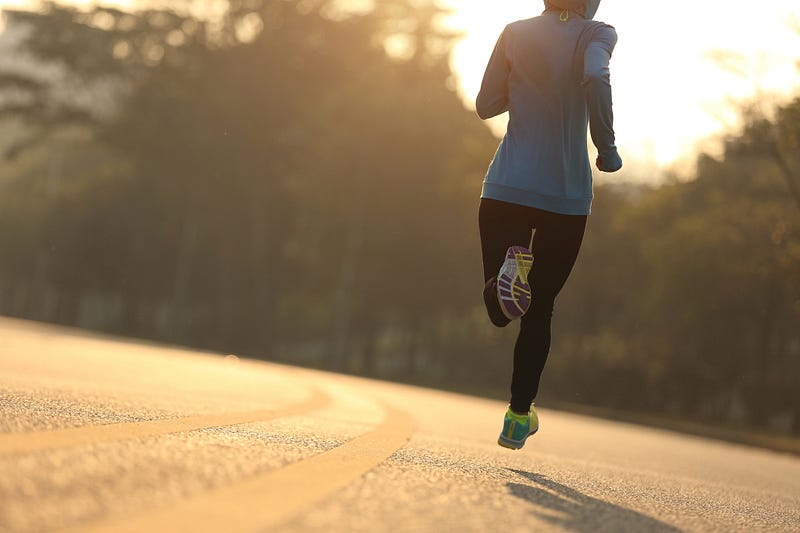
The first time I tried nasal breathing during my workouts, it felt like waterboarding with my own snot. I couldn’t breathe, and I certainly couldn’t maintain my normal pace.
But after four months of consistent practice, I’ve seen my resting heart rate (RHR) drop 5–8 points, increased my estimated VO2 max, set personal records (PRs) on my 2K meter row time and total output on the spin bike, experienced better sleep and improved recovery, and felt the effects of increased energy throughout the day.
I’m not the only one. I’ve seen vast improvements in the clients I coach and the people I work alongside. You can, too.
Nasal breathing in this context simply means breathing in and out through your nose during aerobic training. Sounds easy? I promise it’s not. But I’m going to show you how to do it, with an emphasis on improving athletic performance and aerobic capacity.
Nasal Breathing to Enhance Performance
We have generally have two choices when it comes to breathing — through the nose, or through the mouth. Many people are “mouth breathers” when they exercise (and often throughout the day and night).
Mouth breathing delivers a greater volume of oxygen for the body to use at a faster rate. It’s also survival instinct from our “fight or flight” days. We resort to shallow, chest breathing when we are highly stressed. And, yes, exercise is a form of stress.
If you can get a greater amount of air and therefore run harder and faster when breathing through your mouth, why would you ever want to change that?
In 2018, Dr. George Dallam, professor of exercise science, triathlete, and coach to some of the world’s top athletes published a study examining the potential of nasal breathing in sport. His subjects were ten recreational runners who raced and trained using only nasal breathing for six months in the run-up to the experiment.
According to Patric McKeown at Oxygen Advantage:
“The results of the study indicated that after six months of exercising using only nasal breathing, the runners were able to achieve the same optimum oxygen consumption as when they were mouth breathing. This is thought to be because the nasal breath training enabled them to develop slower breathing patterns. Slower breathing gives extra time for oxygen to diffuse into the bloodstream, as air is pulled deeper into the lungs and stays there longer. The 22% reduction in breathing speed also represents easier, less effortful respiration.”
The nose creates resistance that allows the body to use inhaled air more efficiently.
McKeown notes:
“…nose breathing results in a 10 to 20 percent greater oxygen uptake in the blood. “When you breathe, your lungs exchange and metabolize oxygen and carbon dioxide (CO2). During exercise, your body uses more oxygen, so the concentration of oxygen in the blood drops.
“The increased muscle activity and metabolic rate mean you produce more carbon dioxide. What will normally happen is that your breathing speeds up relative to your CO2 production — CO2 leaves the body in expired air — so your blood carbon dioxide levels shouldn’t change much.
“However, if your CO2 levels become too high, the speed and volume of breathing will increase and heart rate becomes faster. All of this makes it quite hard to continue training. Therefore, your ability to sustain physical exercise is directly related to your blood sensitivity to CO2.”
The athletes adapted to nasal breathing by increasing their tolerance to CO2 without losing peak performance.
Have you ever watched the world’s fastest runners? Do they look like they are gasping for air? No. In fact, what makes them fascinating to watch is just how easy and effortless it appears.
The goal with nasal breathing is to train your body to sustain physical exercise longer and with less energy. That’s ultimately how you improve.
While this all sounds fairly complicated, it’s simple in practice. You can see improvement with as little as ten minutes a day. I’ll show you how.
How to Train Yourself for Nasal Breathing
In March, as the pandemic brought the United States to a standstill, I — along with countless others — found my gym closed and little to no equipment for resistance training at home. The one thing I did have? A Peloton.
I used the bike about once or twice a week before, but now I had no reason (and really no choice) not to hop on. I don’t hate cardio, but I don’t love it either. This seemed like as good a time as any to work on improving my weakness.
My coach and mentor Dr. Mike T. Nelson (yes, I’m a fitness coach who has a coach) programs my workouts and turned me on to the science behind nasal breathing. He started asking me to perform my aerobic sessions — whether running, rowing, or spinning — breathing only through my nose. He also programmed daily cardio starting at only ten minutes per session.
This was the protocol:
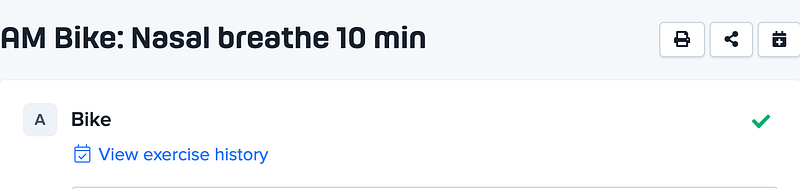
Rinse and repeat, six days in a row. Had I not been able to do ten minutes, we would’ve started with five or six, or even with two minutes. The idea is to start at a place so easily attainable, there’s no reason to skip it.
Ask yourself on a scale of 1–10 — one being no chance at all and 10 being extremely likely — what’s the likelihood I’ll complete this ten minutes of nasal-breathing cardio on a daily basis? If you can’t give yourself a 9 or 10, reduce the number of minutes until you can.
The other option:
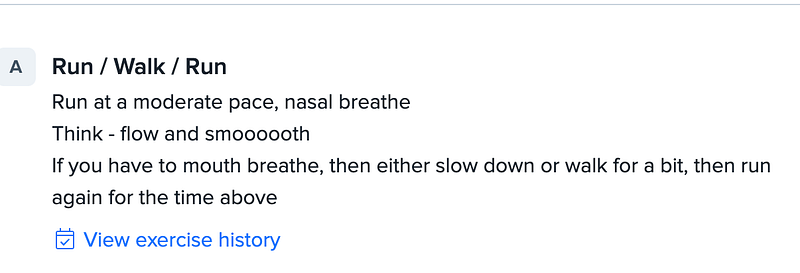
Time for the above exercise? 15–25 minutes. But again, set the same goal as above. Make sure you score a 9–10 on the likelihood scale before committing to a certain time frame.
Pick your weapon of choice — elliptical, rower, treadmill, jogging trail, or bike. It doesn’t matter. Start with a time frame acceptable to you and work to increase that with time.
I’m not kidding when I say it feels like you’re drowning in snot at first. Not to mention it just feels weird.
If you have to mouth-breathe, you’re going too hard. Slow down and try again. It may feel like you’re going at a snail’s pace, but I promise this will get better with time. I tend to run a 9–10-minute mile through my hilly neighborhood.
With nasal breathing, I average around 11–12 minutes. Let go of any ego regarding your speed; no one will know you’re going slower. I promise! And after three months, I started averaging closer to 10:30 per mile and am still improving.
My first client kept a box of Kleenex next to her stationary bike handy to wipe her nose — not as easy to do on a run, but hey, maybe that’s what your shirt is for? 😬
In my experience, it takes 1–2 weeks before it begins to feel more natural (meaning an easy in and out effort). You’ll discover the pace you can maintain and feel like you are getting enough air. In fact, I often forget I’m nasal breathing when I’m lifting heavy on my non-cardio days.
Caution: if you’re prone to singing along to the music in your headphones, you might find yourself accidentally mouth breathing from time-to-time. Whoops. Or if someone tries to talk to you (conversations not allowed). 😉
Kidding. Interruptions happen. They aren’t a big deal. Just return to nasal breathing once you can.
Remind yourself you’re training like a total badass, and ignore any side-eye from strangers.
Payoffs in Performance
My resting heart rate dropped from around 53 to 48 — even hitting 44 on occasion.
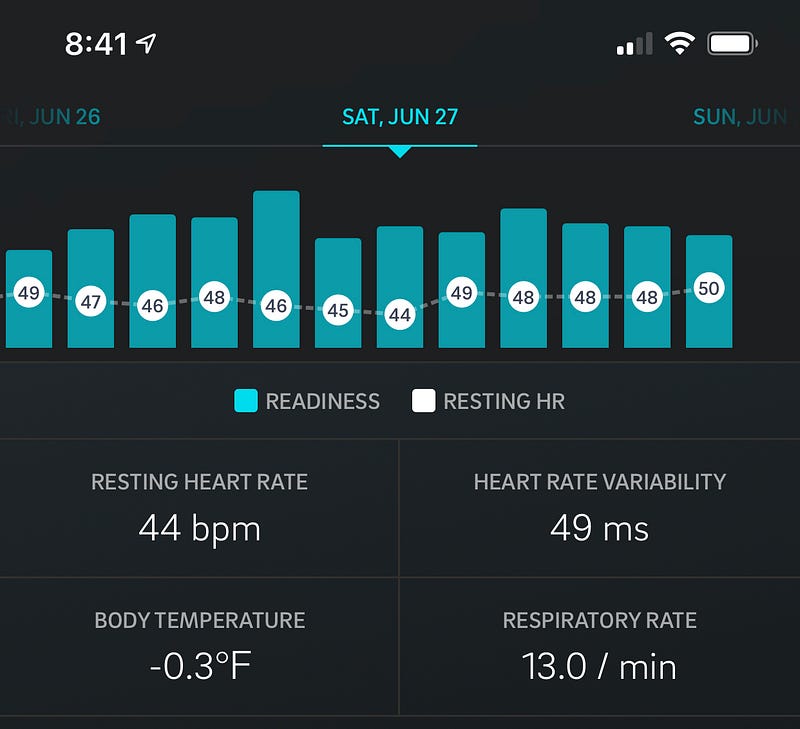
Why does that matter? “In certain cases, a lower resting heart rate can mean a higher degree of physical fitness, which is associated with reduced rates of cardiac events like heart attacks,” says Dr. Jason Wasfy, director of quality and analytics at Harvard-affiliated Massachusetts General Hospital Heart Center.
A lower RHR also means your body isn’t using as much energy for day-to-day tasks. Anecdotally, this can leave you feeling more energetic, as clients with higher RHRs often complain of feeling lethargic no matter how much they sleep.
VO2 Max
VO2 Max measures the amount of oxygen your body uses during exercise. The higher your VO2 Max, the longer you can sustain a certain intensity of exercise — meaning you can go farther and faster before you break.
An accurate measure of your VO2 max requires testing in a lab, but there are a few tests you can do to get a close estimate without forking over a ton of time and some of your hard-earned cash.
Test 1 Row:
Find a Concept 2 rower (they are at most gyms), set the distance to 2000 meters, and row your heart out.
Plug the result into this calculator.
Test 2 Run:
Perform the Cooper Run test. I typically go to the high school track for this, but you can literally lace up your running shoes and do this anywhere.
Run for 12 minutes as hard as you can and record the distance. https://exrx.net/Calculators/MinuteRun
Perform either test (use your normal breathing method) and figure out your baseline. Don’t get caught up on whether it’s 100% accurate. The point is simply to increase the distance you can run in 12 minutes or decrease the time it takes to row 2K meters.
Train using the nasal breathing protocol above. Repeat the test in 8–10 weeks. Note: Dr. Dallum’s study tested subjects after six months, but I’ve found improvements in myself and my clients in as little as two months.
Personal records
The Peloton measures PRs based on total output in kilojoules. I thought I would never set another PR as long as I couldn’t breathe through my mouth.
I was wrong. Four months later, and my nasal PR’s now beat all of my previous mouth-breathing ones.
This didn’t translate to the bike alone, as improvement may be expected after riding it every day regardless of my breathing method.
After ten weeks away from the gym and zero training on the Concept 2 rower, I set a 6-second PR at 2000 meters.
Train your legs, and they will get stronger. Lift weights and your biceps will grow. Breathe through your nose, and your breathing muscles will adapt.
“Breathing hard requires a lot of work from the respiratory muscles, and as these muscles become fatigued, blood is diverted from the legs to support breathing. This redistribution of blood away from the working muscles is called metaboreflex. It makes your legs feel tired, forcing you to slow down or stop,” says McKeown, in reference to this study.
Reduce the inhalation effort and you can improve blood flow to your muscles.
Listen to your body and don’t force it beyond the point of what’s safe for your body. Stay consistent. It’s not fun in the beginning, but the effort will make you a better athlete (and human!).


