
I Tried Google’s Generative Search. It Will Change Blogging Forever.
Creators need to adapt now
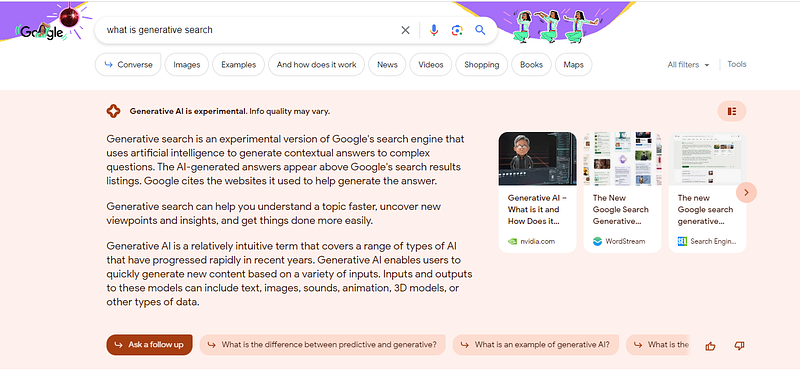
This week, I finally got an invitation to beta test Google’s new generative AI-powered search experience, dubbed Search Generative Experience (SGE).
It's a total game-changer. SGE will likely take over the search experience in fairly short order, with profound impacts for users, web publishers, and bloggers.
Here's a look at my experience testing Google's new generative search, what it means for content creators like me, and how we can adapt and thrive.
What is Generative Search?
Before we dive in, let's cover the basics. What exactly is Google's new Search Generative Experience?
This system is a new addition to Google's search engine that uses generative AI to write what are essentially short blog posts based on a query, instead of showing external web pages, as Google does today.
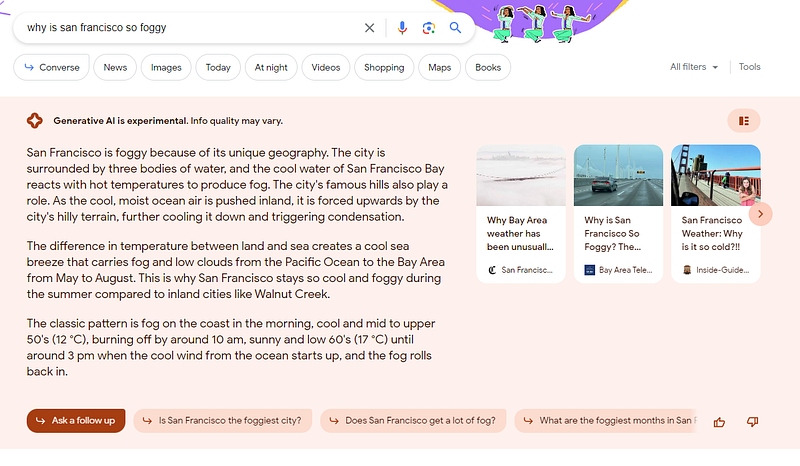
For example, in a traditional Google search, if I enter the query “Why is San Francisco so foggy?” I would get a mixture of different websites. I might see one from a meteorological organization, a local newspaper in the Bay Area, or a big weather-focused publisher like weather.com.
With SGE, Google cuts out the middleman. Instead of surfacing results from multiple web publishers and blogs, Google leverages the tech behind its “Bard” tool to read webpages on the topic of the query, and quickly summarize them in a few paragraphs at the top of the results page.
When I reviewed Bard on the day it was released for beta testing, the first thing I noticed was its speed. It seemed like Google was specifically tuning the tool to work for search, prioritizing rapidity over accuracy.
Bard’s major competitor, ChatGPT, is a great conversationalist, but it takes forever to generate responses. A single ChatGPT response can take upwards of 2 minutes to produce. Bard is way faster, generating responses in a few seconds. I predicted that it was being developed not to compete with ChatGPT, but to enhance Google’s search functions.
This prediction has come true. When users enter search queries on Google, they're not willing to wait the several minutes that it takes for a tool like ChatGPT to generate a response.
Google's Bard-powered generative search is slower than their normal search function, which generates responses in a few milliseconds, but it’s still lighting fast compared to ChatGPT. It’s clearly a tool built for search. It’s currently available for Beta testing by invitation only, but it’s almost certain to roll out to general users soon.
So that’s how SGE works. But what does it mean for bloggers, niche site owners, and web publishers?
It’s Worse Than We Thought
On the day that Google announced SGE, I speculated that Google would ultimately use this technology only for select queries.
Google has a strong interest in preserving its existing search features (which generate billions in ad revenue) and also encouraging people to post content online. If publishers stop writing blog posts and articles, Google will have nothing to show in its results (or to sell ads against) which is bad news for everybody.
Because of these vested interests, the consensus in the SEO community was that generative search would probably be used for longer, more complex queries, while Google would preserve its traditional search experience for much else.
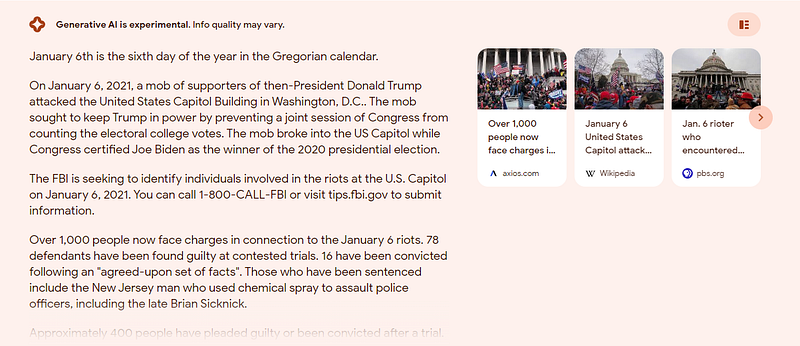
However, if the Beta version of SGE is any indicator, Google isn’t planning to limit generative search at all. In my testing, generative search kicked in on almost every query. Surprisingly, Google was even confident enough in its abilities to have it chime in on sensitive topics.
“January 6th”? SGE was happy to comment.
“Heart attack?” Why not have a robot field that potentially life-ending search?

The breadth of SGE’s responses surprised me. Like most SEOs, I thought Google would only leverage it for long queries, like “What is the best restaurant for kids and a dog in Baltimore, Maryland?” I never throught they’d use it for so-called YMYL (Your Money, Your Life) queries about medical or financial topics.
Instead, they’re using it for everything.
And that’s where things get dicey for publishers and bloggers. Technically, SGE links to its sources, displaying several source websites next to its results. Google has said that it remains committed to sending traffic to external publishers.
But in reality, how many users will click on those links?
The Path of Least Resistance
As publishers and bloggers, or at least, as savvy web users, we like to think that people spend a lot of time analyzing and understanding search results to find the best answer to their query.
We hope that they would enter a search term, click on several of the top results, read the articles, evaluate their authority and helpfulness, and ultimately make a decision based on careful consideration.
Unfortunately, that's just not how search actually works. People are looking for the fastest, easiest answer. It's part of the reason search ads work so well. Studies have shown that people can’t differentiate between paid ads and organic search results. Most people just enter a term into Google and click on the first thing that appears, whether that’s a webpage or an ad.
That's why publishers who rely on SEO should be very concerned about generative search. When the feature came out, many SEOs and journalists dismissed it, grumbling about how it's not very accurate, doesn't provide as much information as a full blog post, or recommends products that aren't the most useful.
Bad news, folks: Users don't care.
SGE provides decent information in a massive, colorful box that dominates the search results page. Very few searchers are going to bother to scroll past the entirely passable information in the SGE box in order to dig deeper into the boring, old-fashioned search results down below.
Maybe some users will take the time to click through the individual articles that are surfaced next to SGE, especially if they're doing research and plan on digging deeper already. But for many quick answers, generative search puts crucial, good-enough information right in front of you. Most users likely won't care to dig any deeper than that.
Searcing for Satisficement
This is a great example of the concept of “satisficing.” Traditional economics assumes that people are rational and weigh their interests, compare multiple options, and carefully reason when making decisions.
The reality, as numerous studies have shown, is different. People tend to choose the fastest answer that's good enough to meet their needs. Political scientist Herbert Simon famously called this tendency “satisficing” (a portmanteau of “satisfy” and “suffice”) when he coined it in 1956.
Google's SGE makes it easy for users to satisfice.
Maybe it doesn't recommend the absolute best restaurants in a place or provide all the details you need to embark on a craft project. But for most users, it's probably good enough to meet their needs. And because it saves them the hassle of clicking through and reading multiple articles, users will absolutely use it if Google continues to make it front and center on the results page, as they are during the SGE beta.
Potential Impacts
If Google rolls out generative search to a broader set of users, it will have profound effects on the web publishing industry.
Websites that rely on providing simple answers to quick questions, as well as those focusing on reviewing products, could see a massive hit to their SEO traffic. SGE will happily and rapidly eat their lunch.
Even websites that go deeper on topics like dining places and travel destinations could see a big hit. It's nice to think that users want to scroll through your 2,300-word, beautifully photographed blog post about your trip to Florence.
In reality, they're probably fine with having Google tell them they need to go to the Uffizi Gallery and eat some Pecorino Toscano, and are content to leave it at that.
How Can Publishers and Bloggers Adapt?
Given the existential threat from generative search, there are a few ways that publishers and bloggers can adapt.
- Firstly, if you’re in the blogging or web publishing space, you should immediately diversify away from SEO traffic as your main source of visits. There are tons of other ways to bring people to your website. My site Bay Area Telegraph gets the majority of its traffic from news aggregators like Flipboard and NewsBreak. These are a great source of traffic that doesn’t rely on search.
- Within Google's ecosystem, publishers should start focusing less on traditional search and more on Google Discover. Discover is Google's platform for recommending content to people based on their interests, rather than waiting for them to enter a query into a search engine.
If you have an interest in metalworking, for example, Google will learn that and recommend stories about metalworking or related crafts that might interest you, both within the Google app on your phone and on certain traditional search pages.
Google Discover can be a source of massive traffic. One of my niche sites had an article that recently got thousands of views from Discover alone. There are lots of ways to optimize content for this system. Because Discover is all about surfacing content to people who are already interested, it's unlikely that Google will start using generative search for Discover.
- Publishers can also focus on optimizing their articles to entice users from the generative search experience to click through to their site. Compelling titles and thumbnails will be even more important now, as these are the things that Google currently displays alongside SGE results.
If a user searches for a travel query and sees your blog post with a beautiful photo and a compelling title beside the SGE text, they're more likely to click through to read it in depth, instead of just reading the summary in the generative box.
- If you haven't done it already, it's also time to diversify into other formats. Video formats like YouTube and audio formats like podcasts will be less prone to being replaced by generative search.
- It's also time to build a brand. Anonymous websites that simply provide information stand to get crushed by generative search, since Google will summarize their content, and users won’t care.
If people come to your site because they know and trust you, however, they're likely to keep doing that, rather than letting Google’s AI roughly summarize what you say. Start a newsletter, build an online community within your site, make yourself the face of the brand, and take action to establish your brand's credibility, rather than relying solely on people finding you through organic search.
- Finally, it’s a perfect time to publish content to platforms (like this one) that have a built-in audience that’s not reliant on search.
What Happens Next
In short, it’s time to diversify beyond relying solely on Google to send you traffic. To be fair, it was probably a good idea to do that all along! But SGE adds urgency.
Of course, no one knows exactly what will happen next. SGE is currently a Beta product. It’s possible that when Google rolls it out more generally, they’ll restrict it to only a subset of searches. They might be testing it now on nearly every query to get crucial data, which they might later use to pare down SGE to only the most relevant queries.
Certainly, if they roll it out more generally, they’ll need to find a way to monetize it. Google doesn’t want to cannibalize its own highly lucrative advertising empire.
My impression from testing SGE is that Google is still figuring things out. During my testing, I asked Google’s search engine a pointed question: “Will generative search destroy blogging?”
Tellingly, SGE refused to answer.
I’ve tested thousands of ChatGPT prompts over the last year. As a full-time creator, there are a handful I come back to every day. I compiled them into a free guide, 7 Enormously Useful ChatGPT Prompts For Creators. Grab your copy today!


