
I Traveled 9,102 miles on Amtrak During the Pandemic. This is What I Learned About Slow Travel.
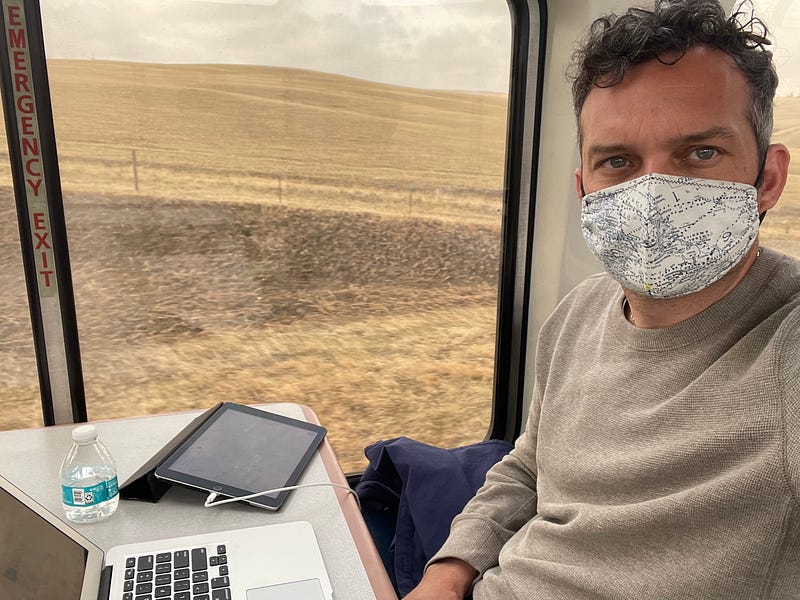
On a rickety and rocky ride, Amtrak’s Cardinal blew its whistle as it passed rolling hills, cows, rivers and rolls of hay in western Virginia, with not a soul in sight. My ears popped as we climbed the Allegheny Highlands through one tunnel after the next.
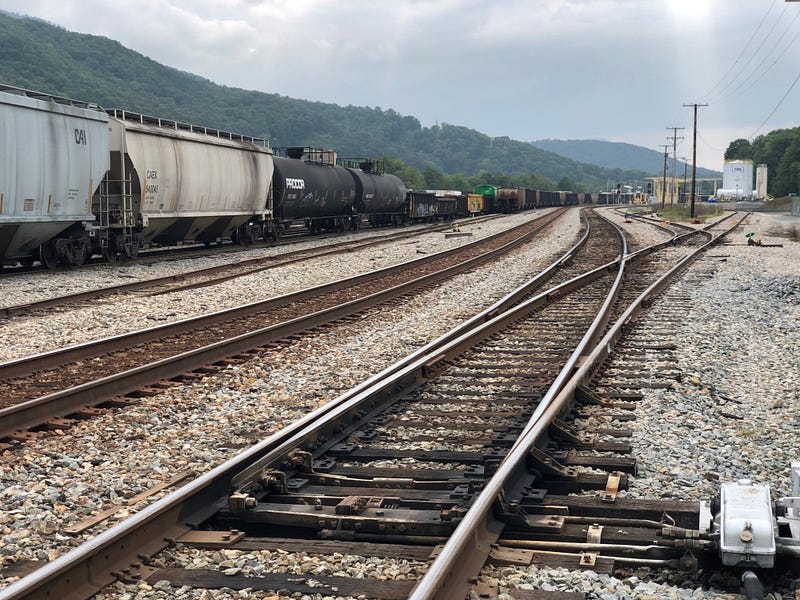
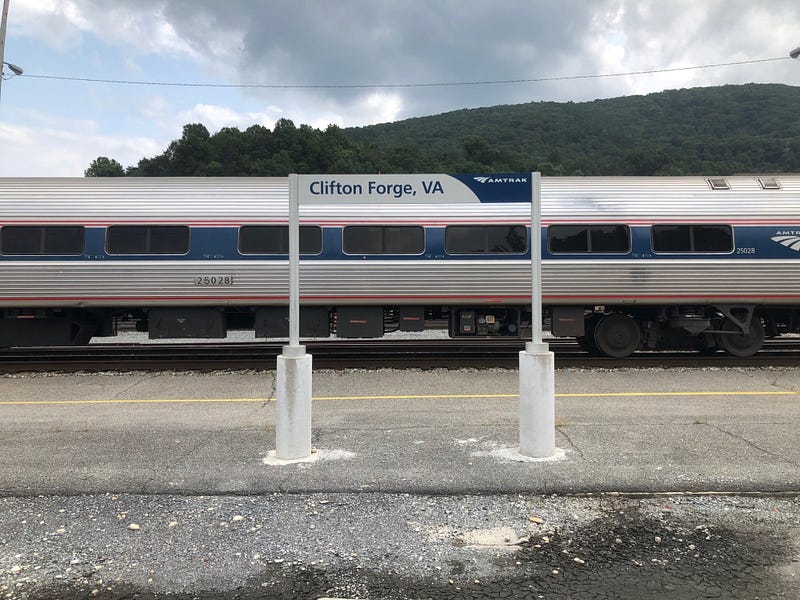
At Clifton Forge, we were so far ahead of schedule — a rarity on Amtrak — that we had an unexpected fresh-air stop to step off the train. With a population of roughly 3,500 people, this town was once home to a steam locomotive maintenance facility for the Chesapeake & Ohio Railroad. From my perspective, the town was deserted.
Just five hours earlier, I was in the shadow of the U.S. Capitol building. And now here I was, pacing around an abandoned railyard gazing at hills in the late afternoon sun, feeling so remote from anything familiar.
I adore train travel, but my decision to make this late-summer trip was not an easy one.
Living in New York City in the spring of 2020 meant weeks of quarantine, taking my temperature multiple times a day, and treating groceries with a dwindling amount of spray sanitizer. But as spring turned to summer, I wondered if I might be able to seize a rare opportunity to travel west by train to see my family, using accumulated vacation time and the ability to work remotely.
I spent much of the summer questioning whether taking this trip would be a responsible decision. Amtrak required masks, even while sleeping, and coach passengers traveling solo would be guaranteed an empty seat next to them. I sought the advice of friends in the medical profession and strangers in an online Amtrak forum. When my mom broke her hip on Sept. 11 — a minor break, thankfully — I decided it was time to see my family, and a slow, socially distant trip across the United States would likely have the same risks as a packed airplane.
Exactly one week after my mom’s fall, I found myself in the stillness of that rural fresh-air stop in Clifton Forge, with that jarring feeling of being someplace unexpectedly foreign, yet not far from home.
Our increasing appetite for long-distance travel is contributing to an impending climate disaster. In The Tourist Gaze 3.0, John Urry and Jonas Larsen recommend several solutions, beginning with this: “We need to somehow dispense with the ‘exotic gaze’ which drives so much contemporary tourism and instead favor discourses, schemes and funding which develop what we might term a ‘local gaze,’ to keep people in places rather than roaming across the globe.”
Looking back at my 20 minutes walking circles around the Clifton Forge Amtrak station, I cannot tell whether mine was an exotic gaze or a local gaze. But one thing is clear: When I am on a slow train, the local feels exotic.
On my first long-distance train trip more than two decades ago, I purchased several magazines at Chicago’s Union Station to help pass the 43-hour ride to Los Angeles. As the train passed through the suburbs of Chicago, and as those suburbs were gradually replaced by farmland, my eyes were fixed on the passing landscape.
This was not breathtaking scenery. But I had no desire to divert my attention from the windows. Perhaps this felt exotic because I had spent the first two decades of my life flying over this landscape, and I was intrigued to see these 2,265 miles pass at eye level, at an average speed of 52 miles per hour.
Having traveled tens of thousands of miles on Amtrak, I can still say that when not in conversation with fellow passengers, my gaze remains on that passing landscape, whether breathtaking or dull.
Back on the Cardinal in September 2020, there was little conversation among passengers. But what I could hear made me wonder whether I should have stayed home.
I was seated one row in front of an Amish woman who coughed incessantly. Neither she nor her companions wore their masks over their noses. Finding the row in front of me empty, I moved forward to put more distance between us. I was more than six feet away, but still close enough to hear her hum as she knitted.
As night fell along the New River Gorge of West Virginia, the woman across the aisle from me fanned herself and coughed, while chatting on her phone about Satan messing with her. Did she have a fever, I wondered?
The next day, I would be eating lunch with my great aunts and uncle, all in their 80s and 90s. I would visit friends with small children in the Bay Area. I would spend a week with my family in San Diego. Was my cousin correct when he joked about my “superspreader trip”?
Thankfully, I crossed the country — the Appalachians, an overnight in Chicago, the rolling hills of Iowa, the great plains of Nebraska, the Rockies of Colorado, the high deserts of Utah and Nevada, and the Sierras of California — with an infrared forehead thermometer that never registered a fever. And immediately upon my arrival in suburban San Diego, I took the first of what would be dozens of Covid tests, all of which have been negative.
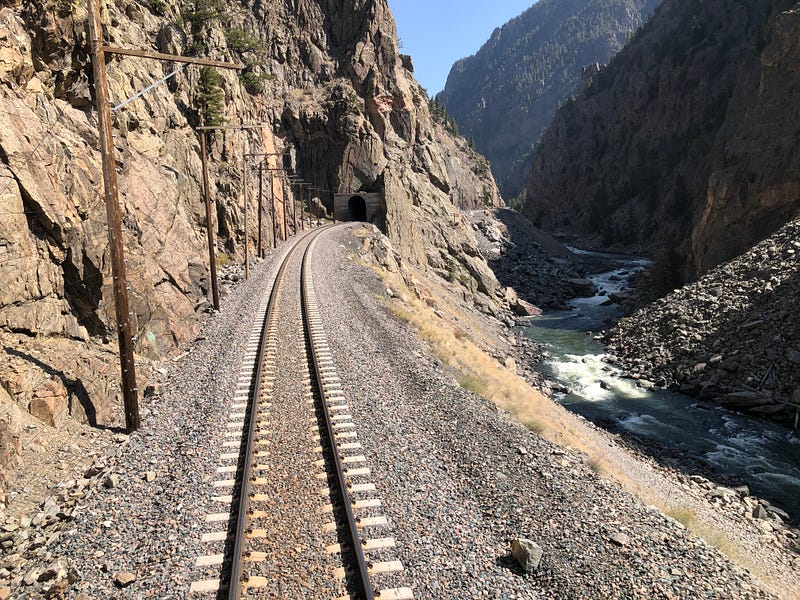
The highlight of that trip — and perhaps of the entire Amtrak network — was the stretch between Denver and Glenwood Springs. But hours earlier, as the train passed the emptiness of eastern Colorado while the morning sky was still dark, I jotted a note: “Is there any greater place in the world to be right now than right where I am, in the sightseeing car, moving across Colorado, an hour from Denver, with a mug of tea next to me?”
Perhaps those thoughts were fueled by anticipation of the grandeur to come. Or, perhaps, the landscape of eastern Colorado just felt exotic to me.
The first passengers on the California Zephyr also recognized the value of slow travel.
Named for the Zephyus, the god of the west wind, the California Zephyr was 10 hours slower than the fastest train between Chicago and Oakland when it debuted in 1949. But, as Henry Kisor describes in Zephyr: Tracking a Dream Across America, the scenery of the Zephyr captured the imaginations of travelers and became the preferred route.
“No other American train traverses such a variety of terrain: the industrial backside of Chicago, the Midwestern breadbasket of Illinois, Iowa and Nebraska over the Mississippi and Missouri rivers to the high plains and towering Rockies of Colorado, the intermountain desert of the Great Basin of Utah and Nevada, the high Sierra of California, the shore of San Francisco Bay.”
Following in the footsteps of these travelers, I could see why.
After leaving Denver, the Zephyr climbs into the Rockies, entering 29 tunnels, including the 6.2-mile-long Moffat Tunnel completed in 1929. Before we entered the tunnel, elevation 9,239 feet, we were alongside the east-flowing South Boulder Creek. Afterward, we paralleled the west-flowing Fraser River.
We had crossed the Continental Divide.
The highlight of this ride was cutting through a series of canyons — Byers, Gore, Red and Glenwood — alongside the Colorado River. For at least an hour, we ran through a stretch of land that can only be traversed by this train, or by raft. No roads. No WiFi. No phone service. Just soaring red rocks and a winding, rushing Colorado River. I had no connection to the outside world, and I was content in the moment.
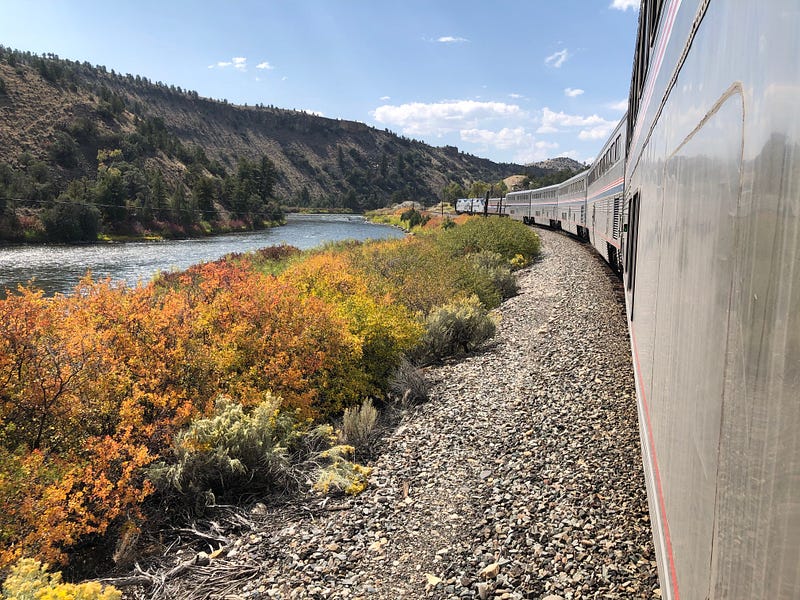
After a 28-hour stop in Glenwood Springs where I biked Glenwood Canyon and touched the Colorado River, I continued westward on the Zephyr, waking up the following morning from a NyQuil-induced sleep to find the Zephyr cruising along a mesa over a massive, rocky desert plain, with mountains in the distance. The landscape took on the pink hues of the soon-to-be rising sun as the train climbed switchbacks. Google maps told me we had just crossed from Utah into Nevada, but to me it looked like Mars.
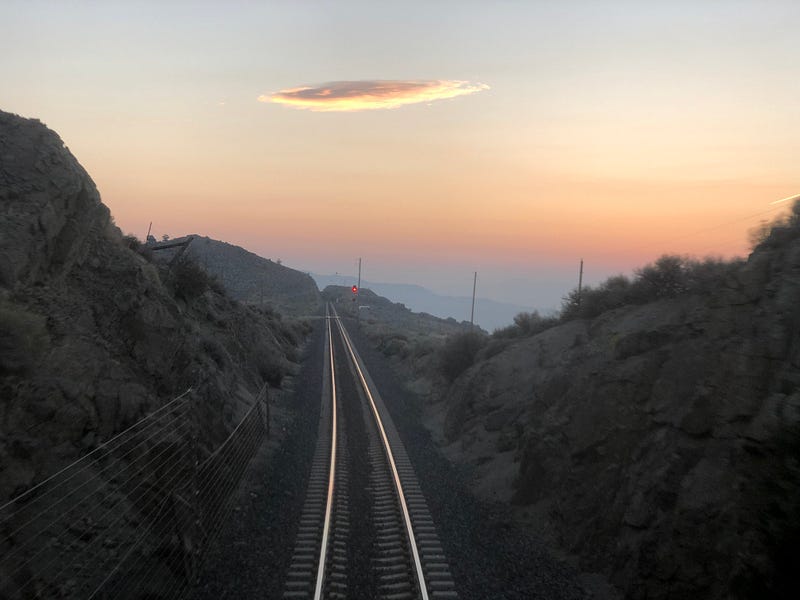
As twilight turned to daylight, the landscape shifted, more lunar than Martian. For more than 100 miles, we ran along the Humboldt River and Interstate 80. Happy, grazing cattle lined either side of the river, some of them even trotting after one another along the water. We passed through Elko, Winnemuca and several smaller towns — settled in part by Basques, I later learned — and I had a difficult time imagining living in this part of the country.
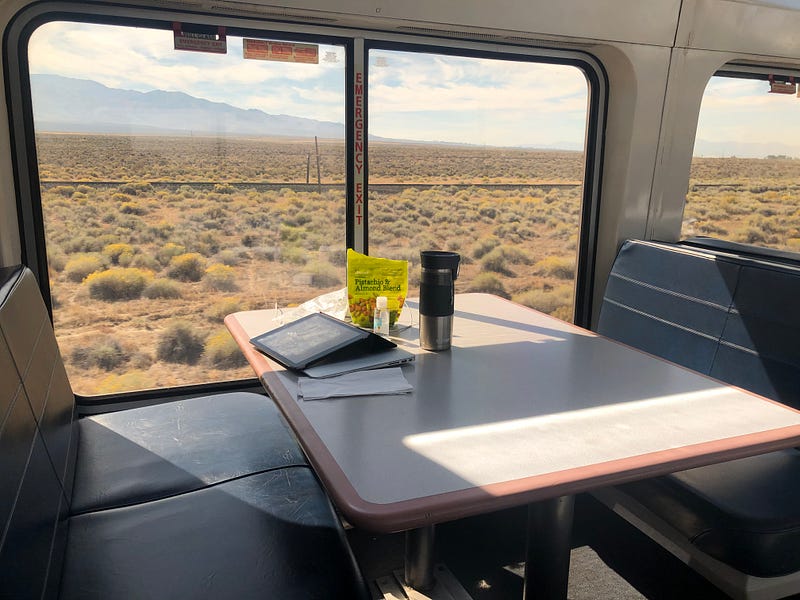
The train was hours behind schedule. But with the nation on pause, I was in no hurry to reach my destination.
When I finally reached my parents’ house in suburban San Diego — after a two-night stay visiting friends in the Bay Area, and a full-day ride down the California Coast aboard the Coast Starlight and Pacific Surfliner — I lay in bed half in disbelief that I had just crossed the country by rail.
In Making Tracks: An American Rail Odyssey, Terry Pindell wrote as he reached the West Coast, “I had a sense of being far from home that is backed up by a tactile feel of the landscape I have crossed to get here.”
I felt the same way, having seen so many changes in the landscape over the last 4,085 miles.
But rail travelers have not always felt the landscape as I did.
Today, we associate the rails with romance and slow travel, but the first train travelers felt the experience jarring, even frightening, as Wolfgang Schivelbusch explores in depth in his 2014 book, The Railway Journey: The Industrialization of Time and Space. He quotes 19th Century travelers who found train travel disorienting, depriving travelers of contact with the landscape and destroying the spaces between destinations:
“That in-between, or travel space, which it was possible to ‘savor’ while using the slow, work-intensive eotechnical form of transport, disappeared on the railroads.”
In fact, for many, the experience was so jarring, it was frequently compared to being on a missile or cannonball:
“The nineteenth century found a fitting metaphor for this loss of continuity: repeatedly, the train was described as a projectile. First, the projectile metaphor was used to emphasize the train’s speed, as in Lardner: a train moving at seventy-five miles an hour ‘would have a velocity only four times less than a cannon ball. Then, as Greenhow points out, there is the cumulative power and impact that turns a speeding train into a missile. … The train was experienced as a projectile, and traveling on it, as being shot through the landscape — thus losing control of one’s senses.”
He is describing exactly the opposite of how I feel when traveling by train.
I returned from that cross-country trip by plane, wondering whether I might have that opportunity again.
The following April, I did. Fresh from my first dose of the Moderna vaccine, I covered a different landscape: Starting in New Orleans, I rode the Sunset Limited across Louisiana, Texas, New Mexico, Arizona and California.
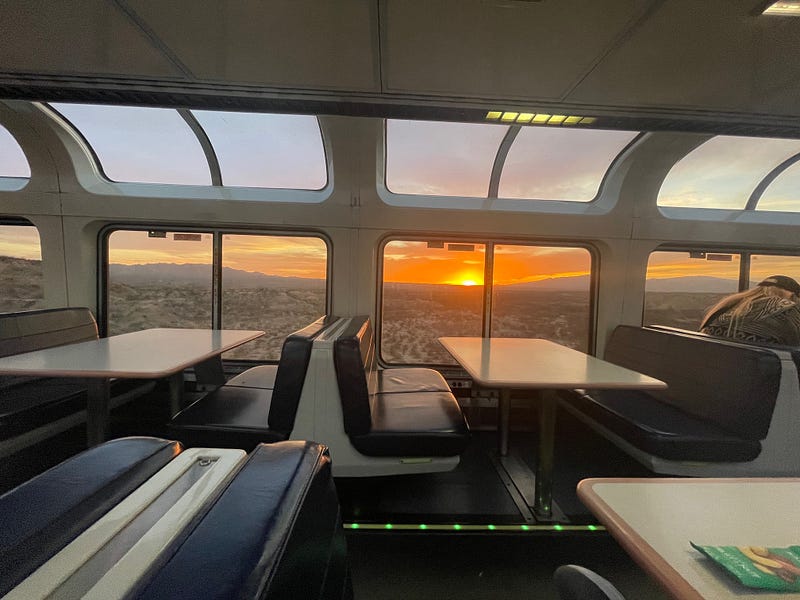
After a week in San Diego with my family, I flew to San Jose to spend the day with friends, and then boarded the Coast Starlight in the evening for an overnight ride to Portland.
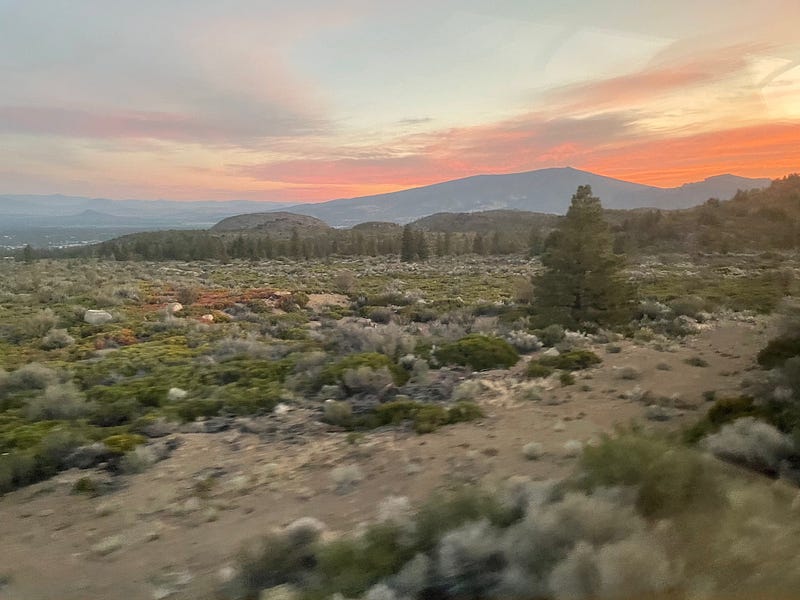
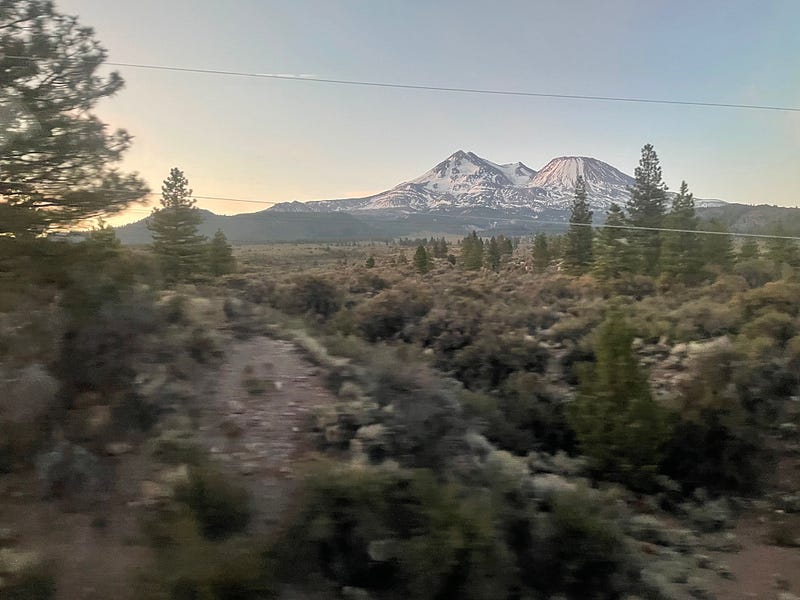
From Portland, I rode the Empire Builder along the Columbia River Gorge, through Spokane and the Idaho panhandle, waking up in the snowy mountains of Glacier National Park.
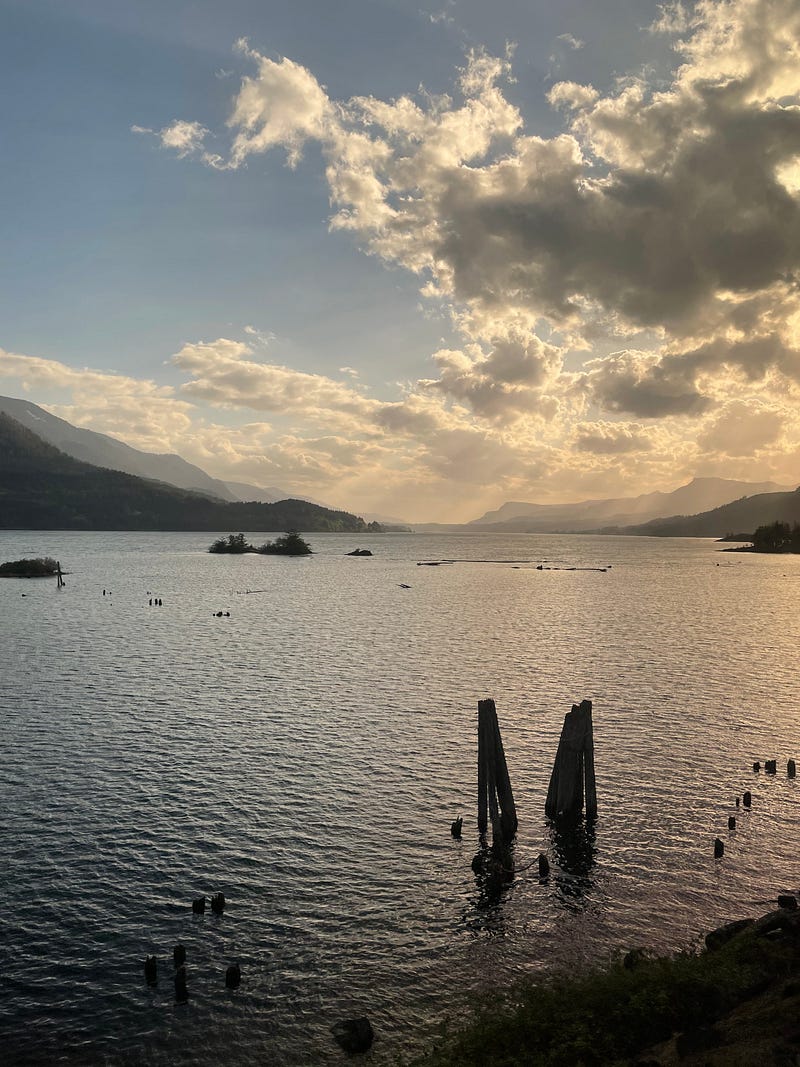
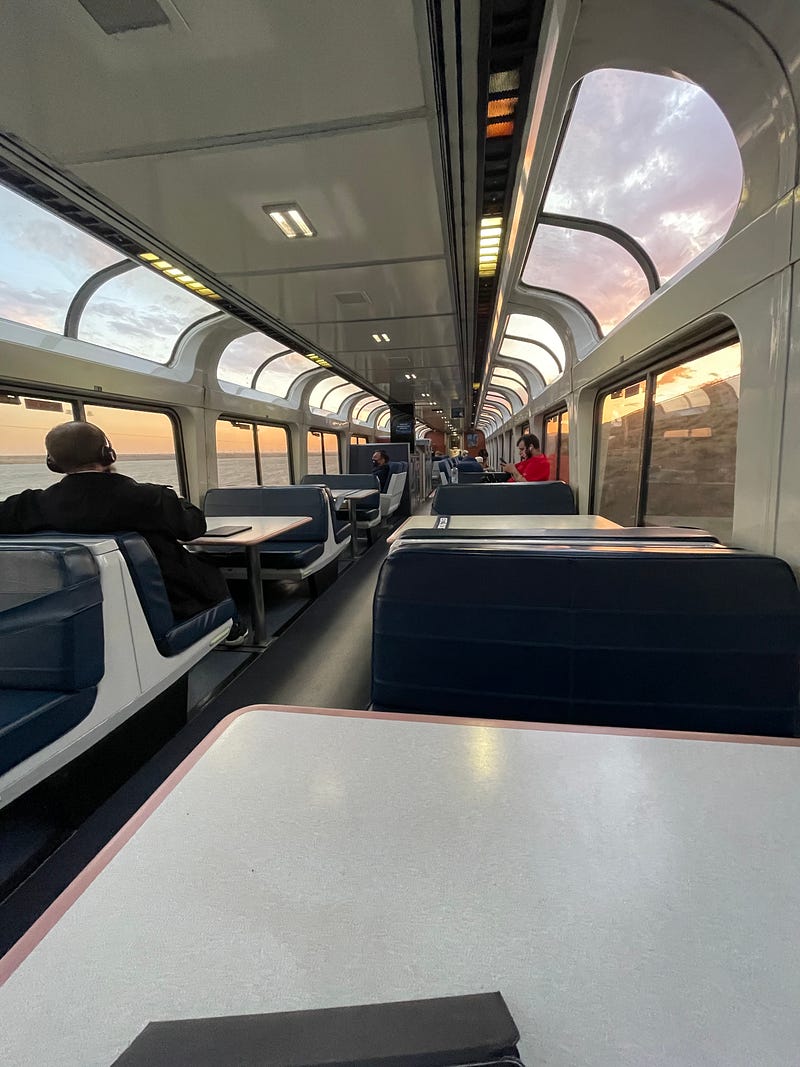
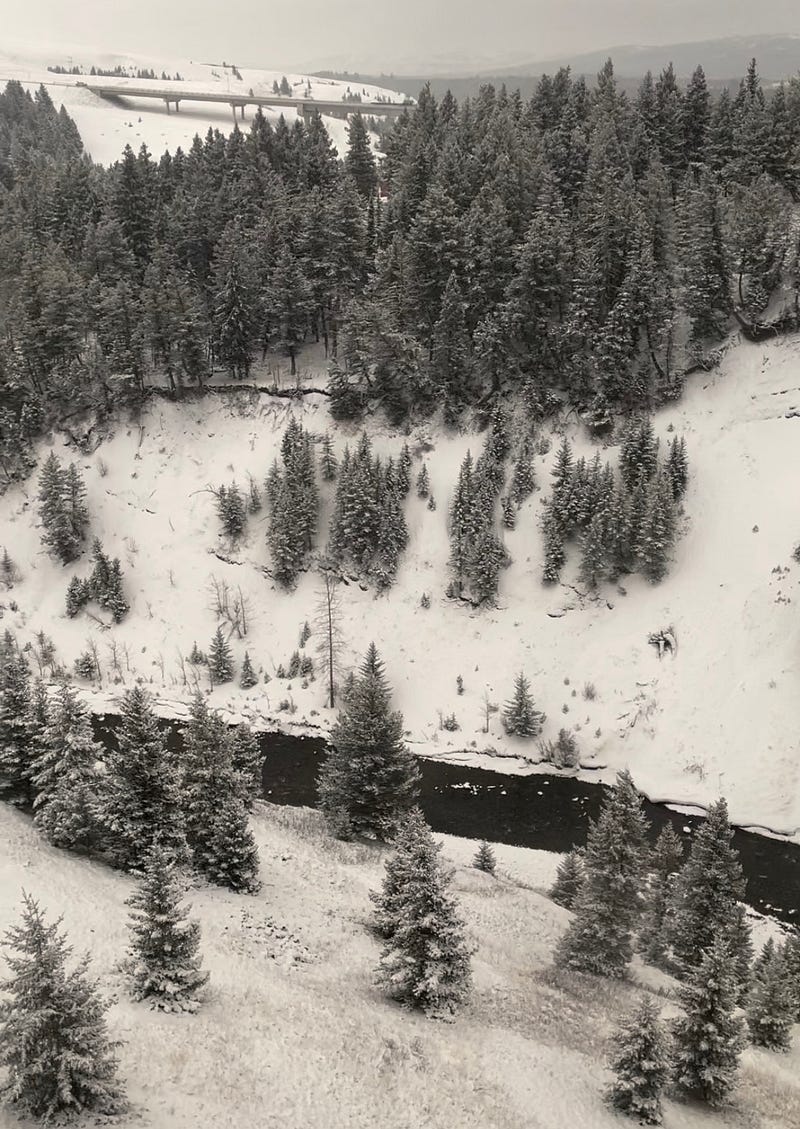
I would continue on this route through North Dakota, Minnesota and Wisconsin, after a two-night stop in Havre, Montana.
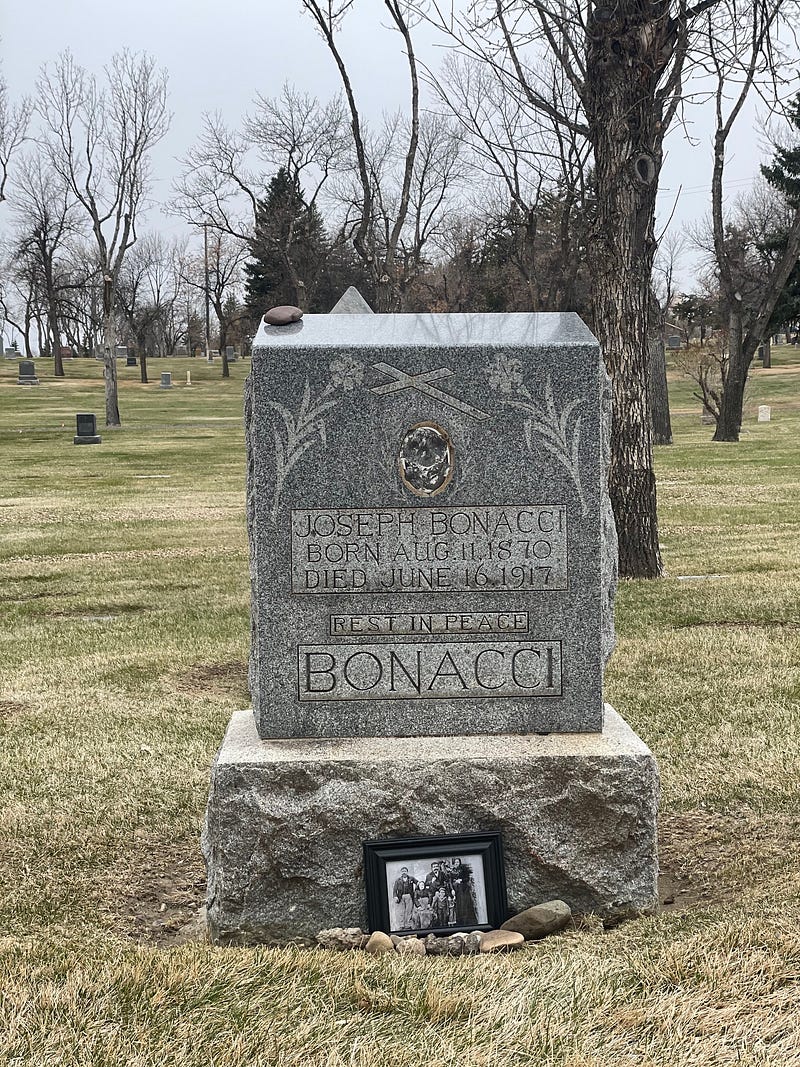
There, I visited the grave of my great great grandfather, who was killed working on the railroad in 1917 — a grave that probably has not been visited in more than a century — and drove to the town of Harlem, population 769, where my grandmother and her brothers grew up during the Great Depression.
I had crossed the Mississippi near its mouth in Louisiana and again two weeks later near its source in Minnesota. I saw the U.S. border with Mexico, and two weeks later, I was 30 miles from the Canadian border.
While the pandemic was by no means behind us, I experienced firsthand people in other parts of the country who believed the pandemic to be over — and began to change my own behavior.
In New Orleans, the French Quarter was full of people, mostly without masks. Restaurants, too, were full, with no space between tables as was often the case in New York at this time. I was horrified when unmasked hotel guests stepped on to an elevator with me.
The ride on the Sunset Limited included a 2.5-hour layover in San Antonio, to link with the Texas Eagle coming from Chicago. It didn’t matter to me that this layover began at midnight. I had scoped out a nearby bar and found it to be lively for a Monday night. For the first time in 15 months, I sat at a bar. Halfway through my Alamo Listo Light, I got nervous about the packed capacity and the semi-adherence to mask wearing. I took my second beer, a Highwheel Betty, outside on the patio.
At the high-end Bow and Marrow restaurant in Havre, no one wore masks. The requirement was dropped six weeks prior, the bartender explained to me. When staff continued to wear masks, patrons harassed them. “Wait,” I said, “They harassed you because you were wearing a mask?” He shrugged his shoulders. “That is the reality here.”
In In Motion: The Experience of Travel, Tony Hiss describes a heightened state of awareness that he calls “Deep Travel.” In his younger days, he writes, he relied on a bumpy stretch of train track north of Albany as a promising source of Deep Travel. “Energied, untethered, unhurried, and protected, your mind can be free to explore any subject at all, because all possibilities lie open,” Hiss said, describing his time in the worn, dated 1960s car, gazing at a bright blue sky outside, and bitingly cold temperatures.
As an adult, Hiss has found that he can enter this Deep Travel state of mind anywhere, even running to the corner deli in his own neighborhood. Or mailing a letter. Or having lunch in his own city.
“What would I notice, what would I want to know more about, what would I find compelling and be fascinated by if we were having lunch in Warsaw right now, instead of New York?” Hiss writes.
That is Deep Travel at home, summed up in a sentence.
As I write this from a coffee shop on Worth Street in Lower Manhattan, I admit I have failed to fully embrace Deep Travel at home. This is not the same as writing from a coffee shop in rural Montana, nor Warsaw, nor from the California Zephyr.
And I am not ready to fully trade the gaze of St. Mark’s Basilica in Venice for St. Patrick’s in Manhattan, nor am I ready to trade a Semana Santa procession in Seville for a Fourth of July parade in Staten Island.
But I will say this: Like Hiss finding Deep Travel on a nondescript, slow-as-a-stagecoach train between Albany and Rutland, I, too, can find it close to home, in places such as an abandoned railyard in the Allegheny Highlands of Virginia.
The more I travel by slow trains in the United States, the more mesmerized I am by the people and landscapes of our own country. The local — or at least the semi-local — can be exotic.
The cancellation of almost everything — and the privilege of being healthy and able to work remotely — provided me the opportunity to see the United States, slowly, and to reconnect with friends and family, living and dead, in other parts of the country.
If the future of travel is indeed local, I am confident it can be almost as fascinating as exotic travel.