
I Travel with Christopher, Saint Christopher
Religious iconography that transcends religion
Religions are full of signs, symbols, and imagery to convey meaning of the ideas and concepts that they represent.
Walk into any Christian church and you’ll see a statue of Christ on the cross somewhere within the walls of the edifice. The Om symbol is featured prominently in any Hindu temple and the only things you’ll see more than statues of the young Buddha in Buddhist countries, are food stalls. The Star of David is recognized everywhere as the symbol of Judaism and although the representation of living things has long been prohibited in Islam, the star and crescent is displayed noticeably in Islamic countries and homes.
Whilst I don’t belong to any one religion, I am a woman of faith. I have a personal belief system that pulls in spiritual and enlightened teachings from many different theologies. The teaching of the Buddha that we create our own realities resonates with me. The ancient sacred texts of the Hindu faith are full of wisdom and I pay close attention to the energy centers of myself and others through the Chakra system. I’ve read the Dhammapada and the Bhagavad Gita, and am more closely aligned with Eastern spiritual philosophies than their Western counterparts.
Having said that, the Christian mystics like St. Teresa of Avila and St. John of the Cross have wisdom that transcends the dogma of Christianity. John’s Dark Night of the Soul is used in conversation between people that have no affiliation to the religion, it’s holy language that we used to convey the depth of pain of a particular time in our lives that common parlance is unable to express.
Religious iconography is only as powerful as the feeling and belief that it conveys.

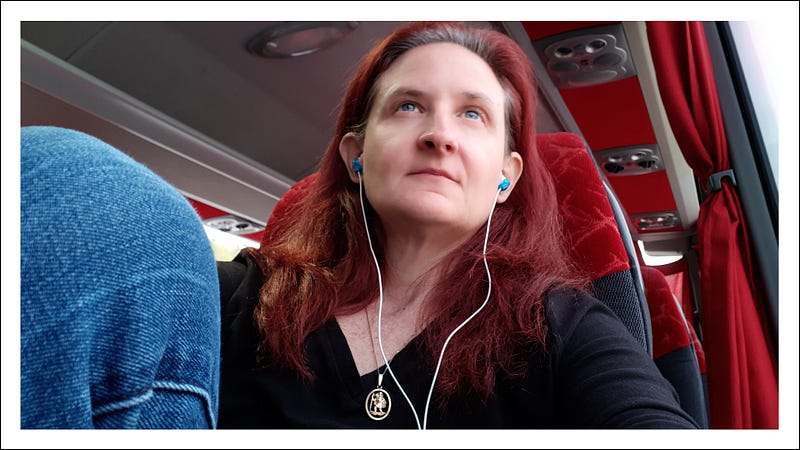
Which brings me to the gold Saint Christopher pendant that I fasten around my neck whenever I am going to board a plane, train, or bus, sometimes even a car if I’m going to travel long distances.
There is a debate as to whether Saint Christopher actually existed or whether he is merely a legendary character. The name, Christopher, translates as “Christ-Bearer” from Greek and the tale goes as follows:
After converting to Christianity, Christopher dedicated his life to carrying travellers across a river. One day a small child asked to be carried through the waters, but halfway through the journey, the child became so heavy that Christopher wanted to relieve himself of the burden. He continued on and upon reaching the banks of the river, asked the child why he was so heavy. It was then that the boy revealed himself as Jesus Christ, telling Christopher that by carrying him across the river, he had carried the weight of the world on his shoulders. Then the Christ child vanished leaving the man to contemplate the consequences of his choice to continue.
Due to the legend, Christopher (Christ-Bearer) became known as the patron saint of travellers.
Whether the pendant works or not is of no consequence, the fact is that I feel safer wearing it when I travel. I believe that with it close to my heart, I will be protected. Maybe it’s the thought energy that I surround myself with that keeps me safe rather than the belief in a legendary figure, maybe it’s something Divine. Either way, it brings me peace of mind in uncertain circumstances.
In fact, I bought a St. Christopher’s pendant for a Turkish friend who, whilst non-practising, was born Muslim. She took no offense at the gesture and knew that my intention was to give her mind a chance to rest from the constant worry of an upcoming trip. Once given, I left it up to her whether she wished to carry it with her or not.
It is our faith and hope that keeps us going when times are uncertain, and when we travel, we need as much of it as we can muster. Out of our comfort zones and under governance of countries that we are unfamiliar with, we desire strongly to be protected as we venture forth.
Saint Christopher is my patron saint of travellers, and when I have this little piece of iconography hanging around my neck, I feel safe. For me, his presence transcends religion.


