
The First (And Last) Time I Told off a Troll
It really didn’t do any good to hijack my highjacked thread
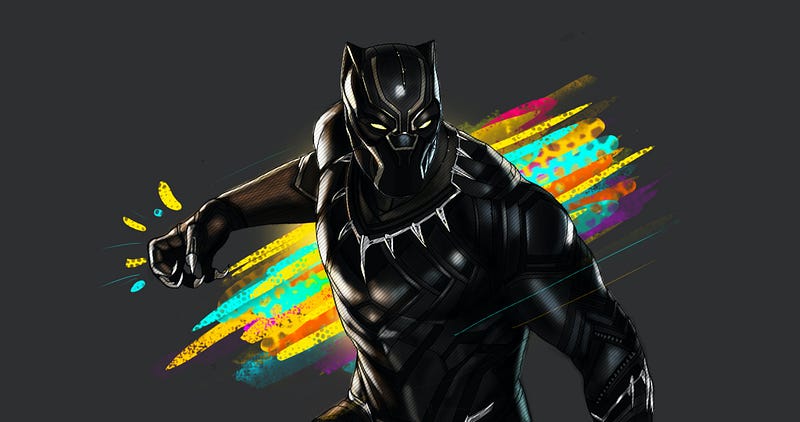
Over the weekend I made a post on Facebook about Chadwick Boseman’s death. I’d just finished Infinity War, ironically, and loved the Black Panther character, as well as the actor who portrayed him. The last thing to enter my mind was that I’d wake up the next day and find that a troll had tried to take over the comments section.
The first comment under my post was penned by a guy I’d known since elementary school: “Who is this person? Really what has he done for you”
Who says that under a RIP post about anyone? Apparently this guy does.
By the time I’d read his comment, several other people had replied. All I said was, “Dude. I just love Marvel movies.”
I figured he was one of those trolls who does the “post and run” but he stuck around for a while reading replies to his comments, and then he said, “Once again it’s about color not character nor life. Really? I wish one day people can see past themselves. Great a fictional character to the rescue.”
Didn’t I post about an actor?
He added: “The first super hero was the green hornet and he has since passed but not before he was found guilty of sexual rape drugging charges.”
That was it. I started writing my official response.
I’d never liked this guy. He’d dated a good friend of mine in high school and had been possessive of her and rude to me and her other friends. I remember him being pretty good at sports, and maybe those talents helped foster a superiority complex, which is often a facade used by insecure people. I should know, really. It’s been one of my faults off and on pretty much all my life.
But none of that was an excuse for his behavior back then, and it was definitely not an excuse for it now, I reasoned. Especially the racist remark. Would he have trolled my post if it had been about a deceased white actor? Who knows. I’ve blocked his account and can’t see any of his past posts, but given his dismissive and hateful remarks, I’ll go out on a limb and say that he probably would’ve left things alone. This post caught his attention for a reason — one that compelled him to be a troll.
Several more people had started in on him as soon as they saw that first comment, which I appreciated, but after reading the rest of his posts I decided to tell him what was what.
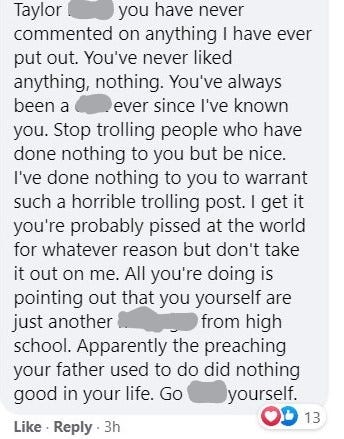
It was everything I’d wanted to say since his pompous ass showed up more than twenty years ago.
And it was great.
I posted some more comments that addressed him as being a racist — one of them told him that he was “just another racist pig from a small town” — and I mentioned the guy’s religious upbringing and how it was one more example of the hypocrisy that has pervaded this country. “If Donald Trump had died and I put up his picture,” I’d added, “[you] wouldn’t be saying that.”
I knew I was defending an actor I’d never met. But I felt like I had to do it. This troll had spoken ill of the dead, and was racist to boot. I’d been literally shaking as I was coming up with my reply. It took at least an hour before I calmed down.
After I gave my comments some time to be read, I blocked the troll, knowing that if he didn’t see them, we have roughly 230 mutual friends on Facebook, some of whom like to stir the pot. He’ll find out what I said, I thought smugly.
I went back to my original post and made an edit.
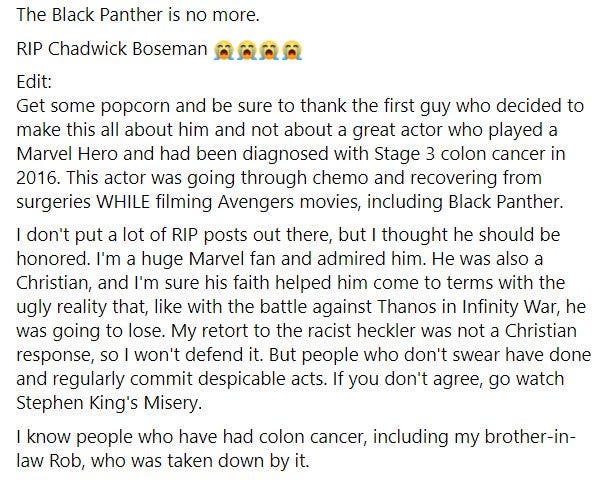
The mention of colon cancer in my edited post prompted the Facebook bots to suggest that I add a donation button to the charity of my choice. This was an opportunity to sort of turn something around, I thought. So I connected the Colon Cancer Foundation to my post, made the first donation, and some other donations followed.
Sure it’s a good thing to donate to a worthy cause. But in hindsight I should’ve just deleted the troll’s comments and moved on and donated to the foundation privately. The whole post was hijacked from the start, and I contributed to it by getting emotionally involved in the thread. My tribute to a great actor ended up becoming one more melodramatic piece in a feed that was already filled with complaints and political memes and arguments. I’d gotten the idea to add a donation button to my post, but I kind of feel like doing that was sort of jumping the shark. Almost all of the donations I make are done anonymously because I don’t want to bring undue attention to myself. Now that I think about it, I feel that my post ended up looking as though I were trying to get pats on the back.
Look at me, the philanthropist was not what I wanted my post to be about. I wanted it to be about Chadwick Boseman.
Yet here I was, acting like my angry tirade against a troll I’d known since childhood was some act of heroism that saved the town. “Let’s turn this whole thing around and make my post into an act of charity so everyone will congratulate me” was not my intention, yet I went there anyway.
So I deleted the post, went to Twitter, and read some wonderful tweets about Mr. Boseman from people who had known and loved him. I went to his Instagram. I read several stories and articles about him. I learned more about him — as an actor and as a person — than I’d ever learned about him when he was alive.
This was what I should’ve done to begin with.
I’m sort of embarrassed at the way I handled my trolled Facebook post, but now I know that, at least for me, responding to a troll doesn’t accomplish anything good. All it really does is show that my buttons got pushed, and as social media veterans have always said, trolls love a response. Any response.
So the next time I’m trolled — and it will happen — I have this experience in my brain’s “What Not To Do” file. I’ll do everything in my power to not allow my emotions to take over my keyboard. With one exception: the Delete and Block User buttons.