avatarVibrant Jellyfilsh

Free AI web copilot to create summaries, insights and extended knowledge, download it at here

1565

Abstract

ed ‘I thought about the consequences for my family’ as the factor which stopped a suicide attempt (67%).</p></blockquote><p id="0a6d">The top four factors that interrupted suicide all involve a concern for others and how their suicide would have affected them. They were “I thought about the consequences for my family.”, “I didn’t want to put the burden on someone finding me.”, “I didn’t want the people left behind to feel like it was their fault.”, “I need to be here for others.”</p><figure id="4ed3"><img src="https://cdn-images-1.readmedium.com/v2/resize:fit:800/1*qfxr6MMmz2EUbieFX6dBdg.png"><figcaption>Table 4 From the Study</figcaption></figure><p id="6f5f">Men were also asked about additional elements necessary to intervene in a suicide attempt. Most men, (86%), expressed the need for support from someone they genuinely trust and respect. The nature of support was deemed crucial, with men specifying a preference not to be reassured that everything will be fine. Instead, they desired someone who would attentively listen without judgment and acknowledge the truth.</p><p id="5207">76% said that they needed to know that others could hear the truth and not judge them.</p><p id="01fb">And 75% wished for others to observe noticeable changes in them.</p><h2 id="8b83">What are some of those changes that depressed or suicidal men would like their family or friends to notice and ask about?</h2><blockquote id="558f"><p>The behaviours that men commonly said others might have noticed when they were feeling down or suicidal were centred on emotional

Options

or social withdrawal: changes in sleep, shutting themselves away, loss of interest in everything and poor self-care.</p></blockquote><blockquote id="d440"><p>The next most commonly endorsed group of behaviours was signs of emotional disturbance: being flustered or easily upset and irritable.</p></blockquote><p id="58ca">With a about 6 Australian men committing suicide each day, I hope that these findings can help to guide us toward better supporting these men through their struggles, potentially offering a lifeline and contributing to saving lives.</p><figure id="47c4"><img src="https://cdn-images-1.readmedium.com/v2/resize:fit:800/0*WAQGKzebAlwV297P.png"><figcaption></figcaption></figure><p id="8656">If you're feeling suicidal in Australia, you can call Lifeline on 131114.</p><p id="5fe2">More information about this research is available at:</p><div id="0988" class="link-block"> <a href="https://www.ncbi.nlm.nih.gov/pmc/articles/PMC4611172/"> <div> <div> <h2>What might interrupt men's suicide? Results from an online survey of men</h2> <div><h3>Men are almost two times more likely to die by suicide than women, yet little research has focused on what is required…</h3></div> <div><p>www.ncbi.nlm.nih.gov</p></div> </div> <div> <div style="background-image: url(https://miro.readmedium.com/v2/resize:fit:320/0*Lyt55baBZhYPsZz3)"></div> </div> </div> </a> </div></article></body>

“I Thought about the Consequences for My Family”- Men Who Chose to Live

Researchers asked 251 men who had recently attempted suicide about their depression and suicidality.

Photo by Quintin Gellar from Pexels: https://www.pexels.com/photo/person-wearing-red-hoodie-sitting-in-front-of-body-of-water-636164/

The study, What might interrupt men’s suicide? Results from an online survey of men, was conducted in Australia in 2015 by researchers including Fiona L Shand aimed to explore factors that could interrupt suicide in men.

The focus was on understanding what men perceive as warning signs, barriers to seeking help, and elements that could prevent a suicide attempt.

The research involved 251 Australian men aged 18 years and older who had attempted suicide 6–18 months before participating in the survey.

The findings revealed that participants identified different language and warning signs for depression compared to suicidality.

Notably, the factor most commonly endorsed as interrupting a suicide attempt was thinking about the consequences for one’s family.

Men overwhelmingly endorsed ‘I thought about the consequences for my family’ as the factor which stopped a suicide attempt (67%).

The top four factors that interrupted suicide all involve a concern for others and how their suicide would have affected them. They were “I thought about the consequences for my family.”, “I didn’t want to put the burden on someone finding me.”, “I didn’t want the people left behind to feel like it was their fault.”, “I need to be here for others.”
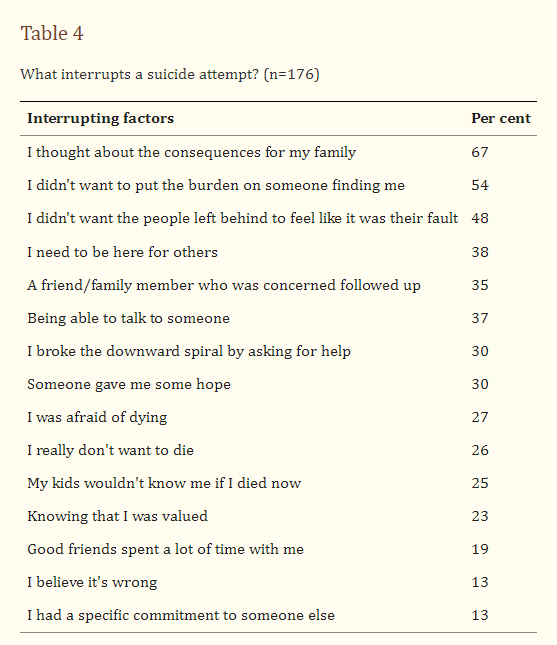
Table 4 From the Study

Men were also asked about additional elements necessary to intervene in a suicide attempt. Most men, (86%), expressed the need for support from someone they genuinely trust and respect. The nature of support was deemed crucial, with men specifying a preference not to be reassured that everything will be fine. Instead, they desired someone who would attentively listen without judgment and acknowledge the truth.

76% said that they needed to know that others could hear the truth and not judge them.

And 75% wished for others to observe noticeable changes in them.

What are some of those changes that depressed or suicidal men would like their family or friends to notice and ask about?

The behaviours that men commonly said others might have noticed when they were feeling down or suicidal were centred on emotional or social withdrawal: changes in sleep, shutting themselves away, loss of interest in everything and poor self-care.

The next most commonly endorsed group of behaviours was signs of emotional disturbance: being flustered or easily upset and irritable.

With a about 6 Australian men committing suicide each day, I hope that these findings can help to guide us toward better supporting these men through their struggles, potentially offering a lifeline and contributing to saving lives.

If you're feeling suicidal in Australia, you can call Lifeline on 131114.

More information about this research is available at:

Depression
Suicide
Men
Mental Health
Science
Recommended from ReadMedium