avatar‘Tine Zekis

Free AI web copilot to create summaries, insights and extended knowledge, download it at here

1971

Abstract

eper. Of course, he had. She asked whether he thought that was because of his Black half or his White half. Obviously, it was because he’s Black.</p><figure id="d1b2"><img src="https://cdn-images-1.readmedium.com/v2/resize:fit:800/0*gFtAWmDIA3kbFuxY"><figcaption>Photo provided by the author. Another family photo; this time I’m on the right.</figcaption></figure><p id="b940">My mom explained to us that there’s no “other” scholarship. And if we were going to face the challenges of being perceived as Black in American society, then we should also be able to embrace any of the advantages.</p><p id="c67c">From then on, I was Black. Years later, I would attend a very expensive college on a full-tuition scholarship for Black students.</p><p id="0da2">When I was 14 years old, I visited my extended family in Nigeria. I told my cousins a story that involved some racist nonsense. They stared at me with complete and utter confusion in their eyes, before one of them said, “But…you’re White.”</p><figure id="ee03"><img src="https://cdn-images-1.readmedium.com/v2/resize:fit:800/0*vgbsa_hCjFqFrNfR"><figcaption>Photo by <a href="https://unsplash.com/@urbanlens20?utm_source=medium&amp;utm_medium=referral">Hala Al-Asadi</a> on <a href="https://unsplash.com?utm_source=medium&amp;utm_medium=referral">Unsplash</a></figcaption></figure><p id="ef6d">It had never occurred to me that I would be White in Nigeria. But of course, I was. Having one Black parent made me Black in the US. And having one White parent made me White in Nigeria. Whatever the majority was, I was something else.</p><p id="fb63">So, perhaps I really was Gray. If you hold a gray item up in front of a white background, it will look dark. If you hold that same item in front of a black background, it will look light.</p><figure id="4c05"><img src="https://cdn-images-1.readmedium.com/v2/resize:fit:800/0*cqFF8DBRaKWFUBHD"><figcaption>Photo by <a href="https://unsplash.com/@bp_miller?utm_source=medium&

Options

amp;utm_medium=referral">BP Miller</a> on <a href="https://unsplash.com?utm_source=medium&amp;utm_medium=referral">Unsplash</a></figcaption></figure><p id="07fe">As an adult, I’m much more comfortable with my Blackness, not as defined by those around me, but as felt within me. I am a proud, Black woman. Though, at some point, I may need to write something up about my incredibly fair children and my concerns about how they will be perceived.</p><p id="8be6"><i>If you’d like to support my writing by becoming a Medium member, you can click on my referral link:</i></p><div id="8cb9" class="link-block"> <a href="https://tinezekis.medium.com/membership"> <div> <div> <h2>Join Medium with my referral link - 'Tine Zekis</h2> <div><h3>As a Medium member, a portion of your membership fee goes to writers you read, and you get full access to every story…</h3></div> <div><p>tinezekis.medium.com</p></div> </div> <div> <div style="background-image: url(https://miro.readmedium.com/v2/resize:fit:320/0*a6tmUih2Y1t_cKih)"></div> </div> </div> </a> </div><p id="55c9"><i>For more of my writing on race, check out <a href="https://zora.medium.com/the-experience-tax-f6be4844b6a5">The Experience Tax</a>.</i></p><div id="6583" class="link-block"> <a href="https://zora.medium.com/the-experience-tax-f6be4844b6a5"> <div> <div> <h2>The Experience Tax</h2> <div><h3>The extra toll Black women in tech pay in “years of experience”</h3></div> <div><p>zora.medium.com</p></div> </div> <div> <div style="background-image: url(https://miro.readmedium.com/v2/resize:fit:320/0*cYQxIu6SIVYMdJLa)"></div> </div> </div> </a> </div></article></body>

“I Think I’m Gray”

My racial identity development as a biracial child

I was inspired to write this piece as a response to Mica Mckenzie’s The Day I Found Out I Was Black. The concept may seem strange to some, but I can relate completely. I vividly remember the first time I ever considered what my own race is.
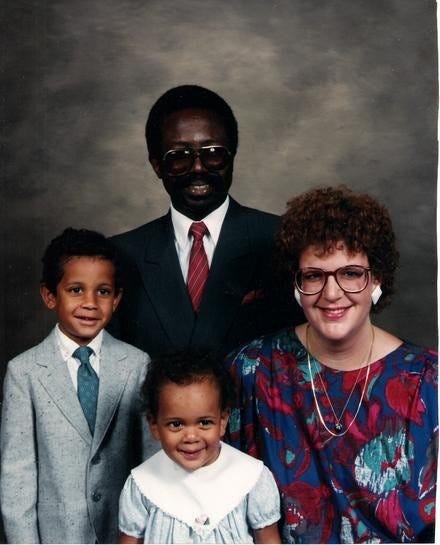
Photo provided by the author. I’m the little one in the front.

I was 8 years old, walking with a classmate in an otherwise empty stairwell at school. My classmate asked me: “Are you Black or White?” It had never occurred to me to ask this question of myself. So I had to ponder it for a moment, and then said, “I think I’m gray.”

It made sense. I had learned in art class that gray is what you get when you mix black and white together.

Photo by Carlos Quintero on Unsplash

But it wasn’t long before I learned that you don’t get to be Gray in this society. Every White person I met identified me as Black. It was other Black kids who would always ask, “Are you mixed?”

On official forms, I used to check “other” as my race. Then one day, my White mom sat my brother and me down to discuss this. We had worried that by checking “Black”, we would be denying her as a part of us.

She asked my brother if he had ever been followed around in a store by a suspicious shopkeeper. Of course, he had. She asked whether he thought that was because of his Black half or his White half. Obviously, it was because he’s Black.
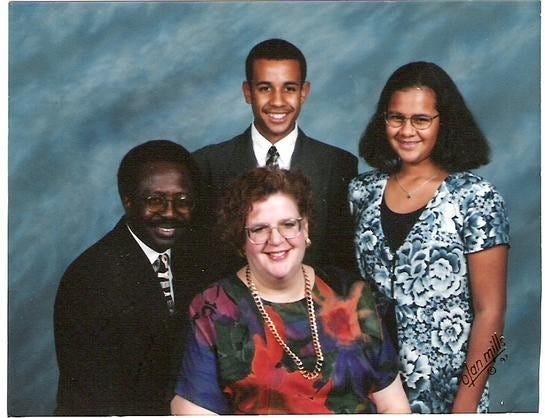
Photo provided by the author. Another family photo; this time I’m on the right.

My mom explained to us that there’s no “other” scholarship. And if we were going to face the challenges of being perceived as Black in American society, then we should also be able to embrace any of the advantages.

From then on, I was Black. Years later, I would attend a very expensive college on a full-tuition scholarship for Black students.

When I was 14 years old, I visited my extended family in Nigeria. I told my cousins a story that involved some racist nonsense. They stared at me with complete and utter confusion in their eyes, before one of them said, “But…you’re White.”

Photo by Hala Al-Asadi on Unsplash

It had never occurred to me that I would be White in Nigeria. But of course, I was. Having one Black parent made me Black in the US. And having one White parent made me White in Nigeria. Whatever the majority was, I was something else.

So, perhaps I really was Gray. If you hold a gray item up in front of a white background, it will look dark. If you hold that same item in front of a black background, it will look light.

Photo by BP Miller on Unsplash

As an adult, I’m much more comfortable with my Blackness, not as defined by those around me, but as felt within me. I am a proud, Black woman. Though, at some point, I may need to write something up about my incredibly fair children and my concerns about how they will be perceived.

If you’d like to support my writing by becoming a Medium member, you can click on my referral link:

For more of my writing on race, check out The Experience Tax.

Diversity
Black Women
Racial Identity
Biracial Identities
Self
Recommended from ReadMedium