
I Had to Teach an Ethics Class 9/12/2001
How do we understand why people would commit such atrocities?
The morning of 9/11, I slept in, having no classes to teach that Tuesday. I made coffee and a bagel, and I turned on the computer to see the headline “Attacks on Twin Towers and Pentagon Building.” The rest of the day was a blur, except the memories of watching the towers collapse and thinking that I was scheduled to teach an ethics class the next morning. The community college at which I was teaching philosophy part-time decided it would go forward with all classes the next day.
As I drove in for my 9 am class, it was surreal how life in the American Midwest seemed so normal the day after the terrorist attacks. The roads were still full of commuters. I wondered if any of my students would show up. I still wondered what to say to them. There was no question of carrying on with the scheduled subject for that day. What was my responsibility to them as a teacher, especially as an ethics teacher? What did they need to hear to cope with and learn from the vile attacks? I had been appalled, but not surprised, at how much vile bigotry had been spewed on the Internet after the attacks. Social media as we now know it didn’t exist in 2001, but that didn’t deter the online shouts of “kill all the towelheads” and other such hatred. How best to address both sides of this exchange of hatred with my students?
When I walked into my classroom, I was surprised to see every single student was present, even those who weren’t that diligent about attendance. Everyone was sad and silent. Some were crying or clearly had been crying. The young woman who I had thought of often since the attack was in her normal seat in the third row. From Indonesia, she wore a head scarf. Had she been abused by people when she walked into school that morning, as I had heard was happening across the country to others of her faith? Like everyone else, she sat silent, staring at the tabletop in front of her.
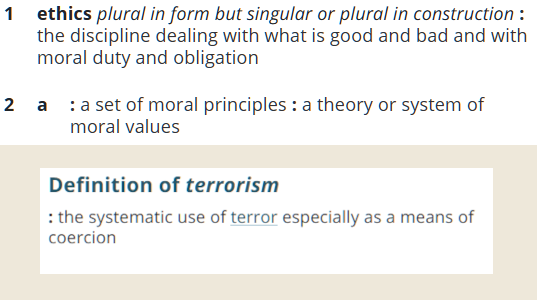
I don’t remember exactly what I said to break the silence, but I needed foremost to put out there the philosophical question of how we are to think about 9/11 and similar acts of violence and hate. It had hit me at some point earlier to frame it this way—that we had talked the first few weeks of the ethics course about the need to define what is ethically good versus ethically wrong. We had talked about Plato’s idea that no one knowingly does what is ethically wrong. I asked my students to consider the very difficult idea that though there was no doubt that they had committed morally indefensible acts, the 9/11 terrorists did what they did thinking not only that their acts of mass murder were not ethically wrong but that they were even ethically good.
Hearing that, some students looked up at me for the first time. They were initially shocked, but they quickly opened up to realization. The class conversation, which in previous sessions had been lively, gradually moved to how some people could rationalize discarding basic human ethics to permit themselves to commit atrocities like terrorist attacks.
I don’t remember many specifics of exactly who said what, but I remember vividly how heartfelt all of the discussion was, how willing the students were to talk out their hurt, confusion, and anger to try to understand. Yes, vile acts are committed because malevolent people think those acts are not only acceptable, but even commendable. How much death and destruction is justified in this way? The difficult question is how to deal with that unfortunate reality. No one in class expressed sympathy for the terrorist mass murderers because none was deserved. But only through understanding could they and anyone move forward.
What each of those young people remember of that class session, I do not know, but the lessons I learned from that conversation so early in my teaching career have stayed with me. There is the need to understand that ethics is not a straightforward discipline of “this is right and that is wrong” and all is said and done. There is the need to confront the reality that some people justify as being good acts what most people would condemn as evil. That reality isn’t limited to terrorist attacks but extends to many everyday human actions. People spend time and energy finding ways to rationalize committing unethical acts.
Ethics, like reality, is complex. It is when people cast the world as a simplistic division of good versus evil that so many malicious acts become acceptable. I am now a full-time philosophy professor, and the understanding that coalesced for me in that 9/12/2001 conversation remains at the heart of my research and teaching.