
DISASTER IN THE NINTH WARD
‘I Survived Hurricane Katrina, 2005’
A preteen boy fights to stay alive after the New Orleans levees break in a new graphic novel
Not far from where I live stands a quarter-mile-long concrete pier that was torn up by Hurricane Katrina and rebuilt afterward. I walk its length nearly every week and have tried to imagine the power of winds and water that could do such damage.
But I’ve never been quite able to picture it, even though I’ve lived through two other hurricanes with wind speeds of more than 100 miles per hour and storm surges that — here on the Gulf Coast — cause caskets to float up from their graves.
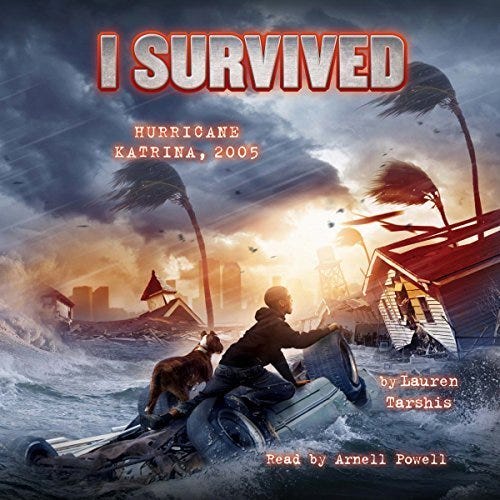
Imagine how much harder it might be for preteens whose visions of disaster come from movies with a superhero standing by to save everyone. They’ll find help in the graphic novel I Survived Hurricane Katrina, 2005 (Scholastic, 2023), adapted by Georgia Ball from Lauren Tarshis’ 2011 novel with the same title, with new art by Alvin Epps and colors by Chi Ngo.
This page-turner lacks the depth and complexity of the best-known books for adults about Katrina, such as Jesmyn Ward’s National Book Award-winning Salvage the Bones and Sheri Fink’s nonfiction chronicle, Five Days at Memorial, which became an Apple+ TV miniseries.
But the creators of I Survived Hurricane Katrina, 2005 aren’t trying to match those standard-bearers on the subject. They aim to show 8-to-12-year-olds what it was like to live through a Category 5 hurricane that was one of the most devastating storms in U.S. history.
Without frightening children needlessly, Ball and Epps tell the swiftly moving story of a creative and thoughtful boy who lives in the Lower Ninth Ward of New Orleans, a part of the city hit brutally by the disaster.
Superhero-loving Barry Tucker and his parents try to heed an evacuation order as Katrina nears. But when his younger sister, Cleo, gets sick, they must turn back and — with the Superdome jammed with 10,000 evacuees — ride out the storm at home.
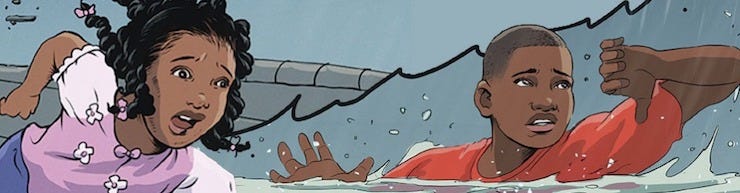
Nonstop action follows as the New Orleans levees break and floodwater rushes into the Lower Ninth. The power goes out and the Tuckers huddle in their attic before moving up to the roof. Then the storm sweeps Barry away and, on his own, he must save himself and Cruz, a neighbor’s dog he kindly rescues.
To survive, Barry must swim hard, avoid a water moccasin, dodge floating debris like logs and broken glass, and climb to safety on another roof, all while tamping down the urge to panic. He comforts himself, in part, by singing “Blueberry Hill,” a song he knows by Fats Domino, the most famous resident of the Lower Ninth, before his eventual rescue.
Vibrantly colored, multi-panel pages tell this turbocharged story from the perspectives of Barry and others, including his younger sister. Cleo sobs when she doesn’t see her dollhouse after her father moves it to a safer spot as the storm looms.
“My princess house! That lady in the sky took it! … Katrina!” she wails.
Barry soothes his sister by explaining that “Katrina isn’t a lady, just a bunch of clouds. We’re not afraid of clouds, are we?”
A theme emerges early as Barry’s father tells the family, “As long as we are together…we will get through this.” By the end of the story, another message is implicit: Strong families are together in spirit even when a disaster separates them.
A section at the end of the book explains why the catastrophe befell New Orleans and what the city has done to avoid another, including details that may reassure children worried that they could be swept away like Barry. The back matter notes that the city has strengthened levees, gates, and pumps for protection from tropical storms.
“In August 2021, that system was tested when Hurricane Ida struck,” it says. “The new levees and pumps did their job. While some areas outside the city flooded, there was no serious water damage inside the protected area.”
Something similar happened in my town after Katrina. Heavy damage occurred throughout the region when Hurricane Sally struck in 2020 with wind speeds of up to 105 miles per hour. But our town pier — which had been fortified after Katrina — remained intact.
I Survived Hurricane Katrina, 2005 is part of a historical fiction series that includes I Survived the Destruction of Pompeii, AD 79, I Survived the Sinking of the Titanic, 1912, and I Survived the California Wildfires, 2018.
© 2023 Janice Harayda. All rights reserved.
@JaniceHarayda is an award-winning critic and journalist who lived through hurricanes Sandy in New Jersey and Sally and Zeta on the Gulf Coast. She has been the book editor of Ohio’s largest newspaper and a vice president of the National Book Critics Circle.
You might like my story about my experience of hurricanes Sally and Zeta:


