
I Surveyed the Top Medium Writers in May — Here’s What Qualifies You for the Bonus
The results help provide some direction to Medium writers on what to focus on to qualify as a bonus-earning writer.
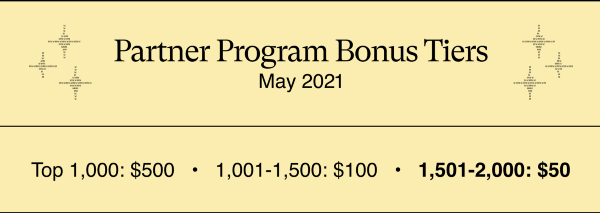
***Updated June 30, 2021*** Medium has officially sent an email saying that the bonus is determined on MPP earnings. The top writers, ranked by earnings, are awarded the appropriate bonuses and could change, based on how much this group earns collectively. The survey results below are directional and speculative.***
Medium Partner Bonus Program
Medium recently awarded its top writers in the form of cash bonuses for the past two months. After their second bonus handout, Medium sent an email to their writers, attempting to clarify the confusion around the program.
The email clarified only two things — How many Medium writers were receiving a bonus and what were the cutoffs for each award bracket, split between $500, $100, and $50 bonuses. The top 1000 writers earned a $500 bonus while the next top 500 writers earned a $100 bonus and the top 1500–2000 writers earned a $50 bonus. It didn’t clarify much after that, only encouraging the lucky writers to continue doing what they do best.
The advice wasn’t that helpful to me. Isn’t it kind of obvious that we should strive for engagement as a writer on Medium?
Many Medium writers in Facebook groups and Twitter discussed how to replicate the success, once they assumed it was a recurring event. A couple of huge-following Medium writers even had conversations with Medium staff about the program. Casey Botticello wrote an article about the Bonus Program, stating that he reached out to a Medium employee for clarification. Casey says the response from the staffer was “ it is not clear whether this bonus will become a regular thing. As to what metric they are using for “top writers” they said it was “based on the partner program earnings.” Sinem Günel said in her Medium Writing Academy Facebook group that the bonus was dependent on Medium Partner Program earnings after a conversation with a Medium employee as well.
In my everyday job, I extrapolate insights from data for the benefit of understanding and confirming or rejecting strategies, theories, and plans. Naturally, I wanted to understand and confirm what were the key metrics in helping push writers to be considered top writers, eligible for a bonus. In my opinion, the best and easiest way to do this is to ask the writers themselves.
I created a short, anonymous survey and wrote a call-to-action article to ask a few questions from the Medium writers who earned a bonus. I opened the survey to all, encouraging those who also didn’t earn a bonus to participate as well. I wanted to see if the results of the survey would produce any meaningful insights and relationships between certain Medium metrics and what it takes to qualify for a bonus.
I must warn you that this survey was just a fun and quick exercise I was conducting out of pure curiosity. The way in which I conducted this survey is not how you would properly conduct a methodological study in the research world. Therefore, it is a flawed study and isn’t the end-all-be-all of Medium truth. I want to establish that understanding with the readers before immediately diving into the survey results.
Here are the flaws with the survey
Not a good representative sample
This was a volunteer-based survey. The survey over-indexes with my followers or writer network since I shared this story on my social media feeds. A properly done survey would have chosen, at random, from the entire Medium community, both bonus earners and non-bonus earners.
Not enough
Additionally, only 84 responses were collected so it’s not a true representation of the writers on Medium. A properly done survey would need at least 200–300 respondents to reduce the margin of error. But, I was still very happy and pleased with the writers who helped and filled out the survey, which surpassed my expectations. Thank you, everyone!
Only asked for results from May stories
To increase the number of responses and make the survey as easy as possible, I simplified the questions. I requested only stats and information from the respondents’ stories for the month of May and no other month. In actuality, a Medium writer’s monthly performance includes past articles as well. Many writers are capable of generating many views from stories they published recently or long ago. Because of that, the survey results do not factor that in and may skew some of the true answers.
Data is Data
Despite the survey’s flaws, some of the information provides more clarity and direction for what will likely help Medium writers earn a bonus. Since Medium was being vague about the parameters, I figured some information was better than none.
Without further ado, here is the survey and the survey results.
The Survey
- Did you earn a Medium Partner bonus for the month of May 2021?
- How much was the Medium bonus for May 2021?
- How many stories did you publish in May 2021?
- How many stories did you publish in May that were chosen for further distribution?
- How many of your stories were self-published in May 2021?
- In total, how many views did your stories receive in May 2021?
- In total, how many reads did your stories receive in May 2021?
- What is the average read ratio for your stories in May 2021?
- What were your total earnings for the month of May 2021 (excluding the bonus)?
Questions I wish I asked in hindsight (not included)
- How many followers do you have?
- In total, how many fans did your stories receive in May 2021?
Total Responses: 84
Survey Conducted: 6/4 — 6/15/2021
Questions: 9
Distribution: Volunteer-basis. Published in Feedium. Shared via my social networks such as Facebook and Twitter.
Did you earn a Medium Bonus?
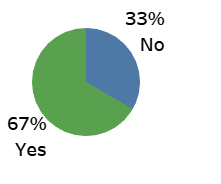
The survey was open to everyone, including the writers who either earned a bonus or didn’t earn a bonus last month.
33% of the survey respondents didn’t earn a bonus in May whereas the majority of the respondents did.
How much did you earn?
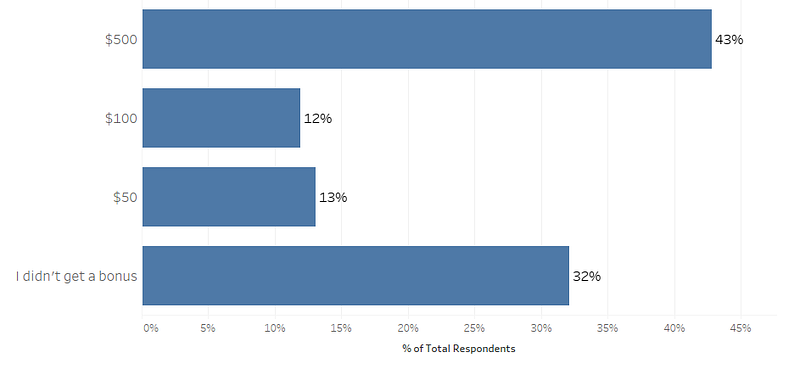
43% of the respondents earned the $500 bonus. I will be calling this group the “Top 1000” for the rest of the article. Understanding the stats behind this group will help us see what separates this group from the rest.
12% of respondents made $100 from the bonus and another 13% made $50, totaling 25% of respondents. Lastly, 32% of respondents didn’t earn a bonus. Since there weren’t enough respondents for each of these groups to help equalize the comparisons, it was more prudent for me to combine these 3 groups into one. For simplicity's sake, I will be calling these groups the “Core” group for the rest of the article.
Groups
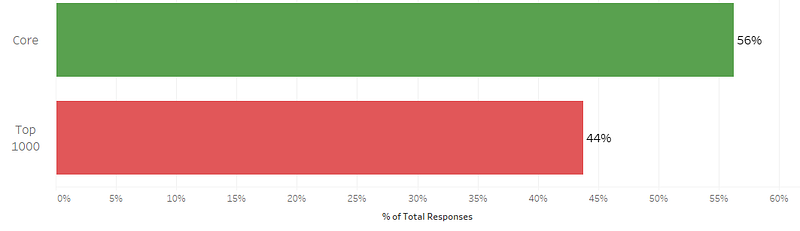
The Core group makes up 56% of the survey and the Top 1000 represent 44%. Seeing the results this way together will give us a good view of the gaps between the two groups. This will allow us to more distinctly tell what key metrics are correlated with being a top-of-the-pack Medium writer.
Just wanted to make it clear that by no means should you look down upon your writing abilities if your stats mirror the Core group or if you were a respondent in the Core group. (Full disclosure: I am a respondent of my own survey and would be in the Core group.)
Ultimately, it’s not what the money that counts. While it’s nice to make money off Medium, it’s your love for writing that explains why you’re writing on the platform — whether you’re a core writer or a top 1000 writer. If you’re not where you want to be with your writing stats, don’t let that deter you from writing. Instead, use this information as an opportunity to learn what patterns are indicative of a Top 1000 writer. Then once you do, adapt and improve upon your methods, and you might become a Top 1000 writer yourself for the first time (or again!)
How many stories did you publish?
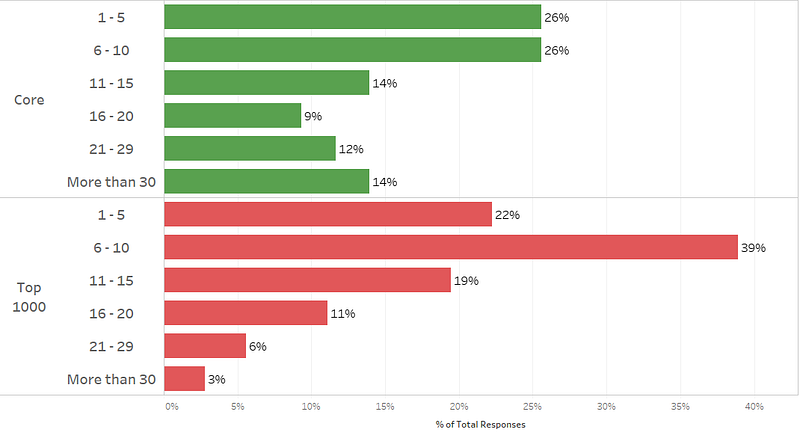
When I look at this chart, it’s telling me that writing and publishing more stories doesn’t necessarily mean it’s better. More is not better.
61% of the Top 1000 writers published no more than 10 stories in May while 52% of the Core Group did the same. However, 26% of Core writer respondents published more than 21 stories while only 9% of the Top 1000 did the same.
Insight
A Core writer is more likely to write more stories than a Top 1000 writer. However, publishing more stories than average doesn’t mean you’re more likely to earn a bonus. Focus on quality — not quantity.
How many stories were chosen for further distribution?
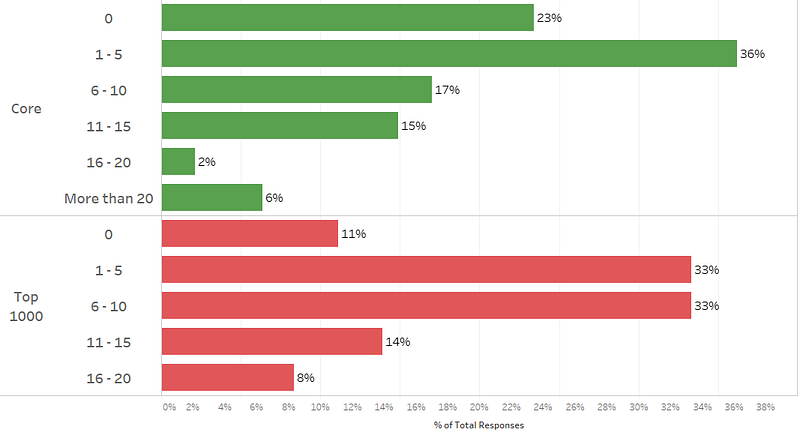
On average, the Top 1000 writers have more stories distributed than the Core Group.
Further Distribution Ratio
Further Distributed Stories / Total Stories Published = Further Distribution Ratio %
Core : 285 / 605 = 47%
Top 1000 : 250 / 384 = 65%
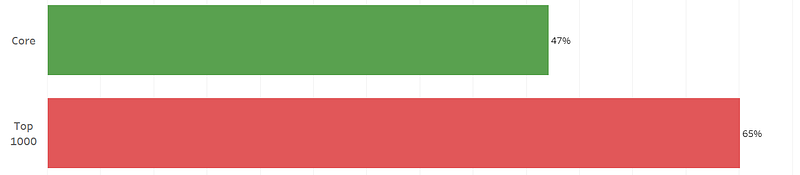
When comparing the further distribution ratio of stories published, the Top 1000 group has a higher chance of having their work chosen for further distribution. 65% of the Top 1000 group’s stories were distributed whereas the Core group had 47% of their stories distributed.
Insight
This data reinforces the fact the importance of focusing on quality when writing as opposed to pumping out as many stories as possible.
How many stories were self-published?
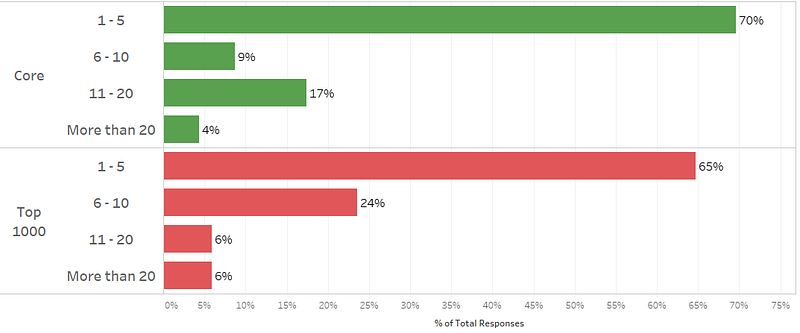
Self-Published Ratio
Self-Published Stories / Total Stories Published = Self-Published Ratio %
Core : 127 / 605 = 21%
Top 1000 : 88 / 384 = 23%
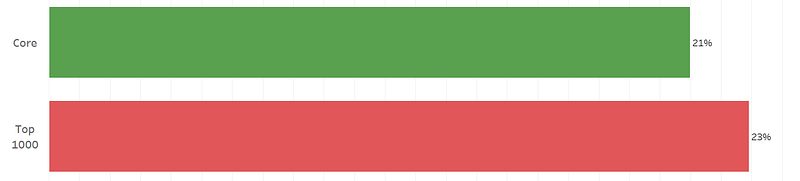
The answers to the question about self-publishing didn’t really produce any discernable insights other than the majority of writers publish their stories in a publication as opposed to self-publishing.
Insights
Self-publishing has minimal impact on your chances of being a top writer or not.
In total, how many views did your stories receive?
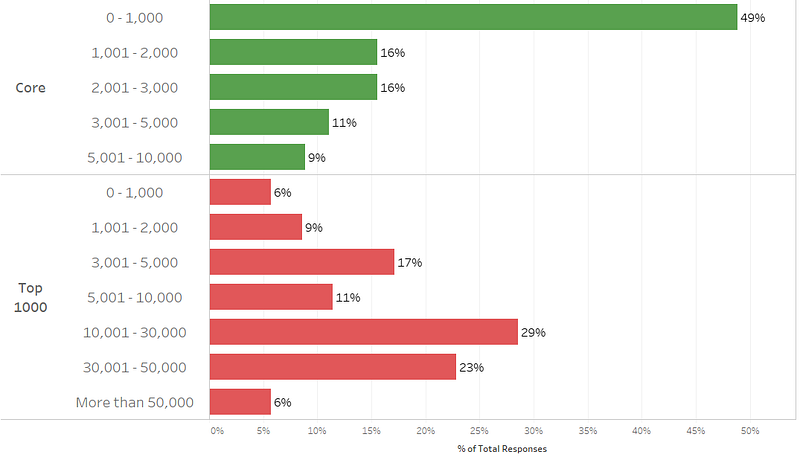
The biggest distinction between the two groups when it comes to total views in a month is the fact that nearly half of the Core writers have less than 1,000 views for the month of May while 58% of Top 1000 respondents have more than 10,000 views for the same time period.
Insight
The more views, the better your chances at being a top writer to earn a bonus. However, what this graph doesn’t show is the impact of external views vs internal views.
In total, how many reads did your stories receive?
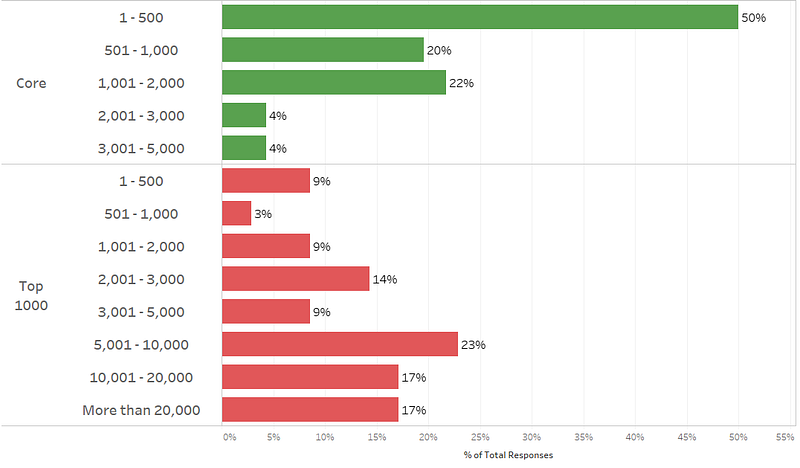
When it comes to total reads, it’s very evident that the more reads you have, the better the likelihood that you’d qualify for the $500 bonus.
92% of Core writers had up to 2,000 reads for the stories they published in May, making up the vast majority of the group, including the earners of $50 and $100 bonuses. On the flip side, more than half of the Top 1000 respondents have reads that number at least 5,000 for the month. 80% of the same group had more than 2,000 reads.
Insight
The goal for Medium writers wanting the top-tier bonus is to go for as many reads as possible. The ideal number is more than 2,000 reads in total for all stories you publish in a given month.
What was your average read ratio?
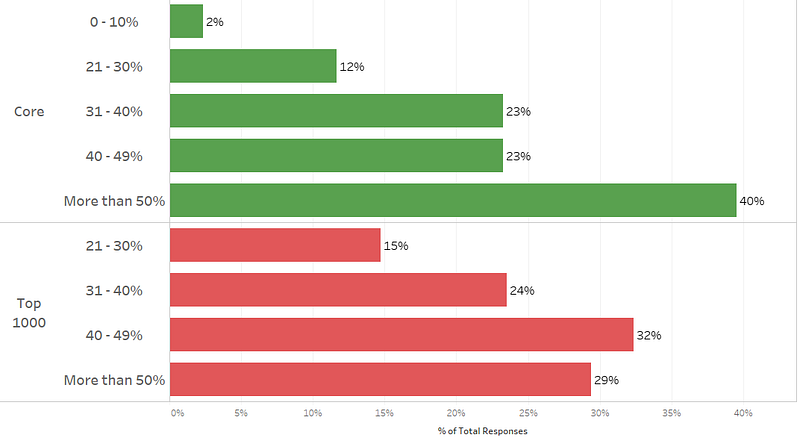
When you look at this chart, the Core group has a higher average read ratio than the Top 1000 group.
On average, it seems the ideal spot for Top 1000 writers is between 40–49% whereas more than 40% of Core group writers had a total average read ratio of more than 50%.
While a higher read ratio may sound like a good thing, it’s actually a deceiving metric. A high read ratio on a short story won’t produce the same member read time or MPP earnings as a shorter read ratio on a longer story.
For example, a 60% read ratio on a 2-minute story would result in a 1 minute and 12-second member read time whereas a 30% read ratio on a 7-minute story would end up being more than 2 minutes in member reading time. Which one would you prefer?
It’s very likely that the Core group writers have shorter stories on average compared to the Top 1000 writers, which is contributing to the large share of Core writers having a high read ratio.
Insight
A higher average read ratio doesn’t necessarily equate to a higher chance of earning a bonus. In fact, it is likely that a higher read ratio means shorter stories, in terms of reading times.
To get a better chance at being a top writer, aim to write longer stories — at least 5 minutes.
What were your earnings in May? (Excluding bonus)
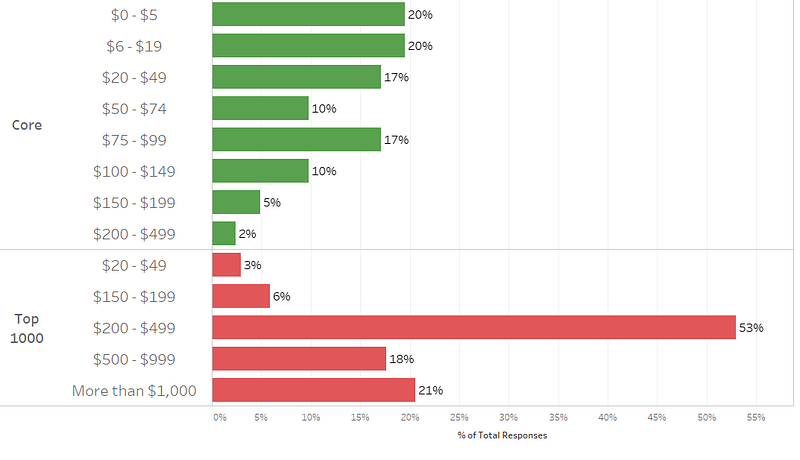
And lastly, the question that inquires about Medium writer earnings. As I stated earlier, several Medium employees had mentioned in conversations with Sinem Günel and Casey Botticello that the Medium Partner Bonus Program is dependent on Medium Partner Program earnings. The results to this question help validate these comments, if not confirm.
This graph points out an obvious gap between the two groups — the higher you earn for the month on your stories, the more likely you are to earn a bonus.
It seems that the sweet spot to have a chance at a $500 bonus is earning more than $200 in one month. However, there are anomalies as a few writers in the Core group claimed they earned more than $200 for the month of May, yet didn’t earn the $500 bonus.
Additionally, 9% of Top 1000 writers earned less than $200 yet still qualified for the top bonus. This probably means that these specific respondents probably had a bunch of high-performing longtail articles. Since I only asked what were the total earnings for the stories they published in May, it’s likely that these past articles would have contributed to higher earnings for the month of May.
Sigh. Why are you so confusing sometimes, Medium?
Insight
It is strongly suggested that you aim for $200 a month in Medium earnings to get a shot at the $500 bonus.
However, the goal might change on a month-to-month basis since what Medium writers can earn as a collective group can differ, making the cut-offs different every month. For example, if each of the top 1000 Medium writers collectively earns more than $300 next month, then that would the baseline for that specific month. However, I don’t think it would swing that far from $200 in the near future.
Directional
I want to make it clear that none of these results are truly conclusive. Instead, the results are more directional. All we can do with the information that we have is make assumptions — even if the data is limited or incomplete.
Based on the results of the survey, if you’re setting a goal to earn the grand prize of $500 on a monthly basis, it is very probable that the MPP earnings is the main driver for eligibility for the bonus, just as the Medium employees said to Sinem Günel and Casey Botticello.
The other metrics that are correlated positively with earning a bonus can help influence your MPP earnings. It's possible that you have to achieve all of these goals, some of them, or just one. It’s also possible that you don’t have to achieve any of these goals because you have other reasons to write on Medium besides money — that’s totally cool too!
Here are the main patterns identified when you look at what separates the Top 1000 writers from everyone else:
- Try to make more than $200 a month (excluding the bonus). In order to achieve this, writers should prioritize member reads.
- Aim for 5,000 reads a month on your published stories.
- Aim to write longer stories — at least 5 minutes each to maximize member read time (not just your read ratio).
- Having stories chosen for distribution doesn’t automatically mean higher MPP earnings. Top 1000 writers have a higher chance of further distribution, but it’s likely due to a higher likelihood of consistent quality writing.
- Don’t publish as many stories as possible — focus on quality instead. Spend more time on each story, perfecting it from editing to storytelling.
- The debate between self-publishing vs publishing in publications is irrelevant, based on the findings. Neither have an impact on the potential to earn a bonus. However, you should only self-publish if you have a huge following. Otherwise, you should submit stories to publications to help build your following.
Please remember that there were instances where respondents answered certain questions and were the exceptions or anomalies. For example, some writers earned more than $200 in May, yet reported they didn’t get the $500 bonus. Another example is when writers reported receiving the $500 bonus despite publishing only a few stories. This is an example of the flaws in my survey.
Edit: Medium has sent an update via email on 6/23/2021, clarifying that to qualify for the bonus, you must be fully enrolled in the MPP, publish at least two stories in the calendar month. Furthermore, the rankings are based on monthly Partner Program earnings, which is a reflection of member reading time.
Thanks
Thanks to all who participated by taking the survey! I promised all that I would let y’all know when this was done.
Additionally, sending a HUGE shoutout to all my fellow Medium writers who discussed the topic and/or spread the word about the survey on social media (or were just randomly tagged by someone in the crossfire of shares). And lastly, those who didn’t know about this survey at all and are just along for the ride. Y’all the real MVPs.
Shannon Hilson Jehan Senai Worthy Laurie Perez Ester Deluna Kayla Vokolek Dr. Fatima Imam Sarah Paris Eva Rotolo Tegan Types Blank Voice Sam Dixon Brown M.A. Mercier Emily Wilcox Niru Synthia Stark Galit Birk, PhD Victoria Kurichenko Katlyn Gallo Kristina Jancar Aimée Gramblin Rochelle Silva Kevin Alexander Aldric Chen Jax Hudur Hogan Torah Sh*t Happens - Lost Girl Travel Fatim Hemraj Kevin Lee David Majister Alyssa Chua Eric Pierce J.J. Pryor Reuben Salsa Joe Duncan JL Matthews Stephen Moore Carolyn Riker Lucy Dan 蛋小姐 (she/her/她) Kelly Eden Alex Cooper Jenny Mundy-Castle, M.S.T, Ed.Spec, ENL, Ed.Lead Aamir Kamal 🚀🚀🚀 Sinem Günel Christie Adams - Writer Jessica A Tom Handy Pach Deng Charlie Brown Ashley Nicole Shain Slepian Shruti 🦋 Trista Signe Ainsworth Ben Su Kate Cohen Tom Fenske Brandy Niremburk U-Ming Lee Amardeep Parmar Zano Tyrannis Violet Daniels Akarsh Nalawade Teresa Sochacka Renton Obinna Alexander Kathy Gerstorff Nickson Joram Shafaque Fatima Andrew Lalchan Kara Barrett Gina Pacelli Eva Grape Martin Andersson Aaberge Jelly Young Coach Tony


