
I stumbled upon this manual while looking for a good book on Military History. The booklet was declassified.
The booklet was created by the CIA to create the possibility for captured soldiers to hit the enemy. This idea of sabotage was implemented quite a bit by the French Allies during Nazi Germany Occupation.
The field manual has been declassified & some of their principles have seen the light of day in a strange way.
Most of its principles have been outdated. Most of us will never (I hope) need to know how to sabotage an electric motor’s functioning capacity (unless you really want to get back at your annoying Tesla-driving next-door neighbor. In that case :
( 1) Set the rheostat to a high point of
resistance in all types of electric motors. They
will overheat and catch fire.
In all seriousness, (plzz don’t burn your neighbors blue Tesla) the last section on the field manual, about sabotaging day-to-day business operation is pretty accurate — and evergreen.
We are the busiest we’ve ever been to. before the whole Coronavirus pandemic, the world has not seen a busier and more pro-active environment. The economy was booming, many businesses were expanding and taking other industries and looking for ways to grow.
Now, if everyone is trying to be more productive, why do we waste our time in such particular ways?
The most common tactics used to sabotage hostiles during war zone situations are still implemented today in most businesses.
Let me paint you a scenario and you’ll tell me if it sounds familiar:
It is Thursday morning, you’re arriving from work at 7:30. You’ve got a lot of things to finish before you can go to your weekend.
Your manager calls you and your team for an emergency meeting about a product you launched last week. The meeting was supposed to be 60 minutes long and it was to discuss the next products your team could add to the product launched to create an up-sale and increase revenue. Your manager picks the biggest conference room in your office to brief your team (of 4) on the next steps to come up with a new product.
The meeting was supposed to be about the next products but ends up revolving around what was done properly & what was not. The manager goes out of the agenda to talk about other, less important things. a 60-minute meeting ends up being 90 minutes long.
What was the expected outcome: Figure out the next products to increase revenue.
What was the actual outcome: Planning the following meeting later that day or maybe the day after that.
Nothing was clarified.
You have less time to finish your checklist.
I’ve witnessed this phenomenon quite often in my short professional career.
I was curious to see how much time was lost in meetings.
I knew it was bad, but NEVER I would’ve imagined it was going to be THIS intense.
3 fun facts about business meetings.
- The time spent by professionals in meetings has not stopped increasing since 2000. It is estimated that the increase is an exaggerated 10% year-over-year.
- There are approximately 11 million meetings held every day in the United-States alone.
- 9 out of 10 people daydream in meetings.
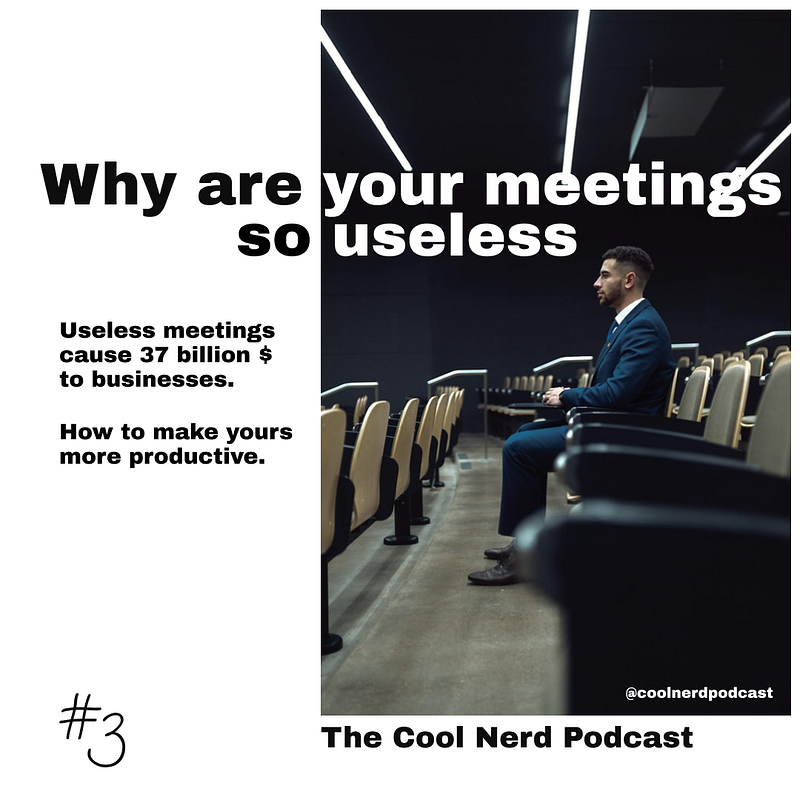
These less-than-productive meetings happening cost around 37 billion dollars to companies.
I’ve been a part of some incredibly useless business meetings and it is not fun. Time wasted and break of workflow should mean something to a company. I’ve taken the liberty to scour the internet to find some tricks to have more productive meetings. Before setting up a meeting, You need to ask yourself these 3 questions.
Is this meeting NECESSARY?
At this point in the blog, you know that your meetings are a waste of time. Nevertheless, briefing your team is important for productivity and team culture. However, make sure that you’re in dire need to meet your team to talk about a specific subject.
Who needs to be there.
Your team might be big or small, it might be a very funneled-down task within a major corporation, or you might be talking to all departments within your firm. Before you send your email, make sure that you’re only sending it to people that need to be there. People that aren’t primordial should be left alone.
How can I keep it interactive?
You don’t want to be the only person in the meeting talking. People remember 5% of a meeting if it’s only a presentation. Instead, make it interactive. Create an agenda of what are the KEY topics for discussion and send it to the list of people you created while reading point 2.
I’m working on a PDF to seek a most productive meeting for all types of businesses. Write a comment below to tell me what do you think is the key element for a successful & productive meeting.
Thanks for reading! If you liked this post, clap to your heart’s content and follow me on Medium. By doing so, it helps me bring more value.
Do leave a response and tell me how I can improve my writing.
Or tell me what to write about next.