I Still Remember the Songs of Thrace
A story about my grandmother
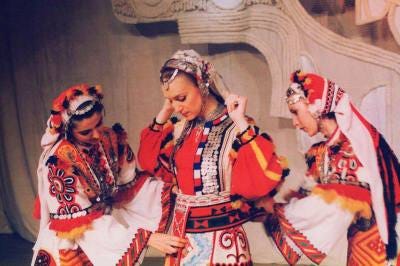
My grandmother is the person who influenced the most my life. She died in 1999, but I still remember what she taught me.
These were the folklore songs. My granny was born in a small village in the Southeastern part of my country, Bulgaria. It is in the geographical region of Northern Thrace. If we talk about folk Thrace music, we may search for its roots even in the mythological figure of Orpheus.
The gaida, a type of bagpipe, is the most characteristic instrument, but clarinets and toumbelekis are also used.
I know that most people relate the bagpipe with Scottland, but it is a traditional folklore instrument in Bulgaria. In fact, there are three types of bagpipes — the biggest is “Kaba gaida” or the traditional Rhodope bagpipe, then comes “Djura gaida” which is the Thrace bagpipe — it has a thin and high voice, and the third type is “Macedonian gaida” which is from the geographical region of Southwestern Bulgaria named Macedonia. The Macedonian bagpipe is a specific combination of the other two.
Let us come back to the Thrace folklore music. My granny knew hundreds of folklore songs. She used to sing when she was working on something. She sang with a soft and low voice.
You may ask why.
It was a sad story. She lost her mother when she was a small child, about five years old. My great-grandmother suffered from pulmonary tuberculosis and died at the age of 33. Those were the years between the two world wars, and the medical care had been quite poor in the village regions of my country.
My granny, Mitka, always said I look very much like her mother with my pale skin, soft brown eyes, and bark blond wavy hair.
After her mother’s death, my granny had a stepmother. She grew her without love and care. Her stepmother did not allow her to sing and after that even kicked her out of the house. My granny’s father had been a paddler and traveled a lot between the villages and towns in the region where they lived. He wasn’t aware what had been happening between his daugther and his new wife.
Then my granny’s aunt took care for her and she lived in her house with her two cousins. My granny told me that she was like a real mother for her.
She turned just for a while in her father’s house for the time he was there.
She had a tough life. She used to sing so low, but the Thrace folklore songs were always with her. She knew by heart hundreds of them. I have a small notebook where I’ve written down some of my favorite songs. She taught me to sing them, and I still remember them. I keep them as a real treasure, what they are.
We all know that such immortal things are the genuine heritage — the heritage of souls and hearts. They determine us as nations. Their uniqueness distinguishes us.
The other reason my granny sang so low was that when she came to live with my grandfather — about 300 kilometers away from her home village, her mother-in-law did not like her, at all. It was 1949, just three years after the end of the Second World War.
My grandfather had to complete his mandatory military service in construction troops first. It was for 2.5 years. His military unit constructed the railway lines in the region of the newly built town of Dimitrovgrad. Dimitrovgrad is a town that was born in 1947. It is a product of the then-established communist regime in Bulgaria.
My granny’s home village is close to the town of Dimitrovgrad. That was how they both met.
So, when the two of them came to my grandfather’s hometown — Nevrokop, to live together, my grandfather’s mother did not like her new daughter-in-law from Thrace.
My granny never told me why the older woman rejected her. She also opposed her weird singing.
So, my granny sang softly and low to her two children. She sang this way when she was doing something. She was a master in knitting and sewing traditional national embroidery, but this is another story.
Soon, I will retell it, too.
Because I want to remember.
Thank you for reading my story.
If you’d like to see more of my stories, you’re welcome: