
I Spent More Money On Online Courses Than On Clothing In 2020
Why my self-improvement budget always comes first
For the majority of people, 2020 was a bad season. Too many plot twists, no clear storyline, and frankly, it was just too long. But like a 2 hours lecture that you can’t avoid, it was the perfect opportunity to catch up on other assignments.
I love learning about anything and everything. To be able to understand how things work and to replicate it yourself is just amazing. But what I like most is learning monetizable skills.
The first set of skills I learned on my own was photo shop. It was the mid-2000s; I was merely a teenager shopping with my parents when I found a photo shop CD. I bought it out of pure curiosity. After a few months of playing with the different tools, I moved over to Illustrator and After Effects. And just like that, I became proficient in the Adobe Suite.
What does this little story have to do with me purchasing lessons online?
Well, digital design was how I first made money freelancing. For the past several years, my degrees had almost nothing to do with my income. A master's degree is definitely an advantage when you are trying to land a client, but the actual work has little to do with it. Throughout the years, I learned to use WordPress, product photography, SEO, digital marketing, and other skills.
Extra Skills Can Be Crucial When You Least Expect It
In 2017, I worked for a well-known ridesharing app that rhymes with Luther. A few weeks after starting working there, a position that required a lot of traveling opened up. I love traveling, but another colleague of mine was also interested. I wasn’t sure to get it because I was shy, socially awkward, and had less experience.
I was on the train with my roommate going for a Friday night out in Paris when I got a phone call. It was my future boss. He was the project’s technical manager in France, a very nice South African guy. The phone call lasted around 3 minutes. All he wanted to know was if I had any prior experience with electronics, if I was comfortable with manual labor, and if I was available to travel the next morning. I told him I was a bit of a nerd who had dabbled in entry-level robotics and some coding and that I could hop on the first train in the morning. And that was it.
The recruiter called me a few minutes later to inform me I was going to the south the next morning. He clearly preferred the other guy, but fluency in English was a requirement. I didn’t know that the phone call was a test, and that what landed me the position was my ability to speak multiple languages.
This is the part where I must show my parents an immense amount of gratitude for all those English lessons. As you may suspect by now, English is, in fact, my third language. If it wasn’t for this particular detail, I would have missed, what I consider, the best professional experience of my young career.
Extra Skills Will Help You With Money Negotiations
Jab, jab, jab, right hook.
— Gary Vaynerchuk
When I first started freelancing, my first customers were people I knew personally, or people's friends recommended me to. But you can only go so long relying on your immediate circle’s demand. Luckily, one of my first customers recommended me to a friend who needed a brochure design. Another dividend from the Photoshop CD investment.
This new client was freelancing for a bigger company. After a couple of phone calls, I knew that I could provide the services they will be needing next. So I decided to use what Gary V calls a jab strategy. I delivered more than what was asked of me, showing a larger skillset, without asking for anything in return. I was only helping a friend. Even when I didn’t have the solution to a particular problem, I took the time to look it up.
This soft marketing strategy works almost every time. Before I had finished the first job, I received a quotation request that included other services. It was the perfect moment for a right hook. The client grew accustomed to having a one-stop-shop for all services, so I negotiated for higher pay. It was a clean knock-out.
The Best Investment You Can Make Is In Yourself
As an independent worker, last year was hard. Once the pandemic hit, business stopped and took with it a share of my income. When you lose a client, you can struggle for months to find another one. As a result, I had to reduce my cash burning rate accordingly.
To cut back on expenses, the shopping and entertainment budgets were the first to go. Even unnecessary subscriptions like Netflix were gone. But reducing the self-development budget was out of the question since I was only purchasing courses during sales. And if there was something that could help through this pandemic, it was learning a new skill.
Courses have the advantage of providing a time reference that a lot of us, adults need. Younger, as a student, September meant the start of a new year, and May meant that summer was around the corner. With each exam, we had short- and long-term goals and a sense of accomplishment after achieving one of them. However, as adults, our only points of reference are tax season and the 1st of January. Without a checking system in place, only the ones with strong self-discipline manage to keep the pace working on themselves.
During quarantine, I focused on learning C# and Unity. Unity engine allows you to create games for multiple platforms using the same code. It was new and challenging, but it can be useful for future projects. And for the results? Well, I was able to make a “flappy bird”-like game in a week. It’s definitely not the next Fortnite, but it is as rewarding.
The Platforms I Use To Learn Online
For the past several years, I have been using two platforms essentially.
The first one is Udemy, which is an open online marketplace for courses, with more than 57,000 instructors and 35 million students. I like to use it the most because of its vast catalog and its social component. You can always ask the instructor or other students whenever you feel stuck.
Another advantage is the constant stream of updates. Instructors need their courses to be up to date to stay relevant. And thanks to the lifetime access, you only need to pay once.
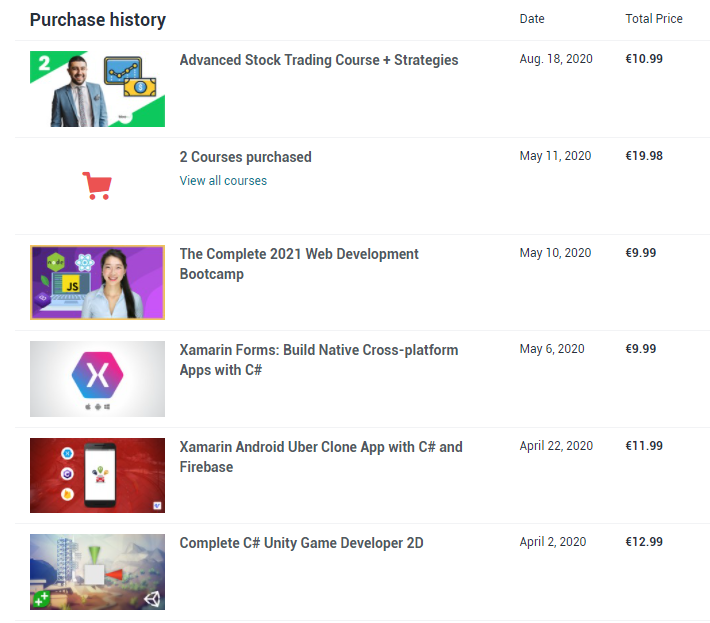
As you can see in the screenshot, my interests vary a lot. I have purchased dozens of courses, but mostly in finance and IT. They typically cost from $50 to $200, but I always get them on sale for around $15. In 2020 alone, I bought 7 courses for $90. Trust me, that’s much more than what I spent on clothing.
The second platform I use is Coursera. It provides courses from prestigious universities like Duke, Columbia, and even Ecole Polytechnique in Paris. Non-specialization programs are generally free. I use it more specifically to further my understanding of different economic theories, my field of study. Boring, I know.
Both platforms provide certification on their paid version. It can be an impressive addition to your resume. It helps convey a feeling of dedication and seriousness to your potential employer. But Coursera is much more recognized by organizations than Udemy in this regard.
In Conclusion
For the past few years, online education has been one of my best investments. But self-improvement isn’t limited to learning online. Whether it is a gym membership, online courses, books, or therapy, if it helps you grow and expand your horizon, it is worth it.
You are your greatest asset, the only one that can’t be seized, traded, or lost.