
I Spent 30 Days Figuring Out Exactly How Tesla Pays $0 For Ads But Stays Ahead
How to build a brand without a CMO, marketing team, or marketing budget.
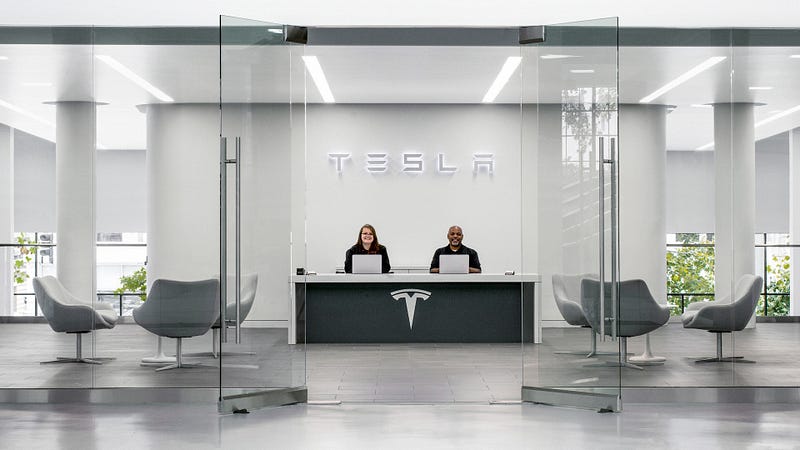
Tesla spends $0 on ads.
- It has no CMO
- It has no ads team
- It has no ad budget
And it has no problem getting love.
Love from Gen Z. Love from Millennials.
Love from Gen X. Love from Boomers.
Basically — love from everyone — except the president.
Tesla is the fastest-growing brand in the world!
As a marketer who advocates marketing that doesn’t feel like marketing, my curiosity drove me crazy. I needed to understand the deep logic behind Elon’s wild $0 ad spend strategy in a world where everyone is spending billions on advertising.
So, I decided to micro-stalk Tesla for 30 days.
Micro-stalking mission objectives:
- Learn how Tesla stays ahead
- Learn where to spend money instead
- Learn how to do marketing without ads
Little did I know it would be the most life-changing 30 days of my marketing career. It opened my eyes to what marketing could be if done right.
Now, let’s break it down.
Make the product the marketing
Create talk trigger products.

Instead of investing in ads, Tesla invests in innovation.
This means instead of trying to chase after customers to buy the same old boring products, Tesla attracts customers by making products so cool even kids at school can’t stop talking about them.
For every vehicle sold, this is what popular brands spend on ads to sell one car:
- Tesla — $0
- GM — $394
- Toyota — $454
- Ford — $468
- Chrysler — $664
Is it just me or do the boring brands seem to pay more on ads?
Now let’s break down how much each brand spends on research and development per car they sell:
- Chrysler — $784
- GM — $878
- Toyota — $1,063
- Ford — $1,186
- Tesla — $2,984
Aha!
There it is.
The coolest brands invest in R&D.
Tesla takes things to a sub-zero level, though.
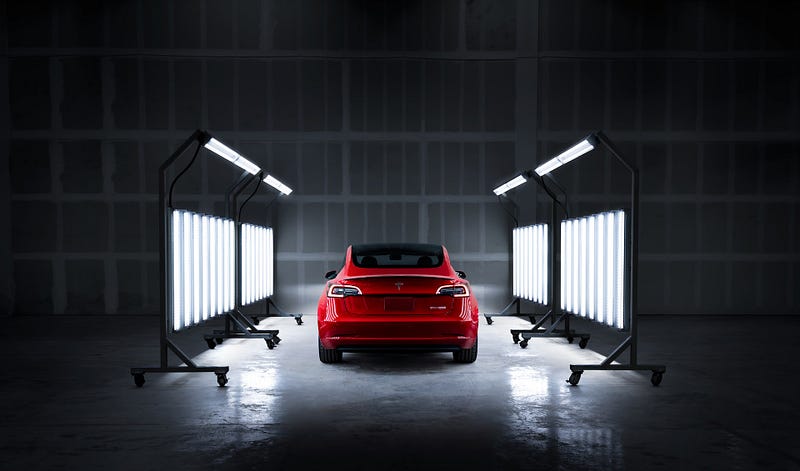
It creates talk trigger products at a fundamental design level.
- When ads sell people trucks; Tesla sells people bulletproof trucks.
- When ads sell people cars; Tesla sells people cars that drive themselves.
- When ads sell people toxic gas cars; Tesla sells people clean electric cars.
I mean, seriously, who doesn’t want a bulletproof truck?
Tesla just goes all-in on R&D so its cars always stay cooler than the ones in the ads, not even to mention the negative stigma that comes with being sold to.
But let’s zoom in on how Tesla manages the spotlight.
Make it easy to talk about you
Remove the friction.
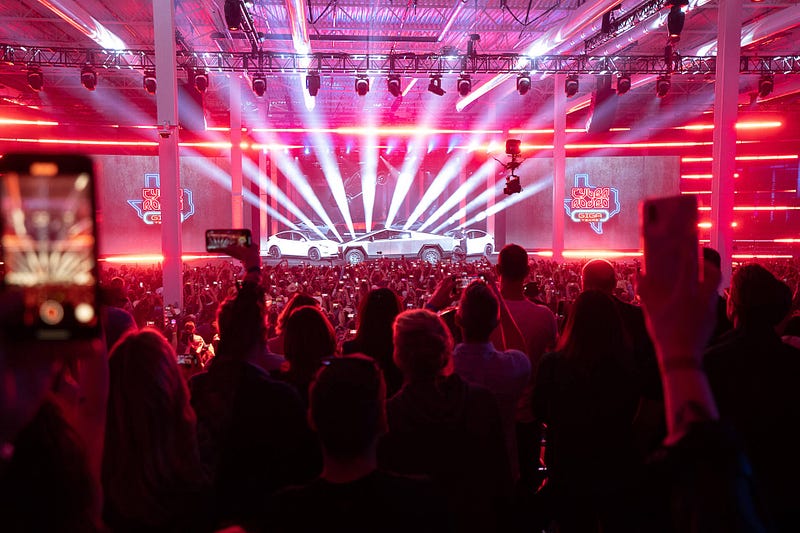
By making products cooler, you’re making it easier for people to talk about you. But Tesla goes a lot further than that!
It makes it stupidly easy to talk about them in the media by adding hundreds — and I mean hundreds — of incredible product and event photos and renders that the media can use when writing about the brand.
You’d think this is common practice, but it’s not.
Even Apple just adds one or two photos to its press releases per product.
As a journalist, it makes it a lot less tricky to write about a brand if kickass images, renders, and videos are already available and free to use.
After analyzing nearly every Tesla event, I spotted a pattern in the conversation technique Tesla uses.
It works like this:
- Tesla notifies the media and heavy fans about future events.
- The media hypes the event up.
- At the live event, Elon nearly always announces something wild.
- During the live-streamed event, media and fans create buzz on social media.
- Tesla then posts feature videos on its Youtube channel and Twitter account.
- After the event, Tesla releases the new renders and images to the press. The media summarizes what’s new in the first layer of articles and videos.
- Next, the media get opinion pieces out that cook up the conversation even more and people keep talking about Tesla.
- When the chatter goes down after an event, Elon brings it back up with his infamous off-the-cuff tweets and Tesla continues showing its newest innovation on Youtube.
Notice how Tesla just sparks the conversation and let the media and the fans do the marketing for them.
Sell more than a product. Sell a movement.
Light the bonfire and the tribe will dance.
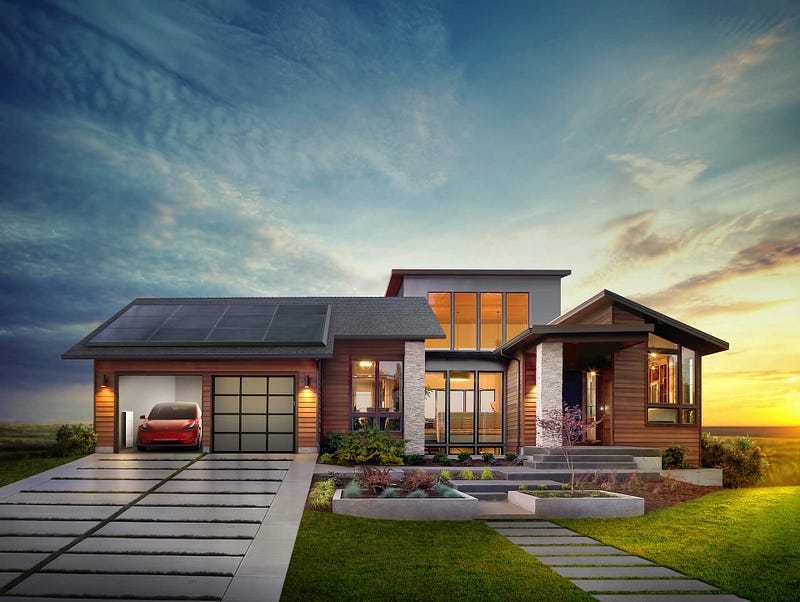
Tesla’s mission is “to accelerate the world’s transition to sustainable energy.”
Tesla sells way more than its products. Tesla sells the future of the planet.
This has since turned into a movement.
If you drive a Tesla, it says something about you:
- It says you give a f*ck about the planet.
- It says you believe in Elon Musk’s mission.
- It says you’re technologically ahead of the herd.
Who doesn’t want to be a part of something that could save our planet?
The Elon factor
Elon’s Twitter machine runs the crowd.
Elon Musk’s personal brand is probably the single most valuable asset Tesla has with his nearly 100 million loyal followers.
But what surprises me most about Elon is his incredible ability to really listen to his followers. Instead of making it about him, he makes it about them.
- When Twitter wants crypto, Elon talks crypto.
- When Twitter wants memes, Elon talks memes.
- When Twitter wants changes, Elon talks changes.
He gets people to fall in love with his movements to fall in love with him to fall in love with Tesla. That means an Elon Musk fan is a SpaceX fan is a Neuralink fan is a Boring Company fan is a Starlink fan is a Tesla fan.
If you take only one takeaway from this article, take this one:
The best way to make things better is to make better things.
Here’s a very unexpected story to end this article:
I grew up in Pretoria, South Africa, in a home on the same block as Elon’s high school — Pretoria Boys High School — while I was attending Elon’s biggest rival high school. And, even more coincidentally, we both ended up on the other side of the pond.
People tell me our accents sound — disturbingly — alike all the time.
But I couldn’t be prouder.
(Too cool not to share!)
If this piece resonated with you and you’d like help moving your brand from a short-term marketing mindset to a longer-term Tesla-vibe marketing mindset — let’s have a stress-free chat: [email protected].


