
I Spent 30 Days Analyzing The Genius Marketing Strategy Behind The Vision Pro
Would you walk around in public wearing a Vision Pro?
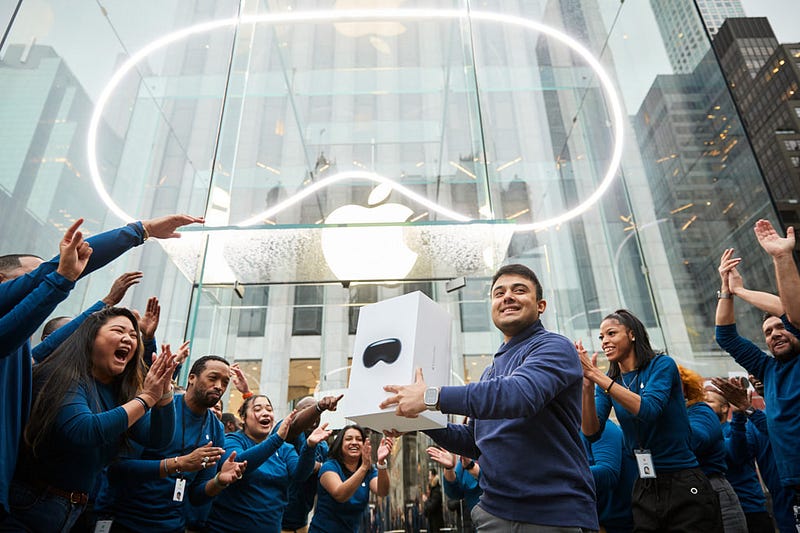
People say the Vision Pro ads don’t make any sense.
Why is Apple spending so much money advertising a $4,000 product that nobody is going to buy?
The average person’s ad journey looks something like this.
- People see the ad.
- People look it up.
- People see the $4,000 price tag.
- People realize they definitely cannot afford it.
- People move on with their day.
From a traditional marketing philosophy — this doesn’t make any sense.
But this is exactly what Apple wants.
Apple’s seed planting strategy
Apple knows most people won’t buy a Vision Pro.
They don’t care.
Apple simply wants people to want a Vision Pro.
They’re planting the idea in people’s minds that they make very high-end very high-quality and very expensive spacial computers. And that’s enough.
Remember this is the Vision Pro.
- Just like we have the iPad Pro.
- Just like we have the Macbook Pro.
- Just like we have the Airpods Pro.
It is meant to give people a teaser of what the future would be like.
In two years, when production costs drop significantly — like what happened with computers back in the day — Apple releases a Vision for $599.
Then Apple simply reminds them. Hey, you remember that $4,000 spacial computer you couldn’t afford but really wanted?
It is now available for $599.
Guess what, people can actually afford it now.
The Vision takes over the world.
Ecosystem expansion over product sales
Apple’s ultimate goal isn’t just to sell products; it’s to expand and deepen its ecosystem. By focusing on creating a cohesive ecosystem, Apple aims to simplify and enhance your digital life.
This approach is not just about adding devices to your collection; it’s about integrating your technology in a way that makes everything more convenient and connected.
- Ease and Integration: The more Apple products you use, the smoother your tech experience becomes. Each device and service is designed to work seamlessly together, making your digital life effortlessly interconnected.
- Beyond the Sale: For Apple, selling a device is just the beginning. The real value comes from how each product adds to the ecosystem, making it harder for users to switch to competitors. It’s about creating an environment where every Apple product you add makes every other Apple product you own more valuable.
- The Lock-In Effect: This ecosystem strategy is Apple’s safest bet for growth. Once users are invested in the Apple ecosystem, the convenience and integration make it challenging to leave. It’s not just about losing access to a single product but leaving a system that’s become integral to our daily lives.
Apple’s focus on expanding the ecosystem is a strategic move to make our lives easier and more connected. This interconnectedness is what sells more products.
It’s a virtuous cycle. The more integrated your experience, the deeper you’re drawn into the ecosystem, and the more likely you are to stay and grow within it.
Apple’s ecosystem doesn’t just lock you in with technology; it locks you in with convenience, making the thought of leaving not just a hassle but a step away from the streamlined digital experience you’ve come to rely on.
This ecosystem model is Apple’s masterstroke, ensuring its growth and customer loyalty by making its ecosystem an essential part of users’ lives.
Is this the next iPhone?
I mean, who needs a touchscreen when you’ve got the whole world as your display? Maybe not yet — but I absolutely believe a future version of Vision Pro could be the next iPhone.
Catch a glimpse of a Vision Bro on the street, and you’re not just seeing the future; you’re feeling a tug of curiosity.
Decked out in Vision Pro eyewear, they swipe and nod at the air, fully immersed in their private digital worlds.
It’s a scene that captures attention and sparks wonder.
What are they seeing?
What are they interacting with?
This public display of private interaction is intriguing, making everyone around not just envious but deeply curious. What exactly are the Vision Bros looking at? It makes people crave the experience, eager to peek behind the curtain of the future they’re living in right now.
Exactly what Apple wanted.
Remember how the iPhone turned phones from just a “call mom” device into your life’s remote control?
The Vision Pro is about to do that for your glasses, turning them from something that helps you see to something that lets you see the future. And just like in those sci-fi movies, it’s not just about clearer vision; it’s about seeing the world with pop-up notifications.
Missed a call? It’s floating by that tree.
Email? It’s hanging out next to your coffee cup.
Then there’s the whole Apple ecosystem.
The iPhone made us download apps we never knew we needed. The Vision Pro is gearing up to take this to a whole new level. It’s like Apple is saying, “You thought we were done innovating? Hold my beer.” Now, we’re not just tapping screens; we’re swiping through the air, probably looking a bit silly but feeling utterly futuristic. Imagine playing augmented reality games where the dragons aren’t just on your screen; they’re chilling on your couch. Thanks, Vision Pro.
And let’s talk indispensability. The iPhone became something we couldn’t live without, mainly because we’d forget how to navigate the real world without Google Maps. The Vision Pro is eyeing to be the next “can’t leave home without it” gadget. It’s taking the term ‘visionary’ quite literally, promising to make the leap from “I think I need it” to “How did I ever live without it?” faster than you can say “Siri, where are my glasses?”
As Apple takes us on this wild ride from holding tech in our hands to wearing it on our faces, one thing’s clear: the Vision Pro isn’t just about seeing the world differently.
Apple doesn’t care about the short term.
They’re thinking about 10 years from today.
And by then, I can almost guarantee you everyone with an iPhone in their pocket today will have a Vision Pro — or at least a Vision.


