
Transform Your Life: How I Corrected My Posture and Fixed My Neck Hump in One Year — A Personal Journey
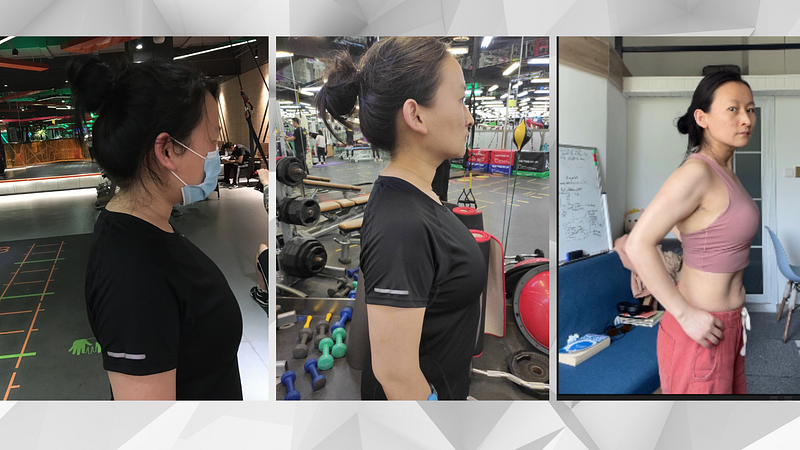
Do you have a neck hump?
Neck hump results from long-term poor posture — forward-leaning. For example, constantly looking down at your phone is a significant contributor.
Depending on the severity of the condition, not everyone with a neck hump has apparent symptoms such as neck pain or headaches. But more often, people will worry about the aesthetic side.
The good news is that the neck hump can be fixed. Depending on the severity, it may take months or years. Or if its condition is terrible, it may not be fixed, but you can still improve the condition with proper exercises.
In this article, the first part introduces my story of fixing my neck hump and correcting my posture, while the second part provides simple but effective exercises to help you achieve the same results.
My Story of Fixing My Neck Hump
I had a neck hump for many, many years. But it didn’t bother me simply because I never took a side profile photo. I just never paid attention to the outlook of my neck.
Several years ago, I started to feel pain in my neck after many hours of working at a computer. During that time, I thought it was because I was working too long. My muscle needed some rest. So I didn’t seek any treatment, visit a doctor, or even ask for advice.
My neck hump and neck pain didn’t get my attention until I bought a gym membership two years ago. The gym has a free service for each new member, such as checking your posture, physical shape, mobility, mass muscle percentage, fat percentage, etc.
When they examined my shoulder posture, they told me I had a severe problem — a neck hump. It’s serious because I can barely move my head upwards — I can’t see the ceiling and move my head to the side easily. So it’s not just neck pain, the “ugly” neck hump, but a significantly reduced neck mobility.
Time for me to change! Honestly, my biggest concern and motive for a change was the aesthetic side.
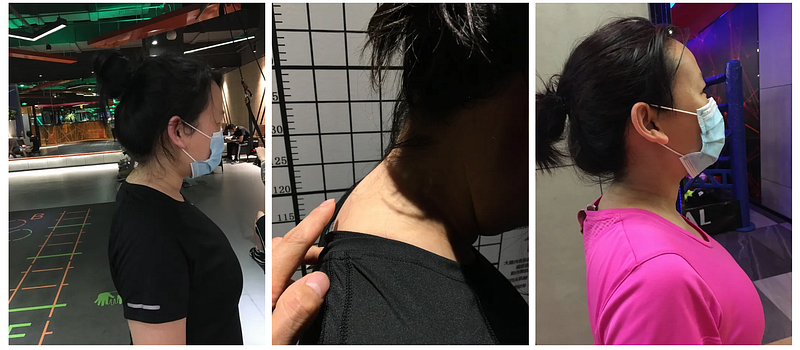
By that time, my body fat percentage was pretty high — 39%- equal to the obesity level. And I did some research to find out the overweight is associated with neck hump as well. Even for my general health, I tried to lose weight while increasing muscle. During one year of nearly daily workout routine at the gym, I eventually reduced my body fat weight from 39% to 23%. I never felt so good about my shape in my life before. Of course, there is still plenty of room to improve.
Besides successfully losing my body fat, the best part was I finally “conquered” my neck hump. You can see the progress from the cover image at the top of this article. I felt so confident about myself. And the strategy for correcting my neck hump focused on stretching and strengthening muscle groups like the neck, shoulder, and back.
Despite the various exercises involved in my training, I found the two most effective. Let me share this with you below.
1. Chin Tuck
Chin tuck exercise is one of the most effective and cheapest postural exercises. You don’t need to become a gym member. Just do it at home. Here are the steps you can follow:
For people with neck humps, your neck is protruding forward. So we need to pull the chin and head back. You could do this by sitting on your chair or against the wall.
Steps to follow:
- Keep looking forward, don’t look up.
- Pull your chin back — feel the back of your head up.
- Hold for at least 15 seconds, rest, and repeat at least three times.
This exercise is working on the muscle in the front of your neck and the top of your upper back because these muscle groups are the ones that pull your head back into alignment over the shoulders. Depending on the history of your neck hump, these muscles probably haven’t been worked for many years. So we must actively work on them to awaken them to do their job.
For beginners, you initially feel uncomfortable. But it’s normal. As long as you don’t feel pain in your neck, you can keep doing this exercise to stretch and strengthen your neck muscle groups until you see the benefits.
After one month or so, you will feel the strength of your neck muscle group. They are starting to pull your head back to a proper position. And you will feel so good not being in the forward-leaning posture anymore.
2. Dead Hang
Why dead hang?
Because people who have a long-term neck hump usually have tight back muscles and bad shoulder posture as well.
And one of the benefits of dead hang is helping your correct posture by decompressing and loosening your back, realigning your shoulders, and strengthening your lats, all contributing to a better posture.
So, if you want an excellent upper body posture, dead hang is the best. Despite their simplicity, dead hangs are a surprisingly beneficial exercise for your whole body. I still perform it every morning before my daily workout routine.
Dead hang is a simple exercise. Just hang off a bar with your body straight and lose your feet off the ground. Very important to pay attention is that the only tension should be in your hands and forearms while all else hangs loose. You can do it at home, a park, or the gym. It looks simple, but many muscle groups, like forearms, hand and wrist flexors, trapezius, lats, etc., are involved in this simple exercise.
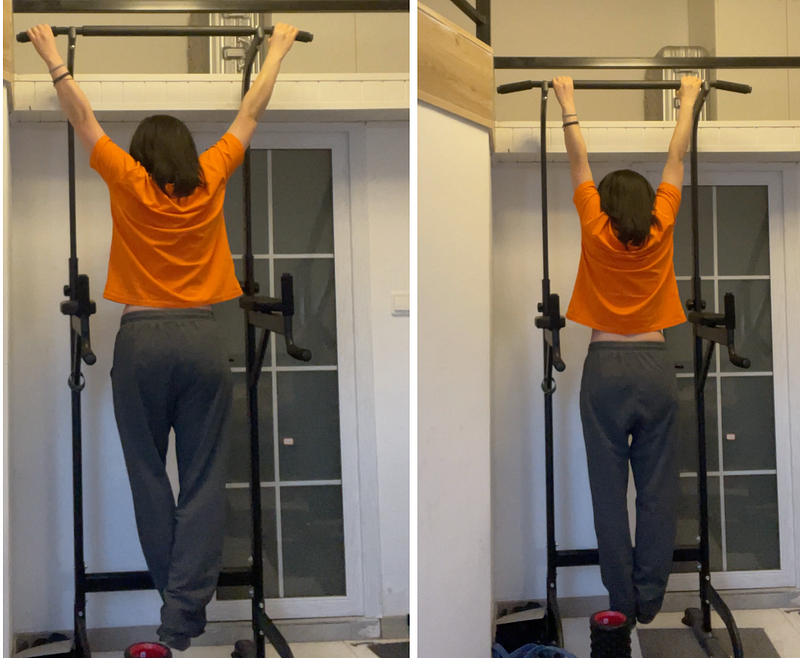
What if you cannot do dead hang?
I can relate to those, especially girls who don’t have firm grip and forearm strength. I went through that journey too. I couldn’t hold for 3 seconds, even with assistance from my PT (personal trainer). I introduce you to an effective exercise to increase your grip strength: the farmer’s walk. After one week or so, start doing dead hang with some assistance, such as a resistance band. Slowly, throw away the assistance to try dead hang for 1 or 2 seconds. You will see the compounding effects over some time.
There is no exact time or reps to follow. Just follow your pace. If you are doing ok with 10 seconds, try to do it in 15 seconds, then slowly build on to a longer time. You will also feel the improvement in your mental toughness by expanding your potential.
Final Thoughts
It does require consistent effort and can take many months, depending on the severity of your neck hump. The two exercises are easy to understand but hard to implement by many people for a sufficiently long time. If you stick to it until you see the effect and your significant progress, you will be grateful for your commitment.


