I shiver in the morning cold: embracing new habits
How do you achieve lasting changes for the better?
Every one of us struggles in life. Your struggle for lasting change is real. We start a new way of approaching life. Things go well for us for a while. Then we fall on our backside. We despair. Even curse our “weakness” or lack of resolve.
Yet what is one way to rethink your struggle? What if your failure is an expected or essential part of your struggle?
Take comfort in this concept of failure. Here’s one way to help you understand behaviour change. James Prochaska and Carlo diClemente developed the Transtheoretical Model of Behaviour Change (TTM)¹. This model expects you to fail at some point in your struggle.
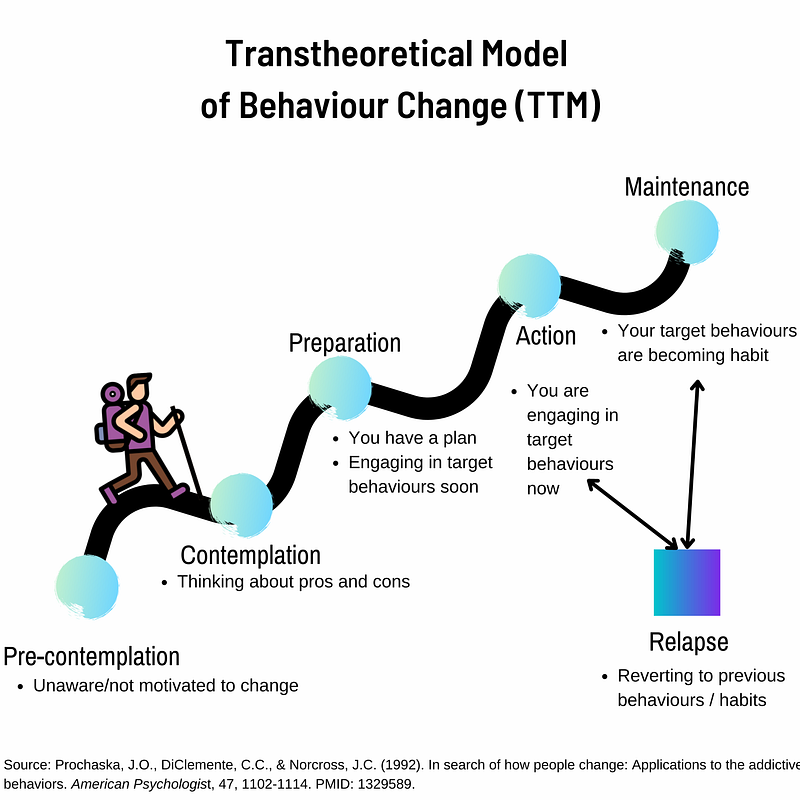
TTM suggests you move between stages in your struggle to change. You can assess and uncover obstacles to your readiness to change — and others- using TTM.
Pre-Contemplation:
TTM’s stages include the Pre-Contemplation stage. Pre-Contemplation is where you — or others- are not yet thinking about a particular change in behaviour. There may be no sense of urgency — yet. These changes in behaviour — or “target behaviours” are not on anyone’s radar.
Contemplation:
The Contemplation stage is where you think about the pros and cons of turning over a new leaf. You might think about which behaviours you would like to embrace. You might challenge assumptions or obstacles to changing your behaviour. Fears surface — and possibilities too.
Preparation:
The Preparation stage is an exciting time and hard work for you during your struggle to change. It’s getting real now. Let’s say you’re trying to become a regular morning jogger. You may have your running shoes and clothes beside your bed. Your alarm is set for an early morning run, and you prepare for a restful sleep.
Curiosity and the art of the possible permeate your life during this stage. More fears and doubts surface. You might tap into a network of like-minded peers to help you start your new behaviours. Asking questions, seeking assurance, buying things to help you. You step out of your comfort zone.
Prepared or not for your target behaviours, you move to the Action phase.
Action:
The moment of truth. You wake up early, struggling in the darkness. You feel strange, nervous and uncomfortable. Your mind reels with potential excuses to not take the first step. Your behaviours speak otherwise. You get into your running clothes and lace your shoes. You still feel uncomfortable. Yet you are in the moment — everything you do feels new. The discomfort is excellent for your mind and body. Your brain forms new neural networks by embracing new ways—your body gains from the stress of facing adversity.
You return from your run feeling sore. Yet you’ve triumphed over your “old you”.
Maintenance
There is also a step in the model for Maintenance where a target behaviour has become a habit. At least six months, for example. You have been undertaking your morning runs at least four mornings each week. Your initial runs many months ago felt atrocious. Shuffling and panting, your embarrassment was palpable. Yet over the weeks and with careful recovery, you started to jog—no more stopping to walk. You overcome excuses not to run. You acknowledge your feelings and thoughts during runs that didn’t go well. Yet you kept going anyway.
Over time, jogging became runs. Then with greater endurance, you mixed intense runs with longer ones. Your mind draws your attention to other successful runners. Your behaviours are becoming habits.
Relapse
All is going well — then an unexpected shakeup to your routine happens.
It doesn’t matter what the shakeup is — a new job, a family emergency, a holiday. It could be the shadow of self-doubt. Or you feel that your gains are starting to plateau. Without this ongoing sense of progress, you feel despondent.
Your new target behaviours — and blossoming habit — stops.
TTM also considers relapse as a part of humans adjusting to change. After all, we are humans and could revert to previous behaviours. This is especially the case when we are under a bit of pressure or have a change in circumstance. And relapse is a normal part of change.
You know that changes to your routine might shake up your running habit for a while. Yet after a short while, you miss your habit. Yet you forgive yourself.
Your regular morning runs were a refreshing part of your day. Your body craves the runner’s high that you enjoyed at the end of some runs. So you start your running habit once again. Your runners besides the bed, clothes ready, alarm set.
Tomorrow morning in the dark. You surface — ready to run again.