
I-shin-den-shin: Why the Japanese Value Communicating Without Words
Cultural considerations embedded in unique Japanese phrases

“I have a favor to ask you,” the Filipino student said during his first Japanese lesson with me. “I know the Japanese concept of 本音と建前 (honne-to-tatemae), and I don’t want you to use that with me.”
This request caught me off guard. As a beginner of the Japanese language, I didn’t expect such abstract words from him. The high-level words 本音と建前 (honne-to-tatemae, honne & tatemae) express a communicative manner typical of Japanese people.
本音 (honne) is one’s feelings from the heart, whereas 建前 (tatemae) is the feelings that you allow others to see. 本音と建前 (honne-to-tatemae) conveys Japanese people’s attitude to distinguish one from the other depending on the situation.
I can imagine my student’s feeling. He must have done some research about Japanese people before his first Japanese language lesson. Knowing this concept, he must have felt intimidated to talk with someone who is smiling but hiding her genuine feelings deep in her mind. I felt sorry for him.
So, does this mean that the Japanese are a group of liars or fibbers? No, that’s not quite true. In fact, in Japanese society, where putting yourself in someone else’s shoes is appreciated, people tend to hide their 本音 (honne); true feelings. 建前 (Tatemae), however, is not the opposite of 本音 (honne), but it can contain truth. Instead, it is the way of conveying real feelings without offending others to keep good relationships. This is the Japanese art of managing social relationships.
Though I’m a patient teacher, his persistently asking me, “Was what you said 本音 (honne) or 建前 (tatemae)?” got on my nerves a little. When I said “That’s perfect!” or “Your Japanese has been improving,” I really meant it. Finally, I told him, in a not-Japanese-like direct manner, to stop asking me that annoying question and to trust me.
This is when the student and I got over our cultural differences by laying everything on the table. However, he was right in a sense. Japanese people’s conventional manners of communication sometimes cause misunderstandings between people who are not familiar with them.
For instance, when I was making an arrangement with another student, I said, “Scheduing a lesson that day might be 難しい (muzukashii).” The word means “hard” or “difficult”. But for most Japanese people, it’s a soft way to say “no”.
It’s always hard to say “no” without worrying about hurting the other person’s feelings. That encourages us to choose indirect words instead of “no”. The student’s reaction, however, made me realize I chose the wrong word because he asked if I was available on the same day again. He looked intrigued to know how Japanese people talk in a roundabout way!
The story of 本音と建前 (honne-to-tatemae) is one of the examples of the fact that Japan is based on high-context culture which values non-verbal communication. Traditionally, Japan has had elements of a high-context culture with a long history as an isolated island and as a homogeneous society. The environment where most people share the same notions, culture, and values makes it possible to communicate without a lot of words.
Interestingly, there are more words, idioms and proverbs that highlight this Japanese way of communication. I’ll introduce some of them.
以心伝心 (i-shin-den-shin)
This four-character idiom means to understand each other without talking. The character-by-character meaning of “以心伝心” is:
- “以” is “by”
- “心” is “heart”
- “伝” is “to tell”
- “心” is “heart”
Originally from Zen Buddhism, it tells you that the essence of the Buddha’s teachings should be conveyed directly from the heart of the master to the heart of the disciple without words even though you have the sutras.
Now this phrase can be used between close friends or couples. My husband and I are almost “以心伝心” (i-shin-den-shin) because we have been together for about 20 years, and he knows what I want to say before I open my mouth, and vice versa.
阿吽の呼吸 (a-un-no-kokyu)
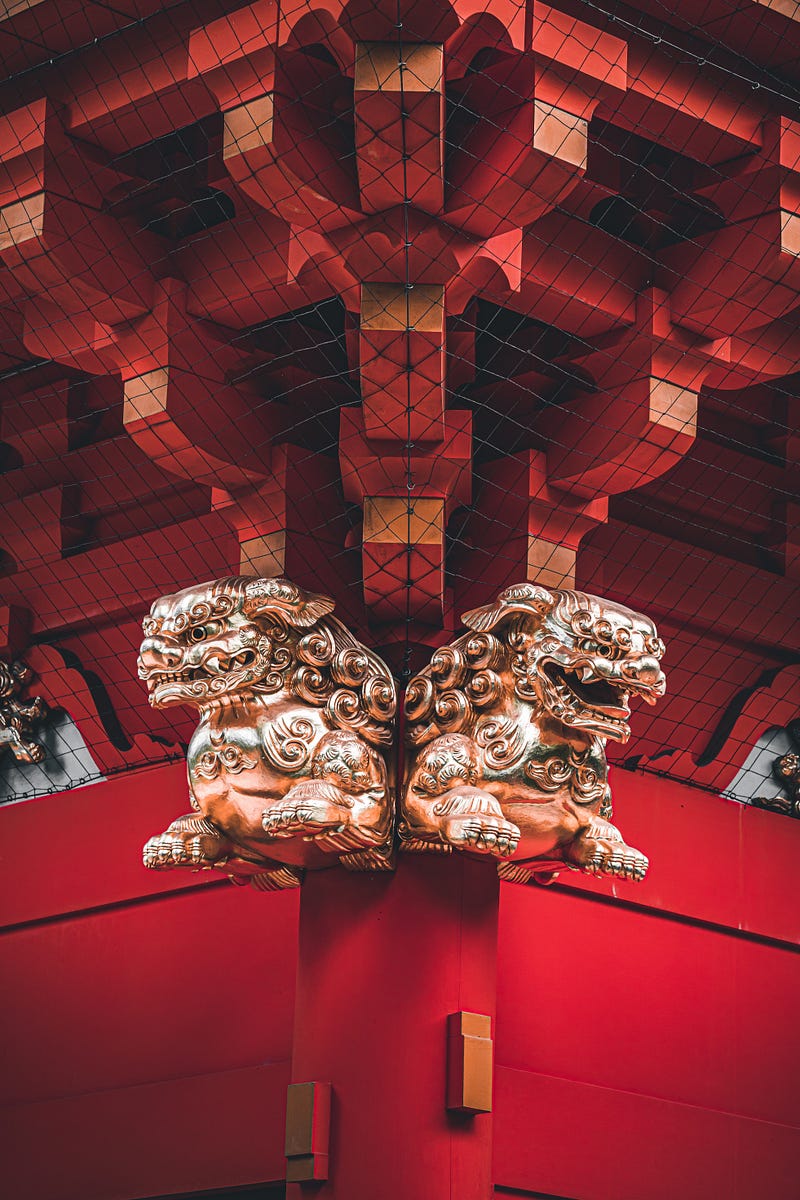
This idiom means the perfect timing in a collaboration. 阿吽 (a-un) was originally a Buddhist term meaning a pair of things or two opposing entities. My understanding is that 阿 (a) is the first character in Sanskrit, and 吽 (un) is the last, which suggests that 阿吽 (a-un) was a symbol of the beginning and the end of everything. Additionally, 阿吽 (a-un) evokes breathing (呼吸, kokyu) because 阿 (a) is a sound with open mouth, and 吽 (un) is a sound with closed mouth.
You can see this concept at shrines and temples. A pair of 狛犬 (Komainu, shrine guardian dog statues) stand at either side of the approach to a shrine. A close observation shows that one dog’s mouth is open while the other’s is closed. The same is true for the pair of guardian statues, 金剛力士像 (kongo-rikishi-zo), at the front gate of temples.
Over time, this meaning, two opposing entities, has transformed into the current usage, like “Wow, you two are such “阿吽の呼吸” (a-un-no-kokyu) to improvise a performance perfectly!” as words of praise.
言わぬが花 (iwanu-ga-hana)
The direct translation of this proverb is “not speaking is a flower”.
A flower symbolizes something admirable. For Japanese people, articulating everything seems “inelegant”. Have you ever come across Japanese coworkers who said little in a meeting or Japanese friends who uttered some short Japanese words which didn’t make sense? In that case, this proverb might have been put into practice.
The easiest example is that we often omit subjects such as “I”, “you”, and “she” in our conversation because it is obvious and inferable from the context. Even stopping in the middle of the sentence is appreciated as a polite way of communicating our feelings.
Daily greetings like こんにちは (konnichiwa, hello) or さようなら (sayounara, good-bye) also serve as implicature. If you try a direct translation of こんにちは (konnichiwa, hello), it would be “Today is…”, and さようなら, “Then…” You may wonder what comes next. However, your Japanese friend wouldn’t reveal more than that. This is the way Japanese are.
Likewise, if your Japanese friend says “そろそろ (soro-soro, it’s almost time to…)”, the expected reply is “Oh, I’m sorry I didn’t realize it’s time for you to leave now. See you then!”, not “Time for what??”.

忖度する (sontaku-suru)
This verb means to surmise other people’s feelings or superiors’ intentions and to act following your speculation. It’s not a new word, but it was not so common before it was famously used when describing a political scandal that occurred in 2017.
Now it implies some nuance of cheating rather than virtue because, as in the political scandal, it can be used to deny one’s responsibility by saying “I didn’t tell them to do that, but they just ‘忖度する’ (sontaku-suru) and did it on their own will”.
Interestingly, it doesn’t seem to have a direct English translation. This kind of attitude is specifically required in Japanese companies, which often leads to toxic relationships like abuse of power.
Such expressions are ubiquitous in Japanese vocabulary as they express our nature; we cherish nuanced expressions and communication without many words. This virtue, however, could ring hollow to foreign people from different cultural backgrounds where assertive communication is more appreciated. Just like my Filipino student, it’s highly possible for them to sense communicating in this outlandish way as daunting and unnerving.
The bottom line is: we need to bear in mind that sometimes we should stop adhering to our traditional virtues, especially in this increasingly diverse society. I’d like to go into more depth into this topic in another article.