
Live Music / the Police
I Sat Twenty Feet Away From an Honest to God Master at Work the Other Night
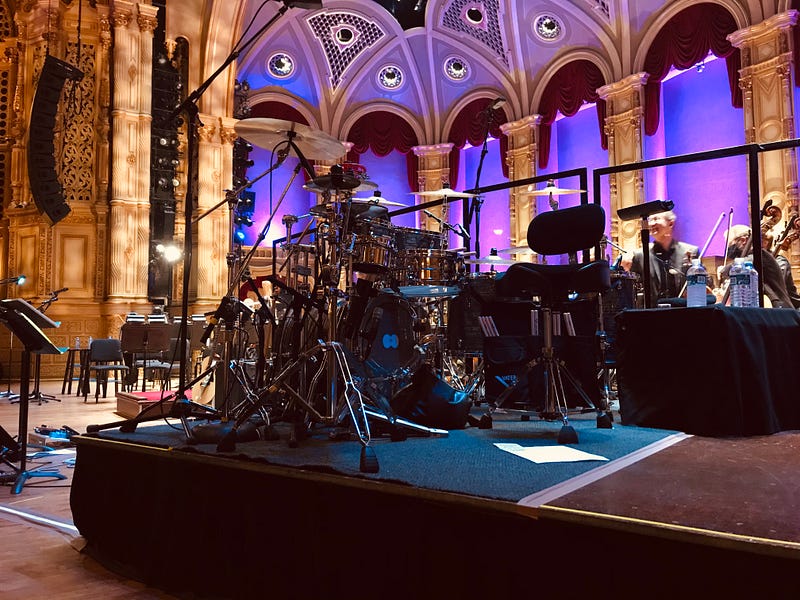
Stewart Copeland and his drums with the Vancouver Symphony Orchestra
The first album (and for the record, it was a record) that I ever bought for myself was “Synchronicity” by the Police in 1983. The first concert I ever attended was Sting at BC Place Stadium in Vancouver in 1988.
I wrote an article about it:
It was only fitting then that my first live show upon my return to the city I left seven years ago was Stewart Copeland, the drummer of the Police, with the Vancouver Symphony Orchestra on his Police Deranged tour.
It should be noted that I believe very firmly that Copeland is the greatest living rock drummer, and I base my assessment on his work on the Police’s five studio albums that he recorded with Andy Summers on guitar and Sting on bass and vocals between 1977 and 1983.
He has lately spent some considerable time reworking their classics from that time into symphony arrangements. These contain the original themes of the songs but come across in ways I had never considered before.
The lights go down, the show begins and the maestro explains how this is all going to work, and also who Copeland is, for the uninitiated. Once Copeland comes out to raucous applause and makes himself comfortable at his drum kit, which was situated no more than 20 feet away from the ninth row where I was lucky to sit, he immediately gets to it. The symphony follows suit.
I assume that wherever he plays these shows, the symphony he plays with is the existing one in the city and that the musicians have to learn all the arrangements. There is, however, also a band featuring a bass player, a guitarist, and three women who add some serious flavour to the vocals.
With all the songs that didn’t have their title announced beforehand, it takes more than a few bars to recognize the song that is being played but once you pick up the theme, it’s unmistakable.
“Demolition Man” — from “Ghost in the Machine” in 1981, was the first out of the blocks, and the bassline and the person playing it make clear how the rest of the night is going to go.
In a word, things are exuberant.
And yet, controlled. Copeland is a master of the drum kit, certainly as a timekeeper — he is flawless in that — but more as a musician with an instrument that he uses to play notes and add instantly recognizable colour, shading, style, and phrasing to all the songs he plays on.
The way he works the high hat, the left-handed jab at a tom, the way he holds the sticks, the distinctive way he strikes the snare and then holds back, the reggae rhythms that the Police incorporated, especially into their earlier work, that he somehow makes work in a symphonic setting. It is pure artistry.
At this point in his career and life — he’s nearly 70 — he could easily mail these in. But he is beyond enthusiastic in terms of his banter with the audience and explaining where all this comes from, his relationship with Sting and Andy Summers and their feeling about what he’s doing, and how he goes about creating and reshaping these songs from the way we already know them.
And just as you think this show might be more talking than playing, he stops and says “And this one is called ‘King of Pain.’” The crowd goes wild.
He knows who he is and why he is loved and emulated. But aside from his talent and skills, it’s his humility and lack of pretense in presenting these songs to the audience that sets him aside.
In addition to that, the unmitigated look of joy on his face in playing them, in turn, gives the assembled crowd the unmitigated joy of hearing them.
“Roxanne,” “Murder by Numbers,” “Spirits in the Material World,” “One World (not Three)” and “Walking on the Moon” rounded out the first set and it seemed like an hour passed in a flash.
To end the set, he took his turn at conducting while the conductor filled in capably on the drums on a non-Police song that he wrote himself.
The second set began with “Every Breath You Take” (which, at the time, I would have wanted to be saved for last), and was followed by “Walking in your Footsteps,” “Bed’s Too Big Without You,” “Don’t Stand So Close to Me,” “Message in a Bottle,” and “Can’t Stand Losing You.” It was actually a perfectly energetic way to end.
You were left wanting more, truly. Fourteen songs barely whet the whistle. You wanted your time with greatness to last. But It never does, does it?
It turns out that the only thing you can do when you are sitting and watching mastery playing out in front of you, from just a few metres away, is to soak in the moment and realise that you’ll take whatever you get, grateful that you had the chance to witness it.
A few months ago, I wrote an article about a song by Copeland that appeared on “Synchronicity”
I really do hope that you like what you have just read. If you want unlimited access to thousands of writers, consider a subscription to Medium. It will set you back $5 a month and if you use the link below, then I get a slice of that that I will put towards the completion of my Police record library.


