
I Remember Childhood as Scholastic Segregates Books about Diverse People
A story about fireflies and learning how doing good is better than doing easy
Scholastic Books, the leading bookseller to schools across North America, is facing criticism for segregating books about diversity so that schools have to opt in to receive them. Books by or about Black people, LGBTQ people, Native Americans, and people with disabilities (among others) are being shipped in optional boxes to Scholastic's very popular school book fairs.
Scholastic says they are trying to protect librarians and teachers from laws designed to suppress books about diversity, but critics say Scholastic is making a poor moral choice — elevating profit over decency, doing what’s easy instead of what’s good.
My story today is not meant as a deep dive into Scholastic’s marketing practices. If you’d like more specifics, USA Today has a detailed piece here, and you can read a non-paywalled article in the Washington Post here.
I personally agree with the critics, and I’d like to explain why. To illustrate what I’m talking about, here’s a story from my childhood — a story about racism that shaped me in important ways.
Do you believe values matter?
Does doing the right thing, acting according to your conscience, take priority over doing what is easier or more practical? I don’t know about you, but I was raised on the following values:
- Follow your heart.
- Let your conscience be your guide.
- Do what’s right, not what’s easy.
Those values sound normal and uncontroversial to me. Perhaps they do to you too, as part of a fairly traditional zeitgeist.
I first became aware of them in the early 1970s when my little brother befriended a Black kid in school, which I’m sure sounds unremarkable if you’re not old-ish like me. In those days, though, for White working-class people in a fading rust-belt town in Ohio, my brother’s choice in friends was a big deal. I knew it mattered — in a hazy way from absorbing the culture I lived in, but I had no idea how big a deal it was to many adults.
Nor did I know how my father would stand up for my brother and set an example about making hard but good choices.
I mean I want them to learn to do right even when it’s hard.
My little brother and Mario were tight in the first grade, as tight as 6 year olds can be, I guess. They had a lot in common (like playing football really rough) and loved spending time together. Once, my brother went over to Mario’s house after school, and then he asked Dad if Mario could come over to our house next time.
Dad agreed instantly, and before long, a gang of neighborhood kids were up in our treehouse playing, then running around with a football in the park right behind our back yard.
I wasn’t interested in football or playing with 6 year olds, so I stayed in the house to read, my primary interest when I was 10. I wasn’t up in my attic bedroom haunt. For some reason, I’d decided to curl up behind an umbrella stand on the staircase landing — with C.S. Lewis (or maybe Tolkien, Heinlein, Louisa May Alcott, or Nancy Drew). I wasn’t trying to eavesdrop on my parents in the kitchen.
“I’m worried, Jim!” Mom told Dad in a sharp tone. That perked my ears up. I started plucking words out of background drone.
“It’ll be fine,” insisted Dad. “John across the street won’t like it, and a few others, but they won’t say anything to the kids. If they do …”
“If they do, what?” Mom asked. “We have to LIVE here. The kids have to LIVE here. Why make problems? Nobody will say anything if he just goes over to Mario’s to play.”
“Mario doesn’t have a treehouse.”
Mom’s tone told me she had rolled her eyes. “That’s your contribution to this discussion? Can you get serious, please?”
“I am being serious. Look, I don’t want trouble any more than you do, but I’m not afraid of trouble. There’s a lot more things I’m afraid of.”
“Such as?”
“Such as our kids knowing right from wrong.”
“They DO know! Two of them are out there playing with Mario right now!”
“Okay, that’s not what I mean, exactly. I mean I want them to learn to do right even when it’s hard.”
Mom interrupted the conversation by opening the back door and shouting, “Kids! Dinner! Get in here before it gets cold!”
As we sat around the table forking up spaghetti or possibly breaded pork chops, I studied Mario. I saw a small boy with kinky black hair, milk chocolate skin, and smiling brown eyes. He and my brother laughed and told stupid kid jokes all through the meal, and then they went out on the front porch to wait for Mario’s dad — an utterly ordinary habit of our childhood that felt extraordinary to me that evening.
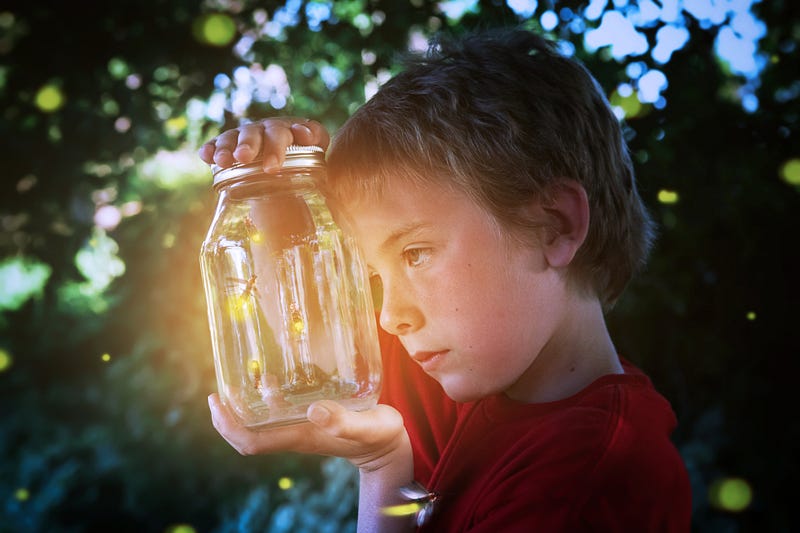
After my brother’s bedtime, I took a margarine tub outside to catch fireflies. Are you old enough to remember those tubs with translucent plastic lids? How you’d cut slits in them to let air in, to create a natural nightlight for your bedroom?
Lying in the grass examining my glowing treasure, I wrestled with the conversation I’d overheard. Oh, I knew exactly what Mom and Dad had been talking about. Mario was Black. Lots of people believed Black folks and White folks should live in different neighborhoods and go to different schools. I’d even heard classmates say mean things about Mario’s family because he and his sister went to the “wrong” school.
I thought Mom was saying she didn’t want kids to pick on us because of Mario. I thought Dad was saying that he wanted us to learn that getting picked on was … sometimes necessary?
That was a lot for me to think about, because I thought I was a pretty weird kid, and most other kids agreed, often loudly. I liked to read instead of play games, and sometimes I liked to play girl games instead of boy games. I got picked on a lot.
My own parents …
For my tenth birthday, I had asked for potted red flowers, a plant I could take care of and help grow. I didn’t get the flowers. I got a list of “for boys” toys, delivered with looks of adult concern that reminded me how weird I was.
I had dutifully asked for a G.I. Joe military action figure, pretended I was happy to get it, then never played with it.
Confused about where I’m going?
I was confused too that night as I clutched my firefly tub and trundled up to the attic. I didn’t know I was gay. I had no words for that, though I would soon. I didn’t know I was autistic, and I wouldn’t have a word for that for decades. I did know I’d been sent to experts because one of my teachers thought something was wrong with me. My dad was relieved when the experts said I wasn’t “slow,” but everybody knew I was different, especially me.
I went to sleep thinking Mario was a pretty normal kid, wondering why being different even in small ways made some people so upset.
In the morning as I got ready to walk to school with my siblings, I released my fireflies. More than half of them fell to the lawn dead. I started to cry, which I tried to stop when Mom came out on the porch with our lunches. Crying a lot was part of what made me different, and I was afraid she’d get mad.
“Are you sad about your fireflies?” she asked. “It’s okay. You can get some more tomorrow night.”
“No, because they died. I didn’t mean to kill them!”
“Honey, you didn’t. Fireflies don’t live very long, but if it makes you sad, maybe you should enjoy looking at them instead of catching them?”
On the way to school, I decided never to keep fireflies in my bedroom again, even though I was badly afraid of the dark and they comforted me.
“I want them to learn to do right even when it’s hard,” Dad had said. I figured that extended as much to fireflies as anything else, and I decided I had better start figuring out how to do right. I didn’t want to make anyone suffer, not even if it was just a little firefly.
I’d like to make that the end of this story and then wrap up by tying into Scholastic’s decision, but more stuff happened, as my 10-year-old self would have put it.
The neighborhood didn’t send a delegation to our house. John across the street didn’t come pounding on the door. Nothing dramatic went down, but things … did happen. Mario kept coming over now and then. Pretty soon, a few kids weren’t allowed to play with us anymore. Mike down the street told me why. I had a crush on him that I didn’t understand, so when he said my family was “a bad influence,” I felt terrible, maybe as terrible as that time he gave me a black eye.
I can’t remember if he punched me that day or even if the punch was about Mario at all. I just remember that instead of feeling a certain curious thrill passing his house, I started crossing the street to avoid him.
I also remember Dad telling me he was proud of my firefly decision. When I told him I was proud of him too, he gave me a funny look before he hugged me.
Mostly, I remember that Mario coming over stopped being a big deal after a while. People got used to seeing him around, and that was the end of the controversy. Nobody’s world had ended, and 6 year olds are not, after all, threats to anyone.
A few years later, Dad struggled to fold my gay existence into his conservative Christian worldview. Telling him in my late teens was one of the few times I’ve had a classic coming-out moment. I prefer communicating my identity without words.
I figured saying actual words out loud to him would be very, very hard. I was right, more right than I knew. But he’d taught me to do hard things.
We were driving somewhere, just the two of us, when he asked me if I had my eye on any girls. Just making small talk. I could have said no and left it at that, but we didn’t have that kind of relationship. We really talked when we talked, and he’d shown me over and over that I could trust him.
I paused for several beats, a million thoughts running through my head before I said, “That’s probably never going to happen. I would like to have a boyfriend, though, one day.”
I can’t remember what he said. I just remember breathing a sigh of relief after he said it. I was different, and he was okay with that!
He really was.
I didn’t know he struggled with religious ideas. He didn’t share that with me until decades later. But he came to know my partner Lenny in New York City, making sure to let me know how much he liked him. When Lenny died, Dad got on a flight the moment he heard. It must have cost him an arm and a leg.
But he heard the grief in my voice and was at my side almost immediately. He helped me make the necessary arrangements, and he stayed until he was sure I was okay, even though he really needed to get back to work.
Dad didn’t always make great decisions. I didn’t always agree with his moral choices. We had one or two blowout arguments over the years, but one thing that stayed consistent with him was treating “different” people with compassion, dignity and respect, no matter how hard that might be.
I believe if Dad were on the Scholastics board of directors today, he would strongly morally oppose their decision to make it easy to reject books about respecting difference. He didn’t believe in easy. He didn’t believe in elevating money over goodness, but I’m afraid more and more people today find that value harder and harder to understand.
The devil’s in the details, of course, and maybe Scholastic management are sincere when they say they’re trying to protect teachers and school librarians from angry parents and neighbors.
But while they’re saying that, I’m going to remember my dad, Mario, and the big trouble that never happened. I’m going to remember that “hard” is more valuable and important than expediency, that respecting difference is fundamentally decent and important.
How about you?

My writing is always free to readers who click my social media links, but if you’d like to browse more, click here to join Medium and support thoughtful independent writing and journalism curated by humans, not algorithms.
To get an email whenever I publish a new story, Click Here.