
Email Scammers
I Receive More Scams in My Inbox Than Writing Gigs
I guess email scams are the trend among scammers these days.
Ever since I signed up for a business email address and launched my website, I’ve been getting random emails daily. Some of them are just marketing and cold pitching. But many of them are email frauds!
Recent statistics show that almost 85 percent of all emails are spam. Though most spams are harmless ads and promotions, 2.5 percent are email scammers. And 73 percent of these fraudsters are identity thefts.
It appalls me to find out that scammers send over three billion emails masquerading as trusted senders every day.
Man, do they work hard!
With that knowledge and the number of email frauds I receive daily, I realized how bad it must be for many businesses.
Then it hit me how worse it is, especially for freelance writers who rely heavily on cold emails!
Business owners are most likely to ignore unknown usernames and email addresses because of these cybercriminals.
Email Scams I’ve Experienced
One of the ridiculous bogus offers I received recently was from a dear email fraudster who claimed to be from Forbes!
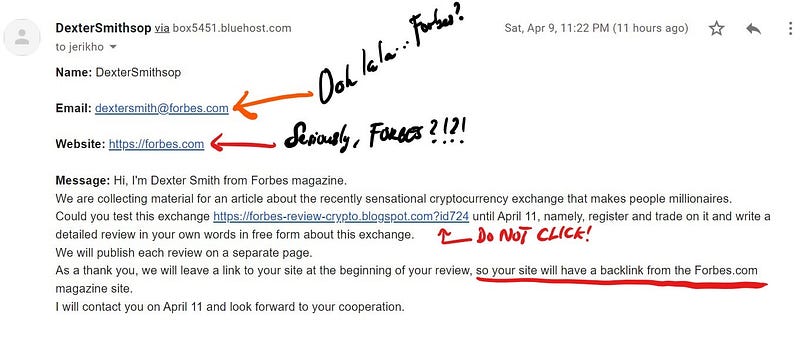
It sounds all ‘fancy’ because it’s from Forbes. But I immediately knew it was fake.
The first clear giveaway is that the email is from a well-established global media company.
So why the heck would they need a small music learning-niche freelance writer to review cryptocurrency exchange?
Of course, our dear sender, Mr. Smith, ‘kindly’ offered a backlink to my site from Forbes.com.
Wow, bonkers, isn’t it?
Well, not today, Mr. Smith!
For the sake of writing this piece, I copy-pasted the link included in the email on a secured browser. And guess what?
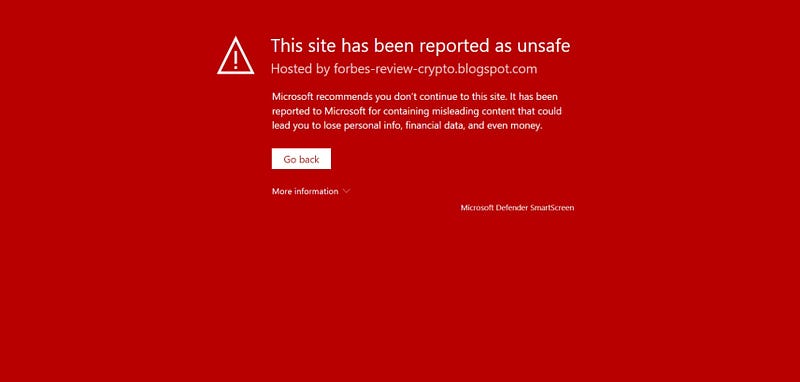
This is just one of the three billion email scams many of us receive every day.
The Mind of a Scammer
The numbers for email scams alone are insane! And it’s not even including all forms of fraud in total.
I wish I have the same motivation as them doing fraudulence to exercise regularly and have a healthy diet. With that amount of determination, I’m sure I’d have rock-hard abs by now.
But it piques my curiosity to know the psychology of a scammer.
According to a Standford and Santa Clara University psychology professor, Dr. Thomas Plante, defrauders are motivated by a few various reasons:
- Narcissism: They do as they please and justify their actions by asserting superiority, importance, and desire.
- Sociopathy: Scammers have no empathy. They believe that it’s the victim’s fault for getting conned. What matters is their interests, regardless of the repercussions for others.
- Bounded Ethicality: When we convince ourselves to act unethically based on how we frame something. For example, Toby Groves fabricated his income to get a loan for his company. Though he knew it was wrong, he cared about saving his business more.
- Some scammers started with more minor, barely noticeable cons, and they got away with it. So they repeatedly commit fraud, which gets bigger over time, and they eventually get caught.
Analyzing a Suspicious Email
What to do with suspicious emails?
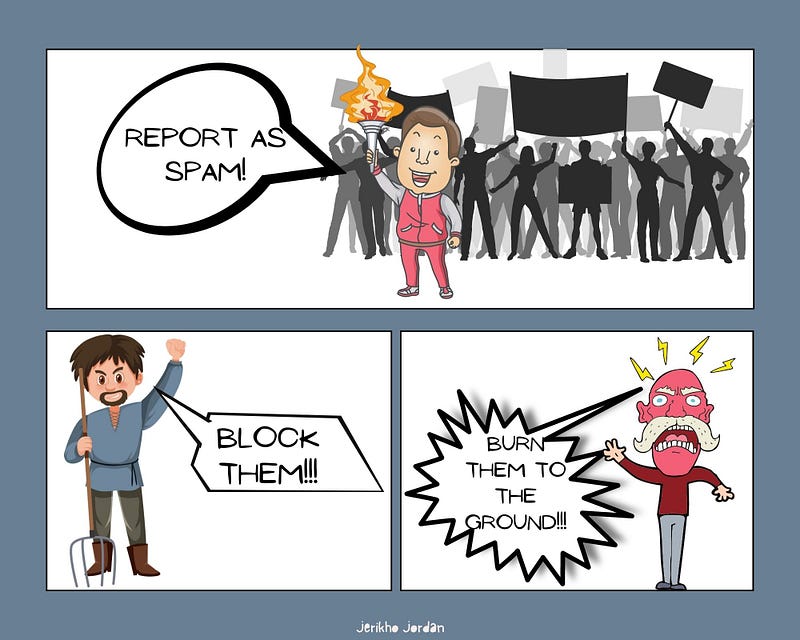
Whoa… Before we raise our pitchforks and torches, it’s essential to learn how to identify a scammer first.
So let’s analyze a screenshot of a suspicious email I received recently.
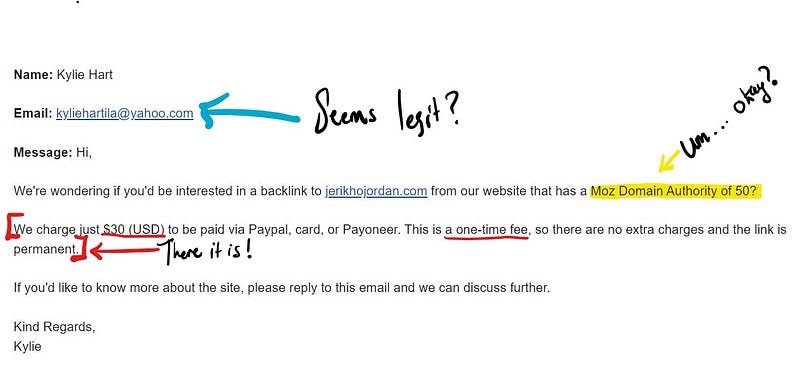
Ms. Hart here seems to have a believable email address.
Questionable, but it looks legit.
Like Mr. Smith, she’s offering a backlink from an unknown website she claimed to have a Moz Domain Authority of 50.
If you’re not familiar, Moz Domain Authority is a search engine ranking score that estimates a website’s rank in search engine result pages (SERPs).
So if I have a backlink from a high domain authority score website, my lonely site may have better chances to make new friends.
But in the second paragraph, Ms. Hart mentioned that all I have to do is pay a one-time fee of $30!
I instantly knew that it was a scam when I read that part, especially when there was no website link included in the email.
How can I decide if I can’t assess the website?
Besides, buying and selling links to manipulate a site’s ranking in Google search results are considered to violate Google’s Webmaster Guidelines!
Free Email Verifier
An easy way to instantly check the legitimacy of a suspicious email is by using a free email verifier:
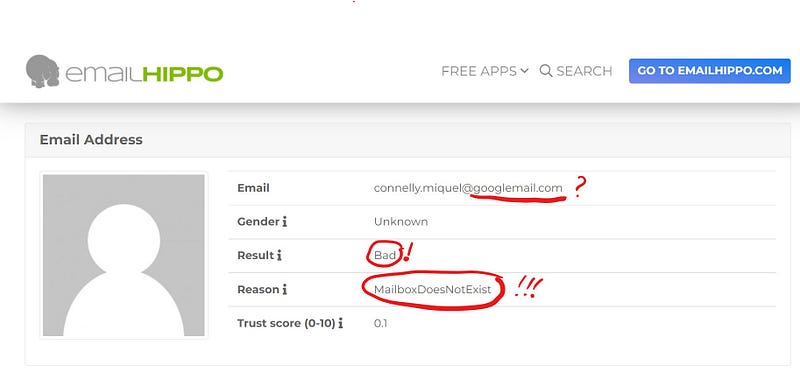
1. Email Hippo:
Email Hippo allows you to check up to 100 emails per day. That’s a pretty generous amount, don’t you think?
I tried checking one of the email scams I received, and the mailbox doesn’t exist!
And of course, the BBC webpage link he included has absolutely nothing to do with the product he mentioned!
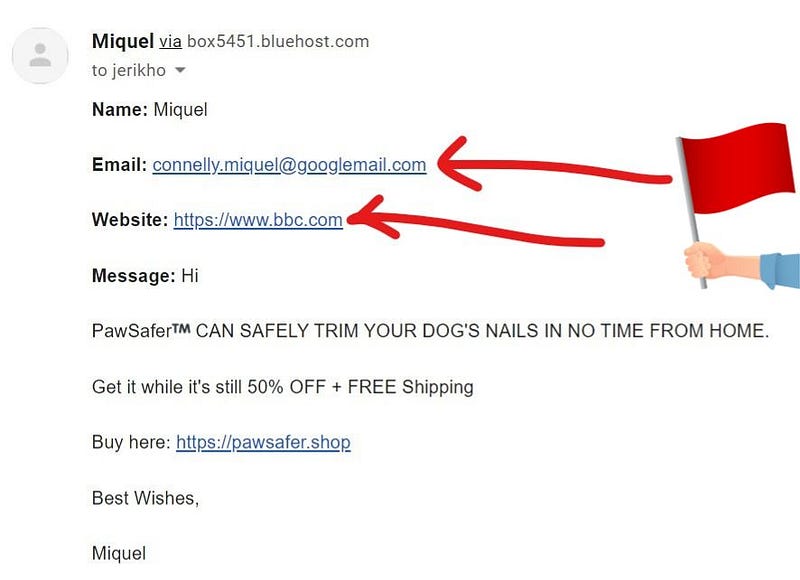
That’s a red flag if you ask me.
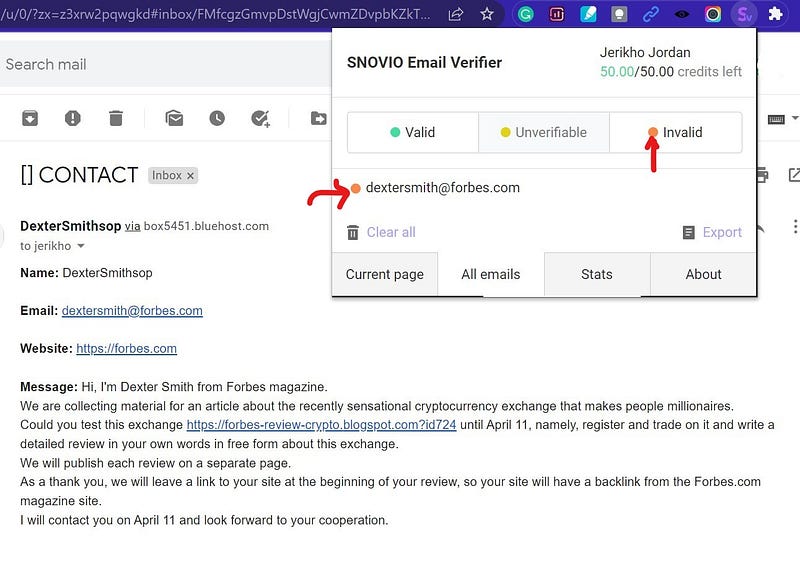
Unlike Email Hippo, this is a Google Chrome extension that enables you to verify an unknown email address immediately without switching to other pages.
Once you’ve added it to Chrome and signed up for free, you have 50 credits per month, which is equivalent to a hundred email verifications.
So if you’ve used all 50 credits before a month is up, Email Hippo is a good alternative.
Remember Mr. Smith from ‘Forbes,’ by the way? So I checked his email address using this extension, and as expected, it was invalid!
Do Not Rely On Email Verifiers Alone
Remember how we analyzed Ms. Hart’s email? It’s essential to do so because any fraudsters can sign up for a Gmail or Yahoo Mail account.
Take this email, for instance:
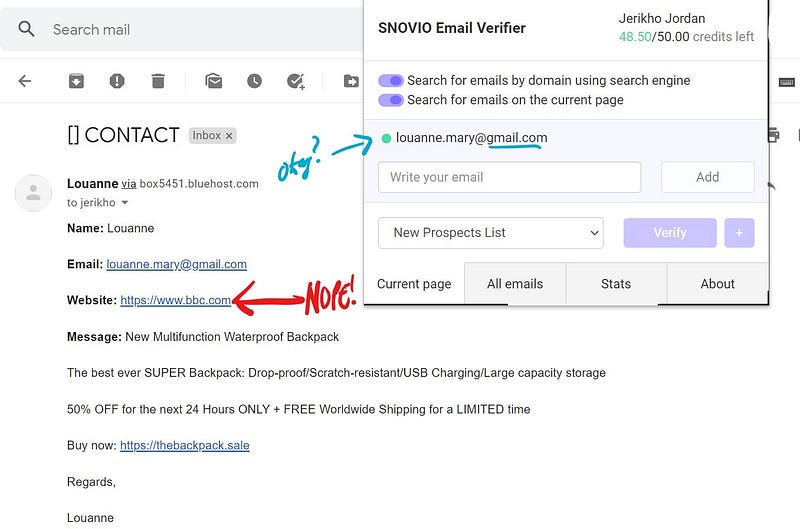
Since Ms. Louanne used a Gmail account, the email verifier found it valid. But why did she include a BBC webpage that has nothing to do with the product mentioned?
That’s why it’s also important to consider other mistrustful indicators in the email.
Final Thoughts
I’ve received more suspicious emails than those I shared in this piece. But if I include all of them here, this post will be a scrapbook of email frauds. It’s aggravating because it affects genuine cold pitchers like me.
As you’ve noticed by now, I didn’t bother to cover the usernames of the emails. Because why would I when these scammers are using fake names anyway!
But thanks to these hardworking con artists who just want to make an ‘honest’ living, I have another writing prompt for this week.
So how do you detect an email fraud? Do you use an email verifier to check the authenticity? Also, what are your thoughts on scammers in general?


