
I Ran My First Marathon…
It was a complete catastrophe — but I’m really pleased with it.
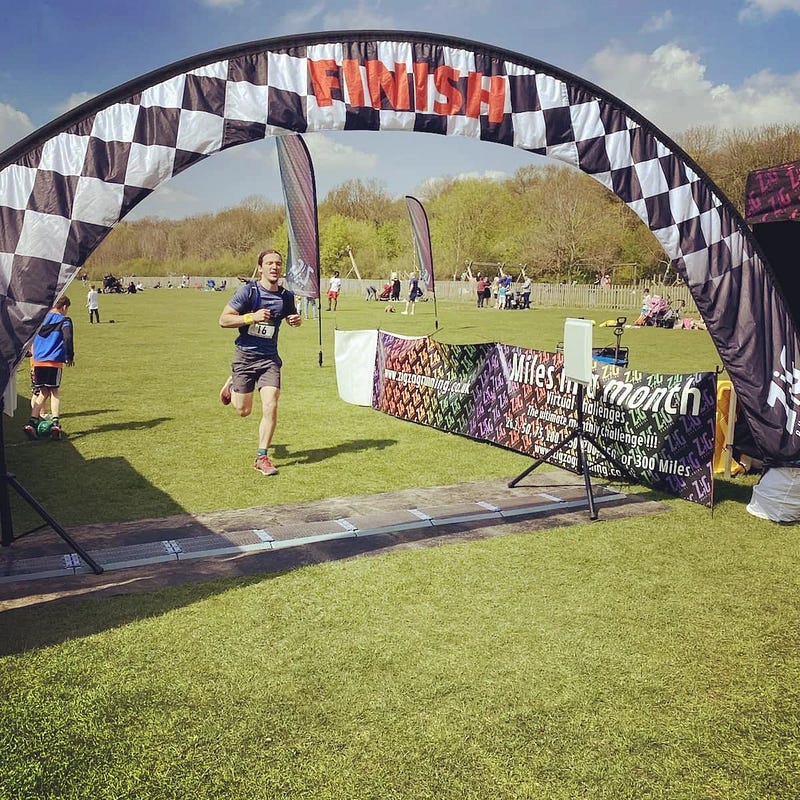
We’ve all seen those cheesy American movies that start with a short clip (usually of a barely-not-prepubescent child being embarrassing), a freeze frame, and a voice-over of the main character saying “Yup, that’s me. You’re probably wondering how I got here.”
Well, that’s pretty much how this article is going to go.
Scroll up. You’ll see me — Rory Cockshaw, or runner no. 16 at the Huntingdon Easter Challenge last week — with my pain face on. You can’t quite feel it from this image, but this was the most pain I had ever felt.
Seconds later I was moaning “No more, no more…” to my mum, who’d come out to support, while lying on a concrete patio (the closest shady area I could find) and drooling into the cracks.
My legs were in a world of pain that I had never experienced.
As a rower, I thought my legs knew what pain was. Boy, I was wrong.
That marathon was the single most difficult thing I had ever done. I had two targets for that day: a sub-4-hour marathon and my first ever ultramarathon. I missed them both. In retrospect, they were ridiculous targets and, objectively, the day was a complete failure as a result.
But I’m so proud of what I achieved, despite that.
So… How did I get there? Here’s my story.
How did I get into running?
It’s a long story.
In the first lockdown, there were months at a time when we Brits could only meet people outside for exercise in pairs, socially distanced.
So I’d run the 5km to my girlfriend’s house, we’d run up and down the river together for 7–8km, and then I’d run the 5km home.
We’d do this twice a week for a month, two months, three months at a time. I can hardly remember now — the time all blurred into one. These runs became a solace — a pleasant jaunt in the sun that I’d look forwards to every week.
I also began to feel the runs getting easier. Before this, I rarely ran anywhere at all. I had little endurance outside of rowing, and I found the long runs to my partner’s house exhausting if I ran at any notable pace whatsoever. My 5k time was around half an hour on a good day (it’s now a comfortable 22 minutes — still not too quick, but not too slow either).
However, I found that I could plod along at a slow, leisurely pace, and eventually I’d get where I wanted to go.
I decided one day I’d take it up to half-marathon distance. I’d never breached 20km before. I’d never even gone above 17 or 18. But I wanted to see if I could run the half-marathon distance.
My First Half
My first half-marathon, run last year, was also a catastrophe. I chose the hottest day of the year to do it — purely by accident, mind you — and finished my water bottle well within the first half. I hadn’t eaten enough and had no more fuel with me. I’d never run that route before. I had a meeting I had to get back for in 3 hours’ time from the moment I stepped through the door.
Predictably, in retrospect, I got hungry in the final 6km. I got thirsty. I got a headache. My legs began to seize up. My breathing and pacing were all over the place. The final few kilometres were walked as much as they were run.
It took me almost three hours to finish.
I barely made my meeting.
I spent the next two days in what was effectively a coma. I could hardly move because my muscles were so tired. My feet were blistered, and my headache was pounding. I knew nothing about proper fuelling or hydration, let alone electrolytes and all the rest of it.
But I had caught the bug. I knew I could do better and, what’s more, I wanted to.
So I trained. I ran, I ran, and I ran. I got better running shoes for Christmas that fit like a charm. I watched videos on running. I learned about proper nutrition. I learned technique. I got faster, fitter, better.
I ran many more half marathons and got my PB down from almost 3 hours to a healthy 1 hour 54 — still not particularly rapid, in the grand schemes, but a number I’m happy with (for now!).
And then…
I entered the marathon.
The Real Race is Run During Training
I adopted Hal Higdon’s novice marathon training plan and, for the most part, stuck to it. They say that the real race is run during training because the race itself is just the tip of the iceberg when considering the total number of hours and the sheer mileage each runner puts in to a single race.
(Full disclosure: There was a two-week period where I went haywire on the training about a month out from the actual marathon. This was when I had 4 rowing races in 4 days, plus another big rowing race the weekend after. I decided to let up on the running and focus on rowing for a fortnight.)
The training plan included one ‘long run’ per week, which usually varied from 10 to 20 miles (or 16 to 32km), plus a mixture of two shorter runs (5–8km) and a mid-length run (8–12km).
My 20-miler, run a fortnight before the marathon itself, was perfect.
Perhaps “perfect” is overstating the case. I was running it in 40mph crosswinds the entire way. The route was off-road and a straight line from the centre of Cambridge, where I live, to Ely cathedral. Rain lashed at my face for the last few miles.
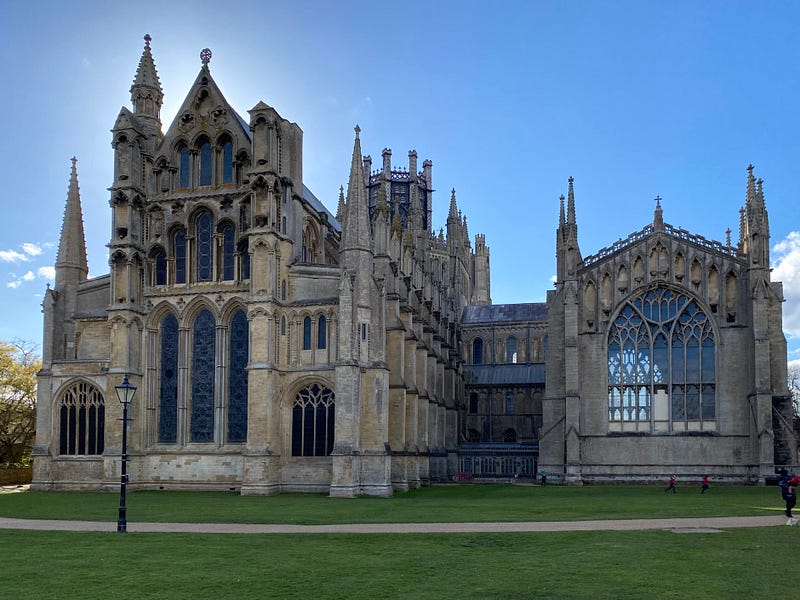
However, the run was “perfect” in the sense that I did almost exactly 3/4 of a marathon in 2 hours and 58 minutes. I was a few seconds per kilometre faster than my target marathon pace of 5:41/km. The conditions sucked, but I knew that, in better weather, I could replicate the run and add another 10km on the end.
I was almost certain, in fact.
I recovered from the Ely run easily. The next day I felt fresh as a daisy. I only needed 5 minutes to shake myself off afterwards, neck some water and a bagel, and I was off charity-shopping in Ely with a good friend.
I was a fortnight out from the marathon. And I felt ready — readier than ever.
The Marathon
Here’s where things go wrong.
When I rocked up to the marathon, I realised the weather was far hotter than I thought it would be. It was April 15th, and the hottest day of the year so far — by miles, it felt like.
Not only that, but I hadn’t researched where we’d be running. It was Huntingon Country Park, and the run was as many 5.3km laps around a forested trail as you could manage. Some only did 1. Some did 8, like me, and did a full marathon. Some did 9, 10, 11, or even 12. The only restriction was that you could not start any laps after 6 hours had elapsed.
I was hoping for a 4 hour marathon that day. I was also hoping to then keep going after the marathon and complete another lap or two to make it an ultramarathon.
(You can see how optimistic I was.)
In my Camelpak rucksack, I had water, some mini Soreen bars, and a bag of skittles in case of emergency. My mum was also there supporting me and carrying around a bag with more skittles, more Soreen, more water, a banana, a few cereal bars, a change of socks, a change of underwear (if things got really bad…), and a few other bits and pieces.
As we set off, I was happy. I was feeling good. I looked like this:
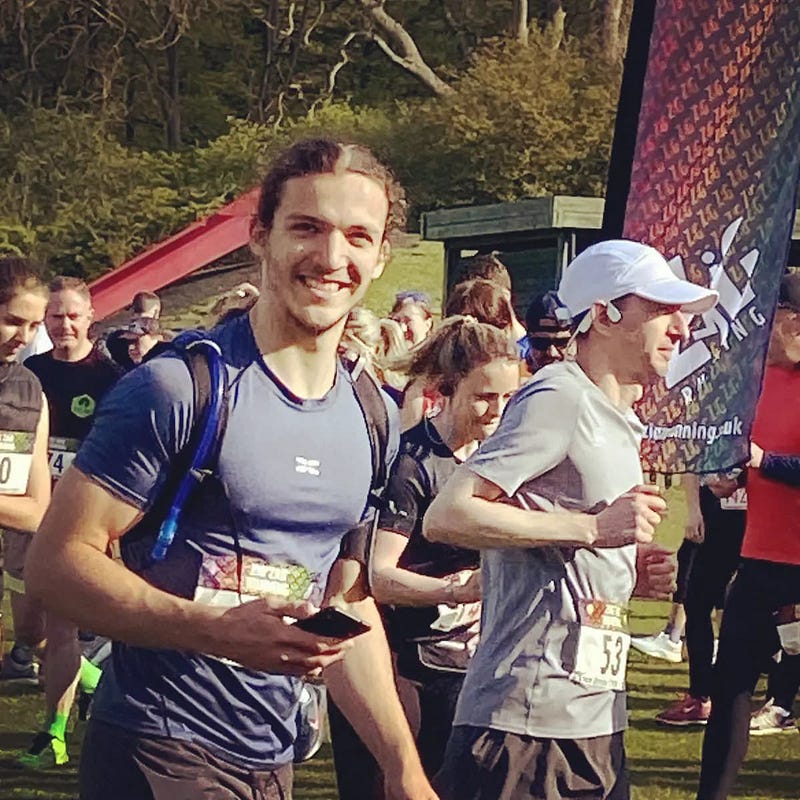
My first half marathon was a blistering 1 hour and 57 minutes — just three minutes shy of my all-time personal best. I was feeling strong, quick, like I could keep going forever. The heat was beating down on me, sure, but I was refuelling regularly and drinking almost constantly.
The 25km mark came and went and I was feeling the first signs of fatigue. That’s fine, I thought. Marathons are hard. I should expect fatigue. My biggest run ever was only 6 or 7km longer than this.
But the feeling got worse. By 30km, and definitely by 35km, I felt myself hitting the wall.
If you’ve ever hit the wall, you know: it hurts. Your body is screaming at you to stop at any cost. Your head is swimming. Your legs can’t possibly move you any further.
I crawled through the final 2 laps — almost literally. I couldn’t run more than a few hundred meters at a time without needing a breather. The pain had spread to my entire body.
Intrusive thoughts kept hitting me like a tonne of bricks — what if I need to get stretchered off? Nobody’s around — who’s going to call me an ambulance? Could I just collapse on this tree stump and wait for someone to find me?
It wasn’t a good place.
My rowing instincts kicked in somewhere in that final hour and I started chanting rowing calls to myself that our boat’s coxswain would frequently yell during a race:
“CATCH… THERE… CATCH… THERE…”
“We’re pushing… NOW! PUSH… THERE… PUSH… THERE…”
And so on. I must have looked an absolute state — and I felt like one, too. I have very few memories of that final 10km. I have a feeling it is the closest to delirium I’ve ever been, and perhaps I had fallen just on the wrong side of the sanity fence for a short while.
Eventually — and I don’t know how — I was in the last kilometer.
The last 500 meters.
I got ready. I’d been limping for the last couple of minutes, half-jogging, half-walking, entirely ready to give up and go home. But the shortest way back now was through the finish line. So, I figured, I may as well give it my best.
I limped up til the tree line, composed myself, and set out on a final charge towards the finish, set up at the far end of the field I had just entered. I felt like I was flying —though I definitely wasn’t, as my sprinting speed at this point was little more than what would ordinarily be a gentle trot.
300 meters left. I kept going.
200 meters. I could see my mum and her dog. They had seen me. She was standing up and getting ready to take pictures of me crossing the line.
100m. Nearly done. I could cry just about now.
And… I was done. Just like that.
“No more,” was all I could get out. “No more.”
The Aftermath (and The Electrolyte Problem)
I collapsed in a pile on the concrete entry to a building in front of me where the race HQ was hosted, in the small patch of shade that I could find. I was dribbling on the floor. Every muscle in my body was in agony. My bones felt like jelly. I couldn’t move. I don’t know how long I was there.
After what could easily have been a decade spent decaying on that cold slab of concrete, I dragged myself inside, motivated by one thought: Food.
Well, maybe two thoughts. I was also thinking about water. And maybe a nice chair, if my brain could push itself to three.
My mum and her dog had joined me by this point, and I staggered over to a table, where I slumped into a chair and put my head on the table. I didn’t know whether I was happy to have finished it, angry that I put myself through it, sad that it hadn’t gone better, proud that I had given it my best shot, or some mix of the above.
My problems weren’t over, however.
I felt myself lose control of my facial muscles. My mouth pursed. My arms started to vibrate as if they were iron bars somebody had struck with a hammer. I found it difficult to talk all of a sudden, and I couldn’t open my mouth wide enough to eat properly. I felt like I had forgotten how to chew. I was cramping up and shaking all over my body.
I mentioned to my mum — as best I could — that I had started to feel a little funny, and tried to describe the symptoms. I remember telling her that I felt like I sounded “really posh”, speaking through tiny, pursed lips.
Doing her best not to laugh at my now-quite-real delirium, though also, she later told me, slightly worried that her son was actually having a stroke, she suggested I take that one electrolyte tablet I had with me.
Yup, one whole electrolyte tablet.
In retrospect, I underestimated the importance of being prepared for electrolyte-related issues. I had been given this singular electrolyte tablet for free after a half-marathon race a few weeks before, and I packed it for my marathon entirely on a whim. May as well take it with me, I’d thought. Even though I’ve never tried one before and probably won’t need it.
Boy, was I wrong. Within seconds of taking the first gulp of the foul effervescent liquid that had once been crystal clear mineral water in my bottle, I felt I could control my face. My voice returned to normal. My arms were no longer sonorous. And my mental fog had cleared.
I’ve never felt anything like it. Not once. And I hope I never will again.
Take your electrolyte tablets, kids.
Conclusion
Look, marathons aren’t fun, I’ve found out. They’re hard, gruelling, and sometimes make you want to die.
But there’s some part of me — a big part of me — that wants to do more. Many more. After I’d done it and recovered from it, I couldn’t stop thinking to myself: I’m a marathon runner. I just ran a marathon. A sodding marathon. I am a marathon runner!
Finishing the marathon in 4h34, and the entire race (a fraction over a marathon — so an ultramarathon, technically?) in 4h37, wasn’t particularly quick. That’s a 6:30 pace per kilometre (despite the first half being 5:30/km!) I know I have it in me to sustain the 4-hour marathon pace, if I just take care of my electrolytes and learn a little more about preparing for all-weather distance-running.
At the same time, I am glad, in a way, that this marathon was such a disaster. There’s not much more valuable than making disastrous mistakes in life because, as learning experiences, they’re invaluable.
If I’d never gone and run that marathon, as poorly prepared as I was, I’d still know absolute jack about marathon running. I still don’t know much, to be sure… but at least now I know what electrolytes are for.

You just read another post from In Fitness And In Health: a health and fitness community dedicated to sharing knowledge, lessons, and suggestions to living happier, healthier lives.
If you’d like to join our newsletter and receive more stories like this one, tap here.