
I Published 40 Articles on Medium in October
Here’s what I learned

If you can’t explain it simply, you don’t understand it well enough. — Albert Einstein
Sometimes I feel that I shouldn’t teach other people (who am I to tell you how to write with 162 followers on Medium?). But then I remember something important about myself.
I learn by teaching others. And because all advice we give others we’re secretly giving ourselves, I guess we all do.
Nothing helps me understand the topic better than explaining what I’ve just learned to someone else. Preferably, to a kid. A kid won’t nod when you try to bullshit with fancy words. Rather, he’ll stare at you, confused, and say something along the lines of, ‘Nope, don’t get it, mate.’
Valuable feedback (such as the one above) disappears when you grow older.
I first learned about Medium a long time ago. But I wrote on it twice, and for no particular reason. It wasn’t until last month that I really started to dive deep and write regularly.
During October I wrote 40 posts and got published in eight different publications. In this post, I decided to put together key realizations and insights that I had over the past 30 days about what it takes to succeed on this platform
I know that there are readers here, on this platform, that are not (yet) writers and these lessons might be valuable to them. However, if you’re a seasoned writer, this article might help you remember simple (yet important) truths about the work we do here.
Let’s go.
You Never Know What Your Best Content Is Going to Be
You think you do. You think you control your writing success. You think you control what other people will like and what they don’t. You think you know what kind of post will make you successful, but the truth is… you don’t.
From my experience, I learned that it’s more valuable to stop paying attention to tactics, and rather to focus on the most important part about your work — writing itself.
For some reason, all my articles that got curated by Medium were very honest and from the heart. Whenever I sat down and planned the article thoroughly, highlighted my thesis, arguments, etc. (all of the stuff they teach you in grade school), my content was bad. Very bad.
And whenever I wrote something that I didn’t want to publish, wrote it for myself and really, really had fun with it — that was the best content I’ve created.
Rule of thumb: no matter how you feel about it, just hit ‘publish’. You just never know.
This week, I sat down to write a short post on why I like to travel. It was more like a journal entry and at the end, I didn’t even want to hit ‘publish’. I thought it wouldn’t be interesting to anyone. But for some reason I did, and in three hours I received the following notification:
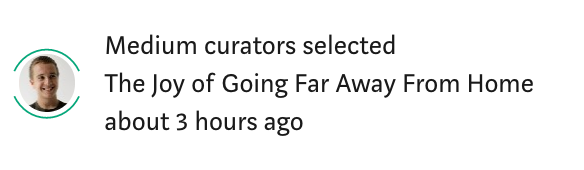
In fact, I tried this ‘from the heart’ approach during the whole week and I am happy to say that five out of my six written posts this week got curated by Medium.
Another thing that I found useful in my writing is to write the text first and only then come up with the headline.
Whenever I tried fitting my writing into the headline or a particular theme, it came out generic and boring. However, whenever I let go and just said what I had to say — that’s when my best writing came.
The quality of your writing is strictly subjective. Just let go. You don’t get to decide what will work. Your job is to write what matters to you and what’s really inside of you.
Write what you think, not what others want.
Live Life Outside Medium
I saw this advice when I first started writing. But you never really get what the person is trying to tell you until you go through a similar experience.
It’s important to live life outside of writing. Going to work, traveling, reading, meeting other people, going to conferences and exploring is what inspires your work. If you are writing non-fiction (which you probably are), how can you write about life without living it?
The tales of lone wolf writers, who lock themselves up in the woods until they come out with a ready-to-read novel are about fiction writers. They don’t need to go anywhere, they can live inside their heads. That’s where ideas come from.
For non-fiction online authors though, living and experiencing life fuels our creativity and allows us to come up with new ideas to write about.
Don’t Worry About the Metrics
We are all here to write.
More than that: we are all here to be recognized for our writing. We want claps (read: reading time), fans and oh, yes — money. Let’s not forget about the money.
When I started writing a month ago I’ve read this advice in somebody else’s blog and I thought to myself, ‘Ok, that’s all great, but how do I know whether what I am writing is actually good enough, if I don’t pay attention to the metrics?’
Back to Takeaway #1, you don’t. You never know what will succeed and what won’t. But this advice is not about closing your eyes every time you go on Medium so that you don’t see the circular green notification alert or the Medium Partner Program payout stats. No, please keep your eyes open. Rather, this advice is about letting go of your stats.
In the first couple of weeks, I was obsessed with my stats. Every hour of the day I kept on refreshing my Medium app, just to see who else clapped for my last article, or whether something I wrote got accepted by publications.
Such behavior is toxic.
Remember that there will be ups and then there will be downs. There is going to be what Seth Godin calls ‘The Dip’ — and not once, but a few times. If you focus on your stats, you might feel great when your work is being recognized. However, if all you do is refresh your page during the bad times, it might make you feel worthless.
You are not your number of followers, the money you make, or claps you receive. Don’t quantify your life and your self-worth won’t be tied to numbers.
The Six Months Rule
I’ve learned this in business, but it can be adapted anywhere. Even to writing.
Whenever I start a project, I tell myself to keep on it for six months and not think about the results, progress or even quitting. Just do what you are doing and wake up in six months to assess how far you’ve come. Only then decide.
This approach is great for three reasons:
- You forget about success. You tell yourself that there won’t be any kind of success (including good payouts) for six months. This allows you to be more patient and less anxious in your daily work.
- You put no pressure on yourself. If it won’t work in six months, you’ll just quit.
- You allow for the time to work its magic. Too often than not budding entrepreneurs or writers quit—and do so very early. They didn’t allow for time to pass and for the results to accumulate.
Until those six months expire, you don’t change course. You continue doing what you’re doing. In my case, it’s only been one month and my six months will expire in April 2020. Until then, I tell myself that my job is to write regularly.
Regularity and patience is key, but it’s important not to burn yourself out. I experimented with writing once a week, once a day and even three times a day, and found out that my best writing came when I didn’t push myself too hard.
Writing one home-run post that can get a lot of fans is much more effective than writing ten generic posts.
Don’t Overthink It
There is tons of advice out there — both on Medium and on Google—about what you need and don’t need to do as a new writer. Some of it is good, some of it is crap. Either way, I don’t think it’s a good investment of your time to spend hours researching it.
For example, there is advice that you should pick a topic and narrow down on it. Or two topics. But even though I agree that focus is important, I don’t think that’s what you should be doing. What you should be doing when you’re just starting out is writing as much as possible and finding your own voice.
You won’t figure out the topics and themes you like to write about (not to mention your style) until you write 100–200 posts. Make that your goal, and don’t listen to anybody’s advice. Their advice worked for them, so if you follow it, you’ll just be 2.0 version of them, when you should be you.
Don’t overthink it. Write. Think. Read other people’s writing. Respond to other people’s stories. Repeat. It doesn’t really matter what you do. Chances are, you are doing everything right. You don’t see the results not because you’re doing something wrong, but because it just takes more time. It’s hard — because it’s hard.
But It’s Really Not Hard
It just takes a lot of patience. Writing is (like long-distance running) for the patient ones.
If you’re just starting out and looking for tactics, they are simple:
- Write regularly (I suggest daily), make a great headline and take the time to pick high-quality images for your writing. I also suggest re-reading your work out loud and making a lot of whitespace (most people read on mobile).
- Write exclusively for publications to get exposure, but don’t wait for too long if you don’t get published. Just hit ‘publish’ and write another post.
- Respond to other people’s stories to support your fellow writers. Be thoughtful and caring. They’ll thank you and you’ll get inspired by them in return.
When you amass a certain following, do this:
- Build an emailing list. It’s a great asset to have (especially if you want a book deal later on).
- Start pitching those big Medium-owned publications like Forge or Human Parts. That’s where all the fun is, apparently.
These tactics are simple and they are there. But they are also secondary. And don’t really matter much. What really matters is patience — sticking with it, even when it’s hard (especially when it’s hard!), and treating it as a full-time job if you want it to become a full-time income.
I still have a long way to go. And you probably do too if you are reading this article.
Wherever you are on your journey, I wish you all the best.
I want to leave you with one final thought: Medium today is like YouTube in 2010. It’s a 100% organic reach (i.e., you can’t pay yourself to the top, at least for the time being) and full of opportunity. Embrace it. You’ll regret it later if you don’t
Let’s walk this path together.


