
ANECDOTE | PERSPECTIVE
I Only Get Asked Directions When I’m With My Dog
Is it me, the dog, or something else?
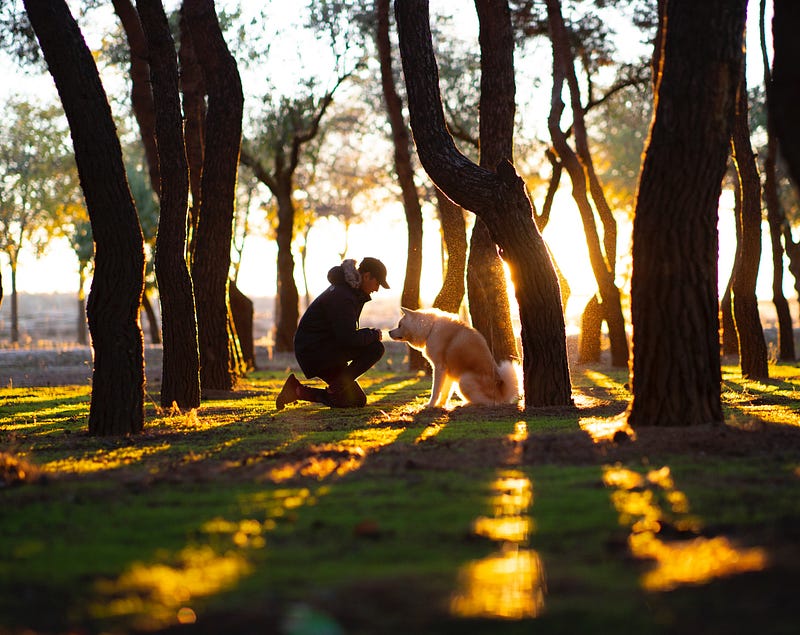
It felt like another of life’s small but meaningful observations.
Three years ago, I was living in Tokyo and had just gotten a puppy. On one of our first walks, a stranger approached me to ask for directions. It struck me afterward that, although I had lived in the city for 7 years by that time, it was the first time someone had asked me for directions.
I witnessed the same phenomenon when I moved to Singapore, where I currently live. I am only asked for directions when out with the dog and rarely when I’m on my own or with friends.
It got me wondering: how do people decide which stranger to approach for directions? To what extent does the presence of the dog or my “status” as a dog-owner affect their considerations?
There are lots of articles out there about how dogs make better people of their owners. I especially love this study by BarkBox a few years ago, which found that dogs made their owners more patient, more responsible, more active, and ultimately happier.
However, do dogs also make other people perceive dog-owners as better — or at least more helpful and friendly — people?
THEORY #1: IT’S ME
I think this can be ruled out immediately. As mentioned, I seldom get approached for directions when I’m on my own. On those rare occasions, my observation is that there was no one else around for the stranger to ask. Conversely, on most of the occasions when I’m with the dog and asked for directions, there were people around me, often very nearby.
I am curious as to why this the case. I generally try to help if asked; I certainly wouldn’t give the wrong directions if I’m unsure. (This is something of a problem in Asian societies, where people sometimes give wrong directions to “save face” and avoid not appearing as if they don’t know.)
I figure that there is probably nothing in my demeanor, aura, or gait that encourages strangers to ask me for directions. I walk fast. I look at the ground and avoid eye contact with people. My attention is usually on the music or a podcast I’m listening to. The only things I stop or slow down for are, unsurprisingly, dogs.
The bottom line is that I might not notice if someone tried to ask me for help if I didn’t have the dog with me. He is usually the first to detect someone approaching me and alert me to it.
THEORY #2: IT’S THE DOG
Do people approach me because they think my dog is cute (which he is, incredibly so)?
I would certainly enjoy giving directions to a stranger a little more if they express interest in my dog. There has however been no evidence that this is a factor in people’s calculations when asking me for directions.
There have certainly been people who approach me to ask about, play with, or take a photo of the dog. However, no one who has approached me for directions has paid much attention to the dog. There were even a few who were obviously scared of dogs but decided that I was their best bet.
I suspect that any stranger considering approaching a dog-owner for directions will consider at least the following three factors.
First, the breed of the dog. People will probably steer clear of breeds they consider dangerous, even though these are mostly misperceptions. In Singapore, certain breeds (such as the German Shepherd, Bull Terrier, Doberman Pinscher, and Rottweiler) need to be muzzled.
Second, the size of the dog. Even if the dog is not perceived to be a “dangerous” breed, people are probably not going to approach someone with a big dog (or at least a dog that seems very big compared to themselves).
Third, the demeanor of the dog. People are probably less likely to approach the owner of a poorly-trained dog. They would naturally steer clear of dogs that seem to behave aggressively. Neither would anyone want to approach a poorly-behaved dog that jumps all over them or humps their leg.
In my case, I reckon that people perceive my dog (a Shiba Inu) to be a relatively low-risk breed. There have not been too many stories of Shibas attacking or biting people. As a medium-sized dog, Shibas don’t come across as too intimidating. Mine also appears well-behaved — at least from afar — friendly, and playful.
In summary, I don’t think there is anything special about my dog that motivates people to approach me for directions. Rather, there is nothing noticeably alarming about my dog that would dissuade them from doing so.
THEORY #3: IT’S THE BOTH OF US
I hypothesize that the people who end up asking for directions harbor certain perceptions or stereotypes of dog owners.
One, people interpret someone walking a dog to mean that he or she lives in the neighborhood. The dog owner probably knows his or her way around the area and can point them in the right direction. This is probably true, although I was once asked for directions on our first walk after moving into the current apartment and was of absolutely no help whatsoever.
This reminded me of a 2017 study that found that pet owners were significantly more positive about their neighborhood than non-pet-owners. Notably, dog owners were significantly more positive than owners of other pets.
The dog and I do spend a lot of time exploring our neighborhood during our walks. I pass most of the shops and apartments a couple of times a day, navigating the area from various directions. As far as reliable directions go, dog owners are probably not a bad choice.
Two, people perceive dog owners to be helpful and friendly. This 2015 study found that the presence of a dog was associated with a higher rate of helping behavior. In other words, dog-owners were more likely to accede to a request for assistance.
This reinforces findings from other studies that dogs serve as a “social glue” in facilitating interactions between humans.
I’m not sure if I’m a naturally helpful or friendly person. However, when I’m out with my dog, I do try to be a responsible dog owner. Our collective image is often unnecessarily damaged by members who do not clean up after, vaccinate, or properly train or control their dogs. Therefore, the presence of the dog motivates me to be helpful when approached.
Three, they assume that someone out walking his or her dog has more free time than other people. They likely perceive walking the dog to be a leisure activity, an observation that would be reinforced by my standard attire of t-shirt, shorts, and flip-flops. Consequently, they might conclude that it is better to inconvenience someone who appears quite free than someone rushing to work or something important.
FINAL THOUGHTS
It is not as if I am being stopped every day by strangers asking for directions. There is little need for that nowadays given the ubiquity of smartphones and Google Maps. Consequently, it appears that the people who tend to stop me tend to face some limitations on the technology front. They have tended to be the elderly (less adept at navigating using a smartphone), blue-collar workers (trying to save money by limiting the use of cellular data), and tourists (who might not want to waste money on data roaming or a local SIM card).
The irony of the situation is that I would prefer to be asked for help when I’m on my own rather than when I’m walking the dog.
Walking the dog means that my attention is usually somewhere else, on the dog and whatever podcast I listen to (the excellent American History Tellers at the moment). I also have my hands full, with the dog’s leash in one hand, and his water bottle and possibly a bag of dog poop in the other. It’s not exactly pleasant to bring the bag of dog poop near my face in order to pause the podcast. (For some reason, it never occurs to me that I can tell Siri to do it.) If the environment is noisy, I have to turn on transparency mode or remove my AirPods altogether. Finally, I have to retract the leash and restrain the dog in case he gets overly friendly and jumps all over the stranger.
My request for all the strangers who may ask me (and my fellow dog owners, if I can speak for them) for directions in the future is therefore as follows:
- Assess the convenience of the situation. Sometimes, we might be dealing with a particularly feisty or rambunctious dog. We might have our hands full carrying stuff. See if there is someone else nearby who can help.
- Get my attention before approaching. I need a little time to get ready before I can attend to your question(s). I need to make sure that my dog is under control and not at risk of running in the road or being run over by cyclists and pedestrians. I also need to be able to hear you.
- Be reasonable and polite. There is no need to be impatient if I can’t give you an answer immediately. Don’t just tell me the name of some obscure building that no one but its residents or workers would know the location of. The name of the street (and cross or side streets) would help. And please don’t shove your mobile phone into my face and ask where the destination is based on the directions you have loaded from Google Maps. Irritating me will antagonize my dog too.
- Be nice to my dog. You don’t have to touch or play with him. (In fact, you shouldn’t touch a dog without first seeking the owner’s permission.) However, dogs can tell if you’re a bad egg. It will be impossible for me to nice to someone who is not nice to my dog.