
I Miss Columbine, Sometimes
I miss Columbine, sometimes.
Let me explain.
I was a sophomore at West Fargo High School in North Dakota on April 20th, 1999. We didn’t all have the internet in our hands back then, so we didn’t know it happened until we got home from school and saw it on TV. It was everywhere, on every station. Columbine.
It was shocking. We sat in front of the TV and absorbed it all, because we were numb and because we didn’t know any better.
Two students had opened fire at a high school in Littleton, Colorado. Twelve students and a teacher had been killed. Many others were still missing.
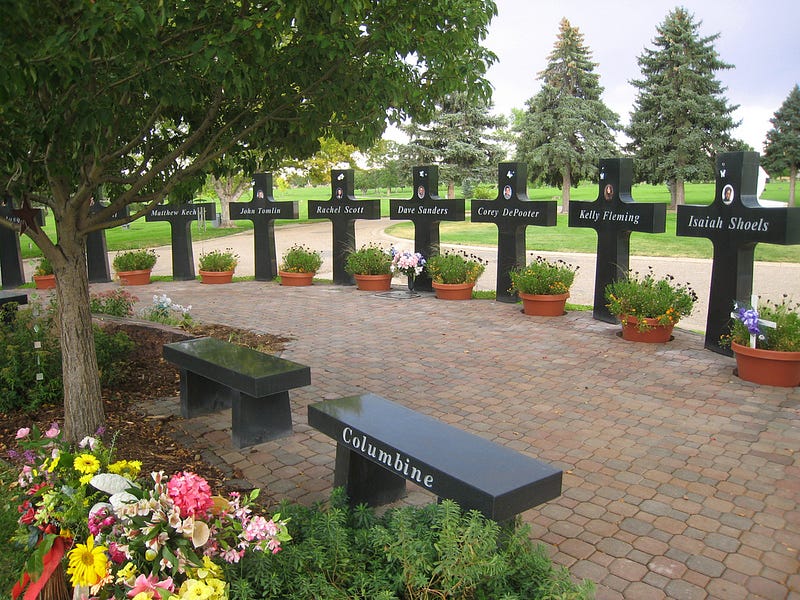
I suppose any American over the age of 30 remembers in vivid detail what unfolded. I can still picture the layout of the school- the cafeteria and the library and the staircase. I remember Rachel and Cassie and Isaiah and others. I remember Dylan and Eric too, unfortunately. I remember the hysteria of desperate parents gathering at the school, trying to find their son or their daughter safe and sound. I remember crying as we watched the nationally televised funerals. All of it is seared into permanent memory.
Columbine was in the news for weeks and months after that. There were books written- She Said Yes- and movies made. Columbine was in pop culture and in politics. We talked about it at school. We talked about it at church. We talked about it at home.
It was all so devastating. Two boys walked into school one day with a planned attack and murdered their own classmates.
School was no longer safe. The world as we knew it had changed, forever. A school shooting had happened and the country was indignant and outraged.
It’s not like that anymore.
Columbine was the first U.S. school shooting in 33 years where more than five young people were killed- and only the second in our history. In just 17 years since, there have been 8 more mass school shootings here in America.
Since Columbine, the U.S. has seen a total of 177 unique school shootings, more than one every month of school. They were spread across 38 different states around the country. In the last three calendar years alone, there have been 82 school shootings on American soil. They’re getting more frequent and more devastating.
At least 210 young people have died in a school shooting in the U.S. alone over these past seventeen years. That’s at least 210 too many.
School shootings happen so routinely in America that everyone is used to the news cycle by now. A shooting happens. There are horrifying images on CNN and a solemn moment on all the late shows. We have the usual discussions of gun control and video games and parenting ad nausem on Twitter and Facebook and every television round table.
Children die. The shooter’s name and picture are splashed across newspapers and televisions around the country. Fingers are pointed. Excuses are made.
We’re so familiar with the cycle by now that it barely even registers an impact on our emotions anymore.
A few days later, the next news story breaks, and we all move on.
One of the most devastating moments on television this year came in a stunning episode of American Crime season 2.
High school student Taylor Blaine, played brilliantly by Connor Jessup, had been pushed to the brink. An alleged rape victim, he had been bullied relentlessly by his peers as the tension built for him, for the accused, for his mother and the school and its headmaster.
Taylor sits quietly in the woods, scrawling names into his notebook. A hit list. He returns to his old school, where he has since withdrawn, and waits patiently for an hour for the headmaster to return. Something moves in him, and he begins to exit the school- perhaps his mind his changed.
Confronted again by one of the bullies just outside the school, a moment of stillness, then a single shot.
The moment is paralyzing. The scene a few minutes later in his mother’s restaurant where she realizes what he’s done, when she sees that everything has changed in an instant- no words.
The only problem for those watching is that the moment had been spoiled. Because we knew. We all knew. Everything had been building in a direction that could only end one way. A school shooting was a matter of when, not if.
Think about that: we’ve trained ourselves to expect school shootings.
What’s the last school shooting you remember?
Was it Sandy Hook? That was almost three and a half years ago.
What about Virginia Tech and Northern Illinois? How about Santa Monica and Red Lake? What about Oikos University in Oakland and Marysville Pilchuck HS in Washington and Umpqua Community College in Oregon?
Each of those shootings saw at least five young people killed. Murdered. We’ve already forgotten the names of some of the schools. Some we hardly remember seeing in the first place.
It’s all become a blur, really. You can tell yourself it’s because it’s all too awful, that you’ve tried to block it all out.
But really, it’s become altogether commonplace. Just another school shooting.
Many students survived that day at Columbine. They’re in their 30s now. Some of them no doubt have children of their own, in elementary and middle and high school. But what kind of school are their kids attending now?
Schools today have routine lock-down drills. Students are taught what to do in case of a school shooting, like the duck and cover drills another generation learned in case of an atomic bomb. Schools have metal detectors and assigned police officers. It’s all safer, safer than yesterday, but what about before that?
Your teenager born this millennium knows what Columbine is.
More accurately, your teenager knows what a Columbine is.
“Columbine” has become eponymous now. Columbine is a noun. Columbine is a verb. Young people who never saw those horrible images on their TV still know what a Columbine is. A Columbine is a school shooting now kind of like a Kleenex is a facial tissue. Students are trained to expect the worst. They know that the next school shooting could be their own.
And there will most certainly be a next.
We were outraged in those days and weeks following the Columbine massacre. That’s what it was, really. A massacre.
If an act of senseless violence could happen even in the presumed sanctity of a public school, what was safe? For many, especially this white North Dakota male, it was the breaking down of a barrier we had not previously faced.
We cried and mourned with the victims’ families. We offered an outpouring of support. We called for gun control and safety initiatives and that our schools would be a safe place once again. We demanded change.
It’s not like that anymore.
As of this writing, it’s been seven weeks since a school shooting happened on American soil. That that is surprising news is unacceptable. That I had to add ‘as of this writing’ because the sentence will soon be outdated is unacceptable.
When did we start just accepting it all?
A school shooting should not be mundane. It should not be inevitable.
Where is our outrage?
Somewhere along the way, we all just decided to sigh, shrug our collective shoulders, take a deep breath, and wait for a more palatable news story to come along. Oh no, not again, #ThoughtsAndPrayers, and on we went.
We should think. We should pray. But what if that’s not enough?
What if the fault no longer lies just with gun control or bullying or violence in media? What if the problem isn’t just the shooters anymore?
When we choose to willfully ignore what’s happening right there in front of us, our complacency makes us culpable as well.
What if we’ve become part of the problem too?
I hope to have children someday. I want them to grow up in a country where it has not become commonplace for them to expect an attack at the movie theater or at the marathon finish line.
Imagine…
Oh, another marathon bombing today…
How distasteful is that to read? How disrespectful? How unpatriotric? Why is that how we treat school shootings now?
Columbine made us angry. It made us outraged. We cared then.
Why have we stopped caring now?
I miss Columbine, sometimes.
If you like this article, please comment below and share it with your friends. Be sure to follow Brandon on Medium or @wheatonbrando for more sports, humor, pop culture, and life musings.