
I Met a Beautiful Lady at the Beach, and She Changed My Life
She loves sushi and weighs 1,000 pounds
I hate meeting new people. I’m terrible at small talk, anxious at gatherings where I don’t know many people, and cling to my wife like a barnacle. She’s outgoing.
Someone might ask, “Who do you want in the World Series this year, Brian?” My mind turns to goo, and I say, “Excuse me, I need to use the washroom.” Then I hide until it’s time to leave.
Sure, I’m outgoing, engaging, and gregarious—when I’m sitting in front of a keyboard. I can write, edit, delete, and look up World Series references at my leisure. The real-time world is far more difficult.
Because of my irrational fear, I’ve avoided situations where I’m expected to interact with strangers. Like volunteering.
That is until I met a mysterious sea creature who changed my life.
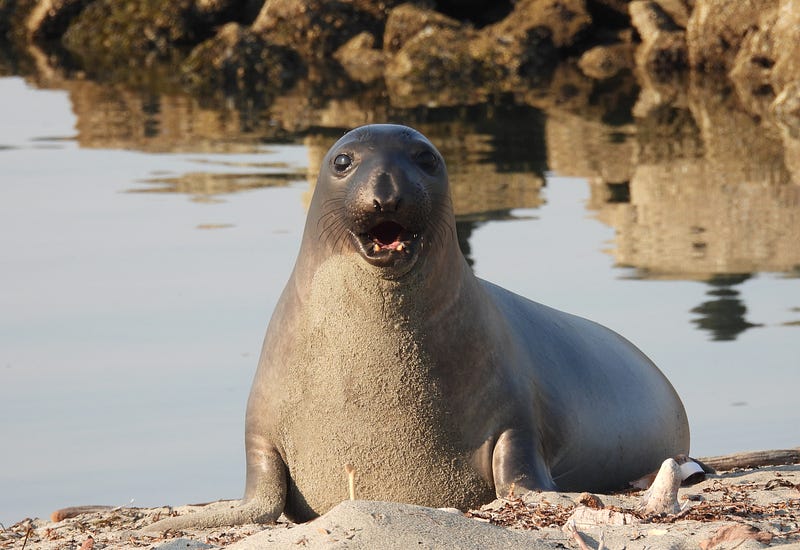
I met a northern elephant seal.
Careers took my wife and me to various cities around the country. Reminiscent of Goldilocks, we found most to be too warm, too cold, too crowded, or too hectic. When we found a place that was ‘just right,’ we bought a home and retired.
We live on an island off the northwest coast of Washington State, surrounded by forests, rivers, mountains, and the ocean — and all their remarkable creatures.
One day, my wife and I hiked along the waterfront to a local bay we loved. As we rounded the coastline, we ran into a line of orange cones and yellow caution tape.
A small group of adventurers gathered around, murmuring and pointing at a dark-brown lump in the middle of the boat ramp.
“Is that a seal?” I asked the young lady who looked official. Her tag said her name was Madison, and she worked for NOAA (National Oceanic and Atmospheric Administration).
“Not just a seal,” she said proudly. “He’s a northern elephant seal. His name is Emerson. He’s five weeks old now, and when he reaches puberty, his nose will look like a short elephant trunk — thus the name.”
“Wow! Really? What’s he doing here?”
“His mother, Elsie Mae, nursed him for a month while he grew from 60 pounds to 300 pounds — that’s 10 pounds a day — and now she’s gone far out to sea to feed.
“She abandoned him?” That sounded cruel.
“Yes, but that’s normal for these animals.”
“Normal?” I whispered to my wife: “Wish we could have done that with our kids.” She whacked me.
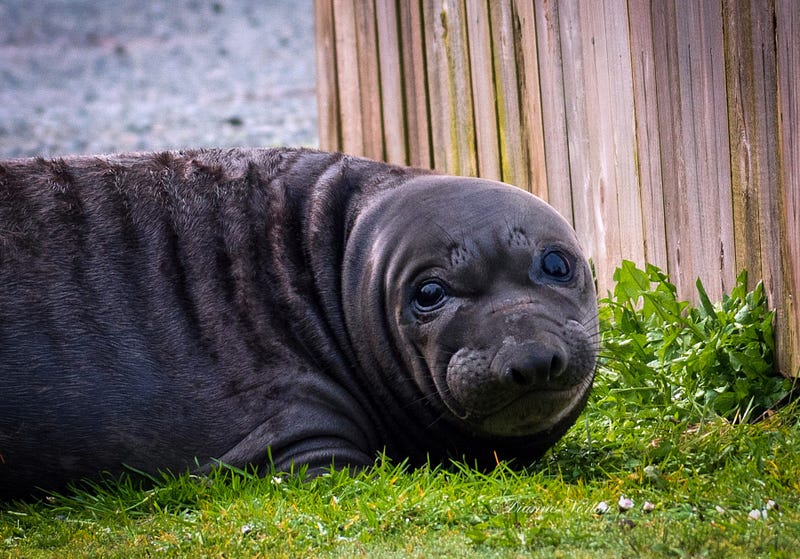
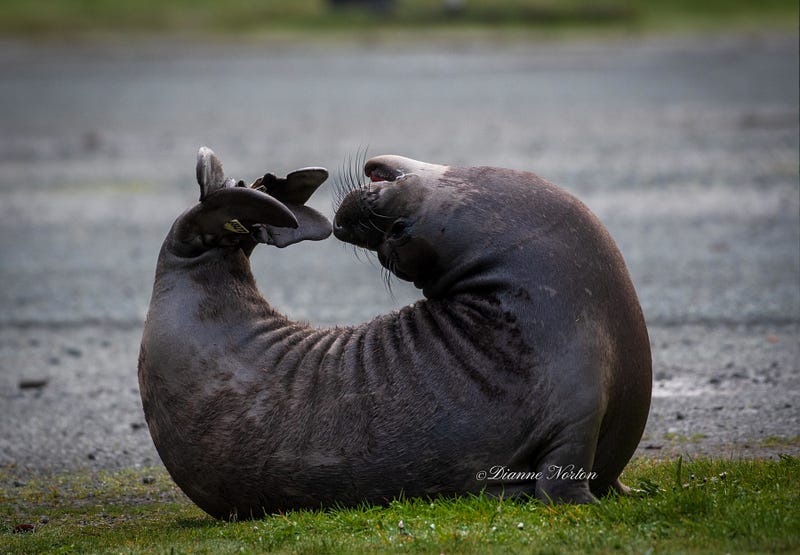
We chatted with Madison for quite a while and watched Emerson sneak glances at the crowd, waddle onto the grass, yawn, and stretch his little flippers, posing like a Hollywood movie star. He had a distinct personality and seemed to enjoy the attention.
As the group thinned and Emerson dozed, I leaned over the caution tape to get the perfect photo. His whiskers twitched, and he opened his big ink-black eyes and peered deep into my soul. That moment I fell in love.
I’m not a volunteer; I’m more of a disciple.
I don’t volunteer. Never have. It’s that small talk thing again.
When I retired, everyone said, “You should volunteer. It’ll fill your time with meaning and passion.”
I envisioned sitting around a table with a bunch of bored geriatrics painting signs and talking about carburetors and quilt patterns.
My wife asked Madison, “Oh, Emerson is such a cutie. How can we help?” I cringed, trapped with no escape.
No, no, no, no, no, I thought. We’ll end up standing on a cold, rainy beach talking to strangers, and I hate talking to strangers. What am I going to say to them?
“Emerson and Elsie Mae sure could use the help. Call Phil, and he’ll set you up. Here’s his number…”
On the trek home, my wife bubbled with glee. She’s always loved animals — all sizes and shapes — and called Phil as soon as we got home. A few days later, she dragged me along to meet him and discuss volunteering.
Phil was a fascinating, highly informed marine mammal expert who put us at ease and dazzled us with marine mammal stories.
“Did you know male elephant seals can dive as deep as 5,000 feet to feed?” Phil asked. “And they can hold their breath for an hour and a half!” No, we didn’t know that. He told us few people did, and it would be our job to dazzle the public with intriguing facts like those.
We could have fostered dogs — that doesn’t require small talk. We could have baked pies, donated blood, or cleared hiking trails.
Instead, we chose to volunteer with NOAA to protect marine mammals, starting with one so large that if she rolled over on me, she’d crush me into a pancake.
Soon after we signed up, Elsie Mae, little Emerson’s mother, hauled out of the sea onto a beach on our lovely little island. For the next four to six weeks, this 1,000-pound beauty queen would lie on the sand, shedding her skin. They call it catastrophic molting, though for them, it’s not a catastrophe.
When molting, these unusual creatures neither drink nor eat. They take nourishment from their blubber and lose 200 pounds in six weeks (a weight-loss program not recommended for humans).
Our first assignment was to protect this lovely lump called Elsie Mae while educating the public on her peculiarities. To prepare, I studied elephant seal facts and spoke with other volunteers who turned out to be fascinating people just like Phil.
My badge labels me as a NOAA Fisheries Volunteer with the Marine Mammal Stranding Network. It implies I’m an expert of sorts, but I feel more like an eager student.
Helping her helps me.
“Is that a seal?” a woman asked me. “It’s awfully big.” She held the hands of two disinterested elementary-age girls.
A thousand-pound dark-brown lump lay on the rocky beach behind me. A row of orange cones and yellow caution tape surrounded the scene.
“Not just a seal, it’s a northern elephant seal,” I said proudly. “They’re very rare around here.”
“What’s it doing?” one of her kids asked, looking at the lump.
“Is it hurt?” asked the other.
Several onlookers heard our conversation and sidled over to listen.
“Oh, she’s fine. She’s molting,” I said. “Once a year, elephant seals grow a new layer of skin, and the old layer falls off. That’s called molting. It can take as long as six weeks.”
“Their skin falls off?” The girls’ eyes lit up.
I held out a piece of molted skin to show them.
“That’s fur,” they said.
“Yes, these animals grow a skin of fur over a 6-inch thick layer of blubber. It’s cold out there in the deep ocean.”
They stopped squirming and squeezed up against the caution tape to watch the lump as we talked. I admired their innocent curiosity and barrage of questions.
“What does she eat?” Bottom fish and octopus.
“How old is she?” Five years.
“How much does she weigh? 1,000 pounds.
‘Does she have a boyfriend?” Maybe several (they giggled).
“Is this beach her home?” She always returns to this island.
“Do they have enemies?” Only orcas and great white sharks.
“When does she sleep?” She takes cat naps when descending to feed.
“How far can she swim?” Up to 15,000 miles a year — the longest of any marine mammal.
“What’s her name?” Elsie Mae. What are your names?”
People are amazing
A crusty old seafarer rode by on his bicycle. He cried when he told me about the loss of his wife and his job. Watching Elsie Mae cheered him, and he returned every single day to check on her, rain or shine.
A family from Germany came to visit. They’d never seen the ocean, much less a northern elephant seal. Their youngest boy spoke very little English, so we pantomimed how Elsie Mae caught and ate octopus. Everyone around us turned and watched the show.
A family from Colorado wandered up to see what the commotion was. They stayed for an hour, taking hundreds of pictures, asking questions, and watching in awe.
Scores of locals getting their daily exercise walked by to check on Elsie Mae. Some came every day as if they’d adopted her. They painted pictures, made hats, and published books and calendars. I got to know many of them and made more friends than I’d ever expected.
And yes, I made small talk — hours and hours of it. The other volunteers are my friends now, and I wouldn’t trade them — or Elsie Mae — for the world.
She comes to my little island twice a year to give birth and molt. She doesn’t know it, but she also comes ashore to inspire me, and hundreds of other people, to be better humans than we thought we could be.
She’s gone away to the deep ocean now, but before she went, she left me a gift. A gift of companionship and wisdom. I learned that volunteering is a cherished honor, and because of it, I’m a better person.
Thanks to a beautiful lady I met on the beach who weighs 1,000 pounds and loves to eat sushi.