
I May Destroy You, Is Artfully Subverting Norms
Michaela Coel’s New Series Quietly Debunks Racial Stereotypes
The media shines a very narrow spotlight on the depiction of Black people, both in the UK and across the globe. What was once satire or stereotype is now, due to the one-sided narrative, believed by many as fact.
Worrying, to say the least, that a Black person can walk into a room and be presumed to love rap music, smoke marijuana, be unable to swim, and have no idea who their biological father is.
Premiering on BBC One in the UK and HBO in the US, I May Destroy You, (abbr. IMDY below) is a twelve-part series that deals with the after-effects when a young woman is raped. Yes, the series deals with a heavy subject matter, but what it also does is show that Black people are as emotional, free-spirited, and as multi-layered as… well as they’ve always been.
Black People do recreational drugs
When it comes to the depiction of drugs and Black people, they are either portrayed as being heavily addicted or selling, with the added violence of turf wars and guns.
Cocaine isn’t reserved for White men who work in finance like Patrick Bateman (American Psycho) and Jordan Belfort (The Wolf of Wall Street), and MDMA/Molly isn’t for their bored middle-classed kids.
This isn’t a debate about the illegality or morals of drugs — just to comment that IMDY unhinges the idea that when Black people do drugs it’s bad, but when White people do it, it’s fun.
Black Women are not ugly
Contrary to popular belief, and statistics taken by dating sites that show Black Women are ranked most likely to be ‘swiped left’, Black Women are desired — and not just by people with fetishes or Black Men/Women.
Arabella’s (Michaela Coel) character captures that wonderfully in IMDY, by not having the topic of the colour of her skin come into the conversation as she hooks up with the likes of Biagio (Italian) and Zain (South Asian).
When cast as a romantic interest, they’re usually played by biracial or multiracial women with lighter skin tones, such as Halle Berry or Zendaya. — Sofi Papamarko (2017)
That makes this message doubly prevalent, is that it showed a dark-skinned Black woman as the object of constant desire, deflating the myth that they are ignored by all other races.
Black People aren’t fighting one another
There is a very strange misconception that Black people are always in competition with one another. Chasing the same man, the same opportunities, and then slashing tires and spreading rumours to make sure we come out on top.
Nope.
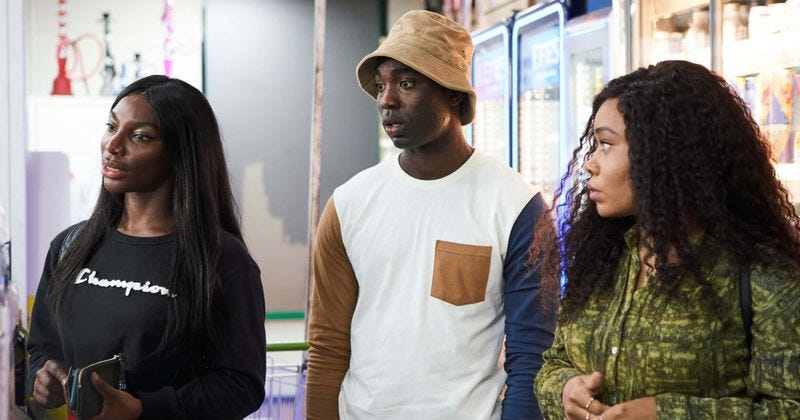
Arabella and her best friends Terry (Weruche Opia) and Kwame (Paapa Essiedu) showed the balance of being a supportive friendship group and also knowing when to call each other out on their bullshit.
The championing continued by the numerous Black Women who approached Arabella (who is Twitter famous) in the street. Catching jokes, getting selfies, congratulating her and showing unwavering support for her next project.
Thinly veiled racism and microaggressions are not lost on us
We may smile tightly, we may choose not to engage but the comment has been registered, logged and there is a red flag by your name.
There is a scene where Terry is at an audition and someone asks if it’s her real hair. It was, of course, a wig, but then they asked if she could remove it so they could see it natural. It showed what a lot of actresses face in some form or another, which is the heavy lack of knowledge towards Black culture — and the unwillingness to learn.
What IMDY did well was to highlight the unconscious bias faced by Black people by medical professionals. Their information is often based on old textbooks that were written with White patients as case studies, and all Black people are grouped as one, noted when Arabella is called Black-Caribbean instead of Black-African.
The asexual white best friend
Typical for a lot of movies (Hallmark ones are especially guilty of this), is the protagonist having a Black best friend who the audience knows nothing about. They have zero personality (‘Sassy’ does not count) or personal objectives, their only job is to act as a soundboard for the protagonist. A way for them to talk to themselves without actually talking to themselves.
The term ‘The asexual Black best friend’ was coined by actress Gabrielle Union.
Completely flipping this notion on its head, IMDY gave us Ben, Arabella’s flatmate. All I can tell you about him is that he is nice. From what I remember we never even saw him outside of the flat and he never argued or disagree with Arabella, Terry or Kwame. The role that is normally reserved for Black characters.
Black Men can be gay
This one is shocking to a lot of people, probably due to the stereotype of the homophobic Black man which “suggests black people are more inherently homophobic given their cultural exchanges in hip-hop and religion” — Ernest Owens (2019)
Kwame, one of the main characters is an openly gay man, and the show brought in a tirade of unnamed Black male faces to drum in the fact that it is not an unusual sight.
We understand different forms of the story — AND how to tell it
The stories Black writers and directors are allowed to tell are typically very limited. We all know these stories tend to surround slavery, activism, or the first steps in our history, etc.
IMDY, within its twelve episodes of half an hour television, showed range. All of the above was woven into the greater story arc of protagonist Arabella’s ordeal and how she deals with it.
Narrative devices used included telling stories through social media, flashback episodes, and alternative endings to name a few. And none of this was racially filled — it was just good storytelling because being a great storyteller isn’t defined by the colour of your skin.
Undoubtedly there are more nuances I might have missed and so if you haven’t already checked out I May Destroy You, I would recommend you do so (trigger warning: rape). Not only for the story but for how it might start to unravel some of the stereotypes you’ve come to believe about Black people.
Others from the vault:


