
I Made $3,100 Selling Digital Stickers. Here’s How You Can Too.
Breaking down how I hit number one on the App Store charts
I run the @goldenretrievers account on Instagram.
At two million followers, it might seem like I should be raking in cash. But the reality is that monetization has always been my biggest challenge. @goldenretrievers curates dog pictures and videos, and when it comes to curation accounts, your audience follows you for the theme (in this case, Golden Retrievers). This is different from influencer accounts (think Logan Paul, Kim Kardashian, Emma Chamberlain), where people follow to see the person running the account.
Monetizing curation accounts is tricky. Influencers get away with posting ads because the content still revolves around them — their face, personality and shtick. In contrast, post one too many ads on a curation account and you can kiss your engagement rate goodbye. In my case, if it’s not a Golden Retriever, the audience doesn’t want to see it.
To monetize a curation account, you need to sell something strictly relevant to your audience’s interest. In 2018, I created an iMessage sticker pack to see if I could satisfy this criteria. I paid an excellent artist $1,500 + 10% of sales to create 35 cartoon Golden Retriever drawings, maximized for cuteness. I called the character Sunny the Golden Retriever, bundled the drawings into a sticker pack, then sold it on the App Store for $0.99.
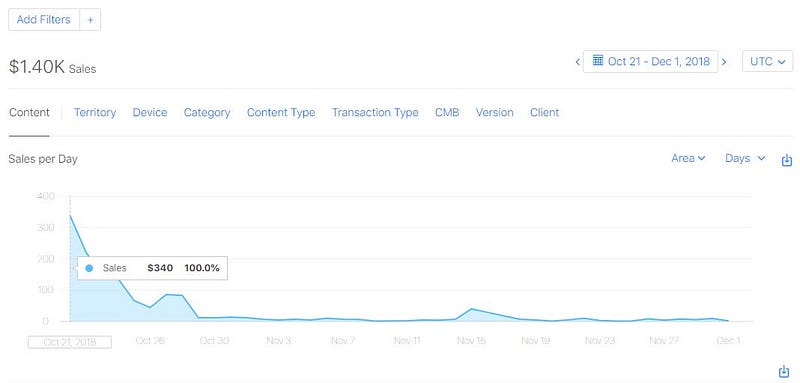
The marketing was simple. I advertised it on Stories, and with just under one million followers at the time, @goldenretrievers landed the sticker pack over 400 downloads on day one ($340 revenue after adjusting for foreign currencies).
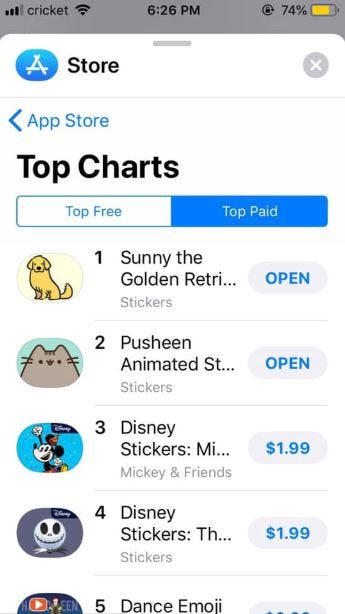
It also hit number one on the charts for 24 hours, briefly unseating cartoon titan Pusheen.
Since then, I’ve evolved the art style and created several newer versions (search “Sunny the Golden Retriever” on the App Store to see the latest iteration). Altogether, these sticker packs have generated $3,100 in revenue.
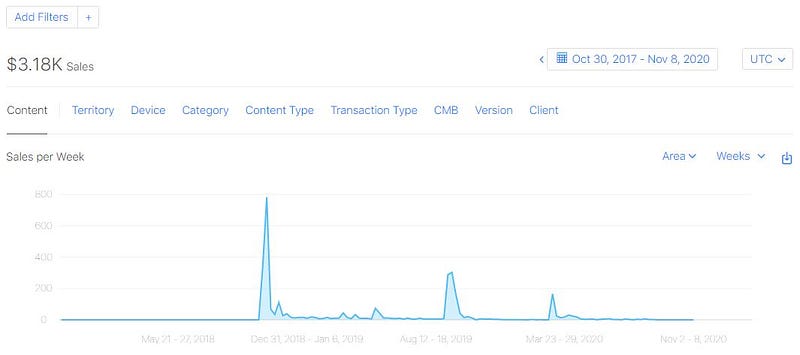
Sadly, I’ve since lost interest in both the Sunny the Golden Retriever brand and art in general, hence the large drop-off in sales this year. I’ve realized illustrating cartoons just isn’t something I’m passionate about. That said, I also realized this can still be a great way for creatives to make money. Let’s take a moment to explore why and how.
The Business of Digital Stickers
Digital products are an entrepreneurial dream, thanks to how easy it is to fulfill orders. Digital stickers are no different. The customer makes the purchase, downloads the product, and the transaction is complete. No need for packing, shipping or any related logistics.
Better yet, you only have to create the product once because the internet allows you to distribute at scale. Draw one set of cartoons, then sell it to as many people as you can. Whether you sell one unit or one million, your product costs are the same.
Some businesses drive truly impressive numbers via digital stickers. Pusheen, perennially top 5 in the App Store, pulls an estimated $300 a day through their animated sticker pack (that figure is extrapolated based on how many units I needed to sell to hit number one). And that doesn’t include their sales on other platforms like WhatsApp and LINE.
Plus, the digital sticker market itself is massive. LINE generated a jaw-dropping $268 million in digital sticker revenue in 2015, the year before they went public.
A Few Downsides
Like with most businesses, digital sticker revenue doesn’t translate one-to-one with profit. For example, both the Google Play Store and Apple’s App Store take 30% of every dollar you make, which means my gross profit on that $3,100 in revenue comes out to roughly $2,170 in profit. Meanwhile, LINE takes a whopping 65%.
It can also be hard for small creators to find motivation due to the price ceiling. Sticker packs typically sell for either $0.99 or $1.99, with most priced as the former. If the platform takes 30%, the average sales generates just $0.70, meaning you have to sell 143 units just to make $100. Unless your brand already has massive reach, you may decide you want to focus your efforts on higher value products.
Finally, outside of LINE, it doesn’t seem like many platforms are taking this market seriously. The App Store’s sticker store, for example, is notoriously hard to access, requiring the user to open the iMessage app and hunt for a tiny blue icon (I’m not sure why Apple hasn’t made their UX more consumer friendly, considering LINE’s wild success).
How to Sell Your Own Digital Stickers
Nevertheless, if you’re creative and like this concept, the template is straightforward.
First, build an audience on social media. A while back I wrote about how I think you should build an Instagram account around original content, rather than curated content. But if your end goal is to sell digital stickers, creating a curation account around your niche can work.
(Alternatively, if you don’t want to spend time building a new account, you can instead identify influencers in your niche and buy shout-outs)
Once you’ve built your audience, design a pack of at least 20 stickers. Price it at either $0.99 or $1.99. Tip: the App Store favors animated stickers and will be more likely to feature you if you cater to their preference.
Then, link to it on social media. I suggest promoting in Stories, rather than on your main feed. Stories allows you to surround your promotion with your typical content, which makes it feel less spammy.
A Great Venture for Artists
Despite its shortcomings, digital stickers are an excellent way to make money for artists in particular. They’re cheap, fun, and for talented artists, potentially low-effort.
They may not have high margins, but they’re a lot of fun to both create and use, and can be a great way to get your fans to spread your brand to friends and family. As far as internet entrepreneurship goes, it’s not a bad way to make a side income, and has the potential to grow into a significant revenue stream.


