avatarUlf Wolf

Free AI web copilot to create summaries, insights and extended knowledge, download it at here

1458

Abstract

s.”</p><p id="5a12">She laughs. “No, it was definitely a bald eagle. I’ve seen him a few times lately, and this morning as well.”</p><p id="d43b">“I envy you,” I say.</p><p id="2a2e">“Why?”</p><p id="2d54">“I don’t see that well. They’re all ospreys to me.”</p><p id="e389">“Ospreys are not that large.”</p><p id="2998">To which I can only shake my head and say, “I rest my case.”</p><p id="452e">Then there are the <i>really huge</i> ospreys that circle above what appears to be a dead seal down there on the beach below. “Vultures,” says a friend.</p><p id="3424">“Not ospreys?” I clarify.</p><p id="f8bb">“Oh, no. They don’t eat carrion.”</p><p id="ce91">“Vultures, huh? I wish I had your eyesight.”</p><p id="c02e">“Yup, vultures. Much bigger than ospreys, too.”</p><p id="8838">Vultures: now, there’s a much-maligned bird for you.</p><p id="dbc3">As I grew up, I never saw one in real life. Vultures are rare in Sweden, especially up north. “Gam”, they’re called, usually referred to as “Asgam”, which means carrion vulture. I learned about them in school, of course, and saw them in movies where they always circled way high above someone out in the desert busy dying — just awaiting death’s <i>fait accompli</i> as it were. The word gam, or asgam, always left a bad taste in my mouth. They were not good birds, the hyenas of the sky, they were. And ugly, too — at least from the long neck up.</p><p id="fc78">And so, for seventy-odd years I’ve not lik

Options

ed vultures much. Ospreys are much nicer said my book. Until that day when I watched the vultures circle and settle and then <i>actually take polite turns</i> approaching and nibbling on the dead seal pup. That day I realized that these birds were not bad birds at all. If a bird was bad, it was the osprey who will hunt for live, quite happy fish tirelessly until it catches and kills and eats one to then go right back out hunting and killing and eating some more. Not very Buddhist at all.</p><p id="73b0">The vultures, on the other hand, they don’t kill to eat, they eat the already dead (much like the grocery store hunter who only captures [buys] already dead meat to then fry up or stew or whatever and devour).</p><p id="977e">Vultures are nature’s cleanup crew. They are good birds.</p><p id="fa70">Buddha birds.</p><p id="e357">© Wolfstuff</p><div id="3488" class="link-block"> <a href="http://wolfstuff.com"> <div> <div> <h2>Wolfstuff</h2> <div><h3>So, who am I? Really really. I could tell you that I was born in northern Sweden during a snow storm, and subsequently…</h3></div> <div><p>wolfstuff.com</p></div> </div> <div> <div style="background-image: url(https://miro.readmedium.com/v2/resize:fit:320/0*ZU58bT1pqI3yaQkt)"></div> </div> </div> </a> </div></article></body>

I Love Vultures

Buddha Birds
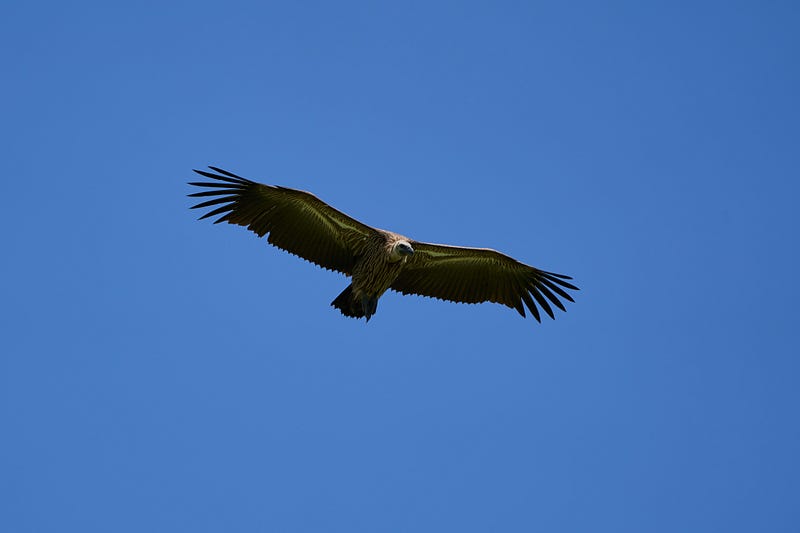
Photo by Dmitrii Zhodzishskii on Unsplash

Vultures do not kill to eat They eat the already dead Cleanup crew

They have got a bad rap, these magnificent birds. But, really, they are Buddha Birds.

They don’t kill. They eat the already dead.

These days, the way my eyesight is going (the same way as the Dodo, incidentally) to me there are now only four kinds of birds: Ospreys (for all birds of prey), Gulls (for all sea birds), the ubiquitous Crows (including their bigger siblings Ravens — they ought to wear signs, you know, these two: an “R” for Raven and a “C” for crows, to help us tell them apart), and Sparrows (for all small birds — though at times I can make out swallows as well, darting within arm’s reach).

I loved Ospreys the best. I loved to see them glide around up there on beautiful, spread wings.

“Did you see the bald eagle?” wonders a fellow morning walker sort of out of the blue.

“No,” I say. “To me, they’re all ospreys.”

She laughs. “No, it was definitely a bald eagle. I’ve seen him a few times lately, and this morning as well.”

“I envy you,” I say.

“Why?”

“I don’t see that well. They’re all ospreys to me.”

“Ospreys are not that large.”

To which I can only shake my head and say, “I rest my case.”

Then there are the really huge ospreys that circle above what appears to be a dead seal down there on the beach below. “Vultures,” says a friend.

“Not ospreys?” I clarify.

“Oh, no. They don’t eat carrion.”

“Vultures, huh? I wish I had your eyesight.”

“Yup, vultures. Much bigger than ospreys, too.”

Vultures: now, there’s a much-maligned bird for you.

As I grew up, I never saw one in real life. Vultures are rare in Sweden, especially up north. “Gam”, they’re called, usually referred to as “Asgam”, which means carrion vulture. I learned about them in school, of course, and saw them in movies where they always circled way high above someone out in the desert busy dying — just awaiting death’s fait accompli as it were. The word gam, or asgam, always left a bad taste in my mouth. They were not good birds, the hyenas of the sky, they were. And ugly, too — at least from the long neck up.

And so, for seventy-odd years I’ve not liked vultures much. Ospreys are much nicer said my book. Until that day when I watched the vultures circle and settle and then actually take polite turns approaching and nibbling on the dead seal pup. That day I realized that these birds were not bad birds at all. If a bird was bad, it was the osprey who will hunt for live, quite happy fish tirelessly until it catches and kills and eats one to then go right back out hunting and killing and eating some more. Not very Buddhist at all.

The vultures, on the other hand, they don’t kill to eat, they eat the already dead (much like the grocery store hunter who only captures [buys] already dead meat to then fry up or stew or whatever and devour).

Vultures are nature’s cleanup crew. They are good birds.

Buddha birds.

© Wolfstuff

Vultures
Carrion
Cleanup Bird
Birds Of Prey
Polite Birds
Recommended from ReadMedium