
I Lost a Brother
How national division became personal division for me
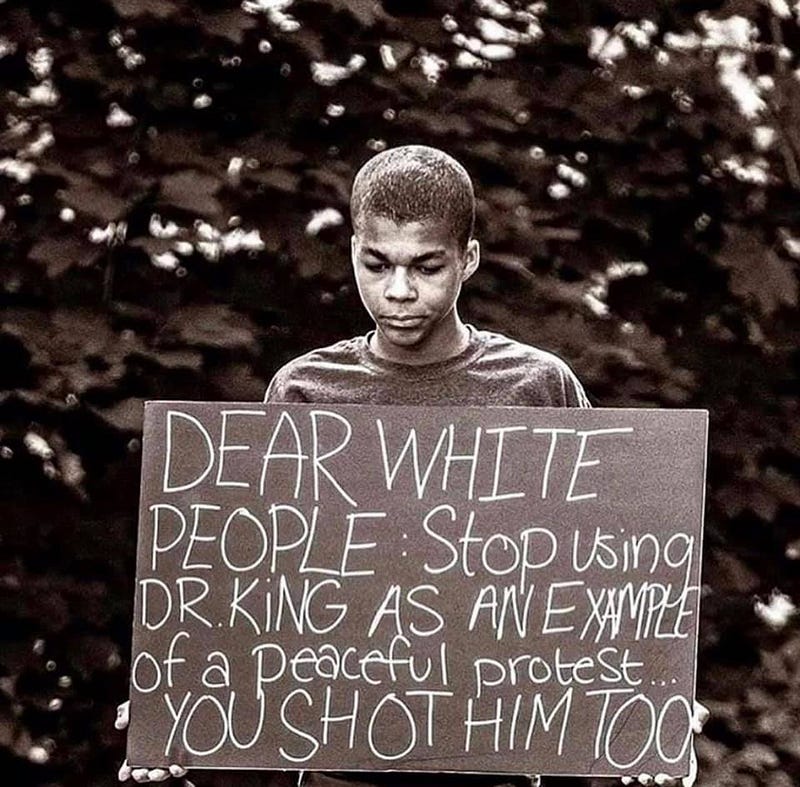
I saw this image on my Facebook feed some time ago, shortly after George Floyd was killed. It was shared by a friend of mine, and appeared to have been posted by someone else on whose page my friend had seen it and shared it. Regardless of how it got there, this picture (which was one of a handful) was staring at me on my Facebook feed with my friend’s name underneath it.
I was concerned.
I considered this man my brother. We had served together for a few years in the Marine Corps. We’d not been in combat together, but I’d been many times and I assumed he’d been, too (a safe assumption for any Marine at the time when two wars were ongoing). We weren’t the kind of brothers that hang out all the time, but I’ve never been very sociable. I considered him a brother the way I consider everyone a brother (or sister) who signed that blank check to the government up to and including their lives. Marines in particular have a stronger bond than the rest of the military. I know what kind of training he’s received and what he’s capable of. We’ve fought each other as part of our shared martial arts training. If you’ve never fought someone, it’s the oldest form of male bonding in human history, and for good reason. I knew, without a shadow of a doubt, that if we were in a life-and-death scenario that I could put my life in his hands and that he knew he could put his life in mine. We would absolutely run into a hail of gunfire for each other if needed, but more likely together, shoulder to shoulder, in defense of others.
So, when I saw this picture with his name under it, I knew there was no way he could agree with this sentiment. Maybe he was merely sharing the series of images in order to start a discussion or share the work of the photographer (which was admirable). I asked him a few questions to figure out why he was sharing. “Do you really think I shouldn’t look to Dr. King as an example? Do you really think I shot him? Do you really think we should all be held accountable for what other people have done because we share some superficial characteristic that we have no control over?”
I expected him to respond with, “of course Dr. King is an example we should all live up to, but…” and provide some insight that this photo had that I wasn’t seeing. I thought at worst he would say, “It’s symbolic. Obviously, you didn’t kill him, but white people did, and I’m trying to point out that white people don’t really let black people protest peacefully,” which would’ve been pretty flawed, but a starting point for a discussion.
He never answered any of those questions. We went back and forth a few times with some other people joining the conversation, some seemingly trying to understand each other and some not, but he never answered my questions. The subsequent conversation indicated that this man who I thought of as a brother, if he was not in complete agreement with the sentiment in the photo in question at least had no intention of acknowledging anything wrong with it or in understanding why I was questioning it. I grew steadily more disheartened as this conversation unfolded up until the point that he accused me of playing the victim.
I was flabbergasted.
I was paying attention to him and truly trying to understand the message and movement in general and my brother’s feelings specifically. It’s why I checked my ego in the face of this absurd murder accusation levied at me and asked questions instead of getting angry or blocking him.
I understand that the country is being very divided over a lot of issues. I thought those with pre-existing bonds would be more willing to engage each other. I thought that it was mostly division in the media and social media by people who didn’t really know each other. In this case I was wrong. Heart-breakingly wrong. Maybe he didn’t feel the bond the way I did. I don’t know how this happened, but it did. This was the moment that I realized that the division is more widespread and rampant than I’d thought, and that it’s only going to get worse as more and more people experience their version of this moment.
Regardless, it’s clear I can’t really talk to my brother about this anymore, because he’s not willing to listen.
It seems like it’s very easy for people to be divided like this, but very hard to stop people from being divided unless they already agree on all aspects of these important topics. I’m finding it increasingly difficult to see us avoiding an end of the United States. If we can’t work out disagreements between people that have meaningful, personal connections to each other, and we’re increasingly antagonistic with people we don’t know, what other outcome is likely than a national divorce from each other? It gets even worse than this worst-case scenario because it’s highly unlikely that such a divorce is going to be peaceful. The United States has already tried this a few times. There’s no mechanism established to do it peacefully, so it’s unlikely to be peaceful, especially with such animosity between the parties.
I felt the need to provide a personal anecdote that seems symptomatic of our current national problem. Maybe I’m in the minority. I hope I am. I hope this isn’t happening to very many people, but I’m afraid it is, and I’m afraid it’s only going to happen to more people as this radical left movement grows. Maybe my story helps other people reexamine how they’re seeing their brothers and sisters. We have to unite, not divide. I don’t know how to prevent all the division. Obviously, I failed in this instance. If you succeed, please share and help others.


