
Working From Home, Pain-Free at Last!
A homemade dynamic workstation made all the difference
I’ve worked from home as a self-employed designer, writer and editor for over 30 years. During that time I gave birth to and raised 4 children with my wonderful husband and business partner by my side and experienced the ups and downs that can go with working from home:
- flexible hours
- lack of motivation
- success
- failure
- the ability to control my work environment
- declining physical health when I felt too busy to sleep, eat or exercise.
The wake-up call
One day when I was in my early 40s, I discovered that I waddled like someone twice my age and size, and couldn’t get up off the floor without holding on to something.
What a blow for this once slim, fit and healthy woman! I mean, I once taught myself to do the splits just because I could.
How had I come to this??
Eyes opened by a bitter reality pill, I saw things were even worse than at first glance. My daily choices over the past couple of decades had caused me to:
- put on 20 kg (44 lb)
- suffer from recurring back pain, sometimes so severe I couldn’t move without help
- often nod off at my desk
- bring on premature presbyopia
Perhaps you’ve experienced something similar, or maybe you’re at the start of your work-from-home journey and are looking for some guidance so you won’t fall into patterns you’ll one day regret.
It’s time to learn how something as simple as your workstation and your attitude toward movement can affect not only the work you’re doing now but also the life you live outside of work.
I’m not making any medical claims and I’m not suggesting that you’ll have the same outcomes, but I know that these are true principles. Apply them with wisdom, and you’ll see changes for the better.
30 years of workstations
For nearly three decades I worked at a desk in front of a computer screen or a piece of paper, in whatever part of our home was designated “the office”. I’d sit there for up to 10 hours a day, or more, if there was a deadline to meet.
I had a comfy chair with the cushions arranged just so, to help support the bad back I’d had since I was a teen.
Over the years, I bought various things to make sitting more comfortable. I tried kneeling chairs, cheap Kmart office chairs, expensive ergonomic chairs and exercise balls, all of which were variations on a theme of ‘chair’.
Chair (my definition) = any device that allows the human body to sit upright on their rear with legs bent at approximately 90˚.
I’m aware of hybrid sit-stand chairs where your butt is propped up and your feet extend forward, but be warned that they don’t solve all the problems caused by sitting.
Don’t buy a treadmill desk, and ditch the ergonomic furniture.
The catalyst for change was (surprisingly) my expensive treadmill desk — although I’m not recommending them for some very good reasons.
It felt revolutionary at the time, and I thought it would be THE answer I was looking for. However, not only did I not lose weight with all that walking, I began to suffer additional pain in my feet and hips.
One day I was talking with a good friend of mine who is a podiatrist and a Restorative Exercise Specialist, and she gently let me know that the issues I was having were likely from the change in gait brought on by my treadmill.
What she said made sense, so I began researching gait and soon found the writings of Katy Bowman. Her blog is a wonderful rabbit hole to explore, with enough layman-friendly scientifically backed information to keep you busy for weeks.
My new obsession, or, how to find out who your friends really are
I gobbled up the information and happily talked the ears off anyone and everyone about what I was learning. It was a revelation! The light had gone on, and I would never be the same.
Did you know that the way you get up off the floor can be a mortality predictor? Getting up from cross-legged position is still something I’m working towards, but I’m much closer to it in my 50s than I was in my 40s. Progess feels wonderful.
Before selling the treadmill desk, I dragged a table in front of it to simulate floor-sitting because I’d read that this was good for the hips. While it sounded great in theory, I came to realise that too much of anything is never good in the long run.
Ergonomic shmergonomic
To read more about why I hold a significant amount of disdain for any furniture labelled “ergonomic”, see the section on Movement below. My main beef with the term comes from the tendency of many people to outsource their good alignment habits to something external to themselves.
The chair becomes a cast for your body, and as a result the body shapes itself to the contours of the chair. When the chair does the work, the body doesn’t have to. That results in weaker supporting muscles. Read more here.
All hail the dynamic work station!
Fast forward to today. I’m now in my early 50s and mostly pain-free (unless I do something stupid), 10 kg down, and more productive than ever before. I no longer have a traditional chair-desk setup, and I know that this is how I’ll be working for the rest of my life.
What I’m using now is what I call my mobile dynamic workstation. Just a few pieces of equipment, and I can happily change the way I use my body all day:
- laptop, bluetooth keyboard and mouse
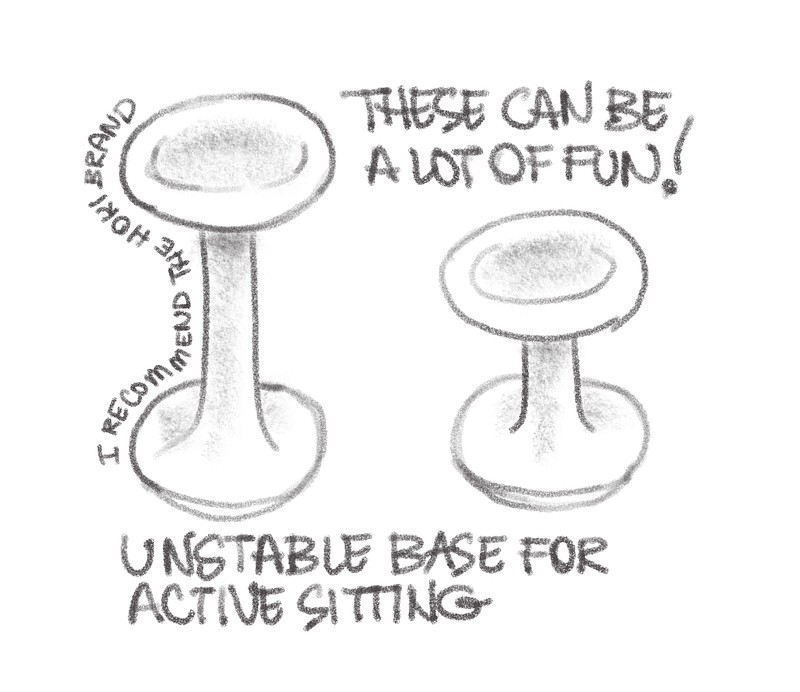
- wobble stools in two different heights (I like the Hokki)
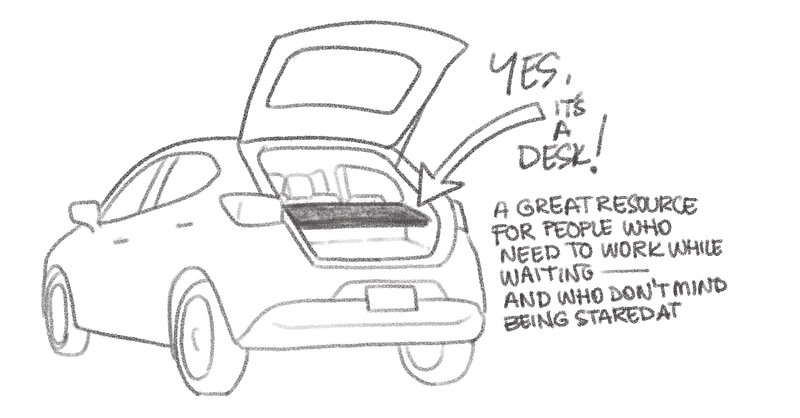
- whatever flat surface can act as a table (top of the piano, kitchen bench, a chair, the privacy platform that sits over the trunk of my hatch-back car)
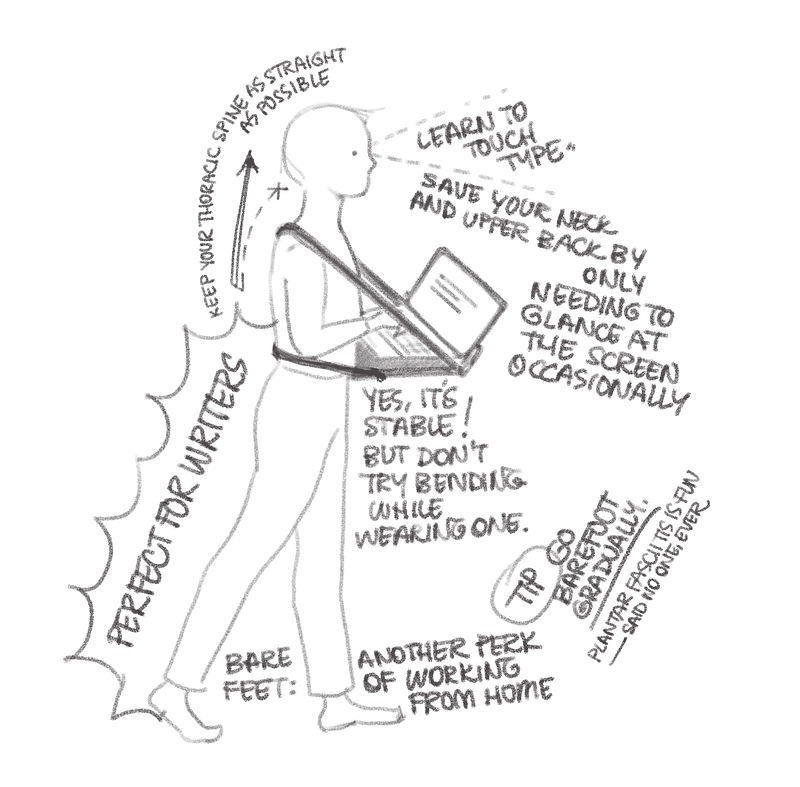
- a strap-on desk
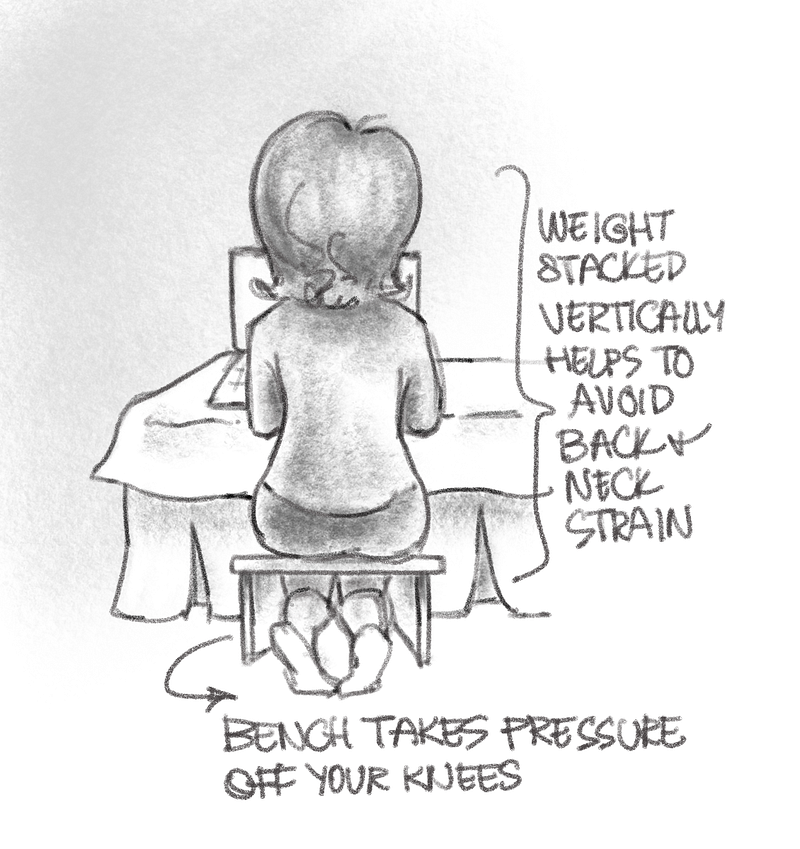
- a homemade meditation bench that acts as both table and chair
- a bolster to help me sit with good alignment on the floor
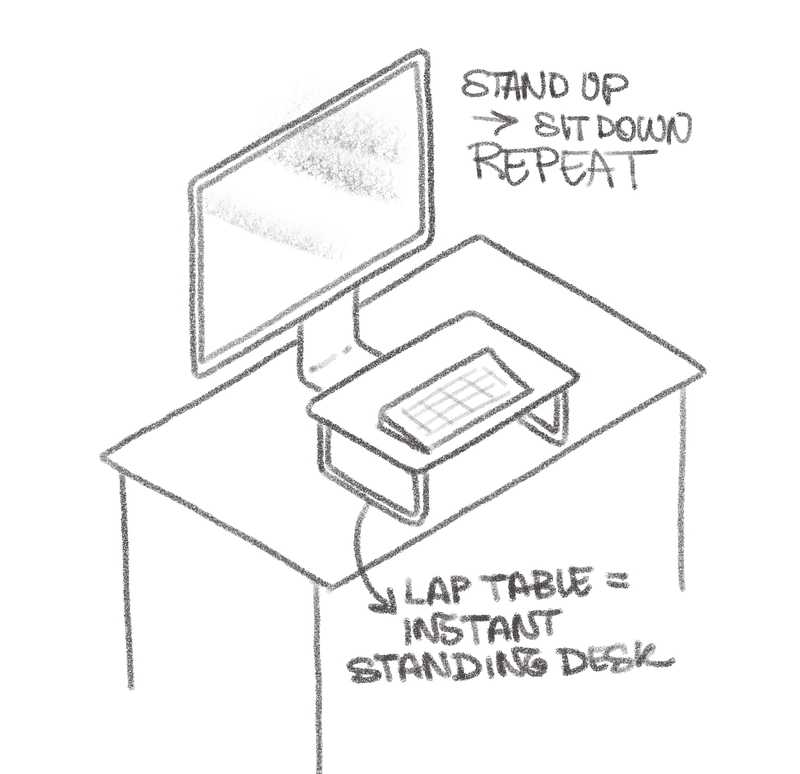
During a typical work day I will spend time sitting at a desk, standing away from the screen with a bluetooth keyboard, sitting on the floor or on the meditation bench, and sprawled out with my head propped up on one hand. I’m typing this story on my laptop while walking around my lounge room, using the outstanding Connect-a-Desk.
5 benefits I’ve found from using a dynamic, mobile workstation
- Physical: I’ve lost 10 kg and rarely get back pain
- Mental: I can think more clearly; greatly reduced brain fog
- Creative: Change of scenery leads to better ideas
- Financial: Cheaper energy bill (migrate to where the fire is rather than heat another room)
- Social: I’ve inspired others to make changes (can’t tell you how good that feels).
Movement
Forget sitting and forget standing desks. They both suck if one of them is all you use.
The key is movement: often, and with variety.
I’m not talking about better standing desks, and I’m not talking about better ways to sit. It’s time we learned the truth: it’s not standing or sitting that helps or harms us; it’s spending too long in one position.
You need to learn that movement and exercise are not the same thing. An hour of exercise can’t undo 12 hours of being in one position, so don’t think going to the gym daily will make up for 6 hours of sitting.
Building movement into daily life.
People do not decide their futures. They decide their habits, and their habits decide their futures. ~ F.M. Alexander
You can easily build movement into your work-from-home set up with the equipment listed above, but if you don’t have all those things you can improvise. There’s an abundance of inspiration online. Try searching “Natural Movement Workstation” on Pinterest.
Here are some other ways to get a wider range of movement into daily life:
- Put organising containers down low rather than at table height. Squat to pick up each item.
- Store often used items above head height. Reaching up multiple times a day will help with shoulder mobility.
- Use an app to remind you to get up and stretch at intervals throughout the day. I use a Keyboard Maestro action to display a brief inspirational message on the screen in large text every hour; seeing it reminds me to change pace. You could also set up your desktop wallpaper to change every hour as a reminder to switch things up.
This needs to become automatic. Change how you work multiple times every day, and soon it won’t feel right staying in one position for too long. That’s what you want! Check out Movnat for principles, inspiration and online courses.
Stop making excuses; you CAN do better.
Here are some excuses I hear for staying in one position while working.
I’m ill and I can’t move very well Try introducing variety in ways that work with what you’re experiencing. There’s always something you can do. Work with your trusted health care provider to make sure the movements you choose are right for you.
My work involves fine motor skills. Yeah, mine too. I make it work and so can you. All you need is a stable work space, sitting or standing, and not too long in one position.
I live in a small, shared space Try changing the furniture around if that’s an option, or move to another part of the room to work. If you have room to sit, you also have room to stand. Build up your computer/keyboard with sturdy boxes, or set it on the bed while you sit on the floor.
I’m not flexible enough to sit on the floor But do you want to be? Set a goal. Get advice from your preferred health practitioner. Work on it. Don’t stop.
I can’t afford all that fancy equipment That’s ok, because you don’t need it. Improvise!
Whatever your excuse, write it down and then brainstorm your own ideas for why it’s not going to stop you.
Moving your body can help to move your brain and lift your emotions. I recommend reading from a motivational text every day, because a positive mindset will lead you to make positive changes.
Even if you’re in a wheelchair and can’t get onto the floor, there are still things you can do to move differently. Stop making excuses! When you really can’t move your body, you can still move your mind in different ways. Accept your limitations, but only once you’ve pushed them as far as they’ll go.
Build your future body
Your environment is slowly changing you, so observe, and be intentional.
Remember:
- Movement and exercise aren’t the same thing
- Educate yourself. Look up Katy Bowman and Movnat for free information that will change your life.
- Proactively change your environment so that your environment can change you in ways you’ll be happy with in a year’s time
- Build movement opportunities into every day life
- Don’t make excuses; make tiny changes today toward where you want to be
Ok, maybe yesterday wasn’t that great.
Maybe you know all this stuff but you sat all day and have lost the enthusiasm you once felt for this dynamic workstation thing.
That was yesterday!
You’re building the future right now and no one can make you use yesterday’s blueprint.