
I Looked at the West’s Finances to Determine If It’s Really Bankrupt
Here’s what I found.

There are two ways to judge whether a country is financially bankrupt or not.
- Is it running a deficit? That is, does the government spend more money than it earns?
- Is its commercial balance positive or negative? That is, does it sell more stuff abroad than it buys abroad?
Let’s find out who’s bankrupt, and who’s not.
1. Is It Running a Deficit?
Running a deficit means that the governmental budget is bigger than its revenue.
The equation is Revenue - expense = “net profit”.
How do states earn money?
States predominantly earn through taxes, but they also earn when they sell stuff (Eg: rights to energy contracts, gold, state companies, shares of companies, etc) or when these assets are earning money (dividends from shares in companies).
Alternatively, states also earn when they invade new territories to extract resources, the military equivalent of “conquering new markets”.
Here’s a ranking of 148 countries based on their surplus/deficit expressed in GDP points.
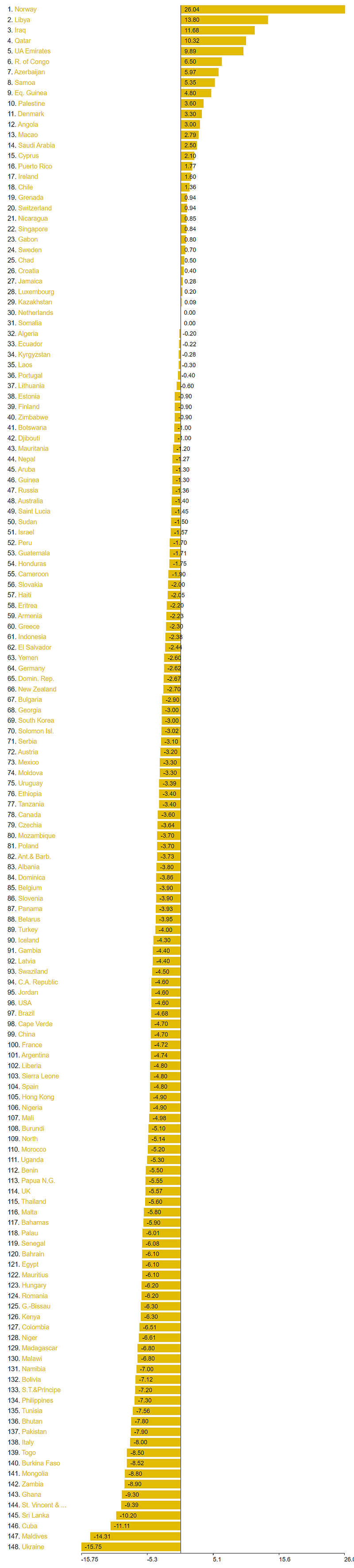
As you can see, most countries were running deficits in 2022.
In fact, the average worldwide fiscal balance that year was -2.67% per country.
Running a deficit once is not a big problem.
Not all companies are profitable every year. Look at Uber or Blackberry; they both lost billions but they’re still running.
What matters the most is the perception of whether these entities will be able to make money again in the future.
If the answer is positive, then lenders are happy to lend them money.
But if the answer is negative, the country goes bankrupt.
However, it hardly ever happens, for two reasons.
The first one is the IMF. The IMF exists to give countries emergency loans so they avoid bankruptcy.
Second, money printing.
If your economy is reasonably strong, like the US, Canadian, Australian, or European economy, you can print your own currency and give it to your debtors provided that they accept it and that they can buy something with it.
This is what separates a country from a company: a country, when its economy is strong enough, can always print itself out of debt.
A company can’t do that (unless its name was VOC and even then, it didn’t work out so well).
The consequence of such a policy is that countries with solid economies like the UK or France are not disincentivized to borrow money.
On the other end of the spectrum, countries that can hardly borrow due to having a poor economy are forced to have healthy finances.
This is why Jamaica made “a profit” in 2022, while Spain made a “loss”.
Ironic, isn’t it.
2. Is The Commercial Balance Positive or Negative?
The second equation we need to look at is whether the commercial balance is positive or negative.
The commercial balance informs us of whether a country buys more than it sells abroad or sells more than it buys.
Theoretically, the government is not concerned with the commercial balance because it’s a competence that falls within the authority of the central bank, and the central bank is supposed to be independent (it no longer is).
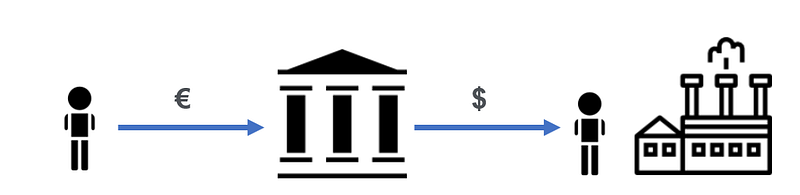
Let’s take an example.
Portuguese entrepreneurs go to Brazil to buy passion fruits. They go to the central bank in Brasilia, exchange their euros for reais, buy the passion fruits, and go back to Portugal.
Great! The Brazilian central bank has now some euros that it can give to entrepreneurs, companies, or the government if they want to buy stuff in Europe with.
But Brazil should beware.**** If it spends all of its euros, it won’t be able to buy anything in Europe anymore, which is why it’s important to keep selling stuff to Europeans to avoid running out of euros.
The more the country sells to other countries, the more foreign currencies it has, the more stuff it can buy in those countries, and the other way around.
This is why we sometimes hear that “ the level of foreign currency in this country is getting dangerously low”.
That amount, however, depends on the dynamism of the economy and on how much it exports. If the economy is not exporting anything, the central bank will run out of foreign currencies pretty quickly.
Not taking foreign currencies into account for a moment (pun intended), it’s still important for a country to be able to sell at least as much as it buys. Otherwise, it becomes economically poorer.
Here’s a ranking of countries per commercial balance surplus expressed in billions of dollars in 2022.

This is where things are looking awful for the US, Japan, France and the UK.
These four countries have respectively bought for $951, $158, $89, and $87 more billion than they sold.
India is developing its economy so the balance will likely flip at some point; but these four countries are already among the most developed countries on the planet.
They’re living a lifestyle they can’t afford.
If they don’t reduce their trade balance deficit, their currency will lose value.
So, Is The West Bankrupt?
No.
But some countries are.
We could argue that countries that have both deficits *and* a negative trade balance are broke.
Not only are they spending more than they earn, but they’re buying more stuff abroad than they are exporting.
They are a dead weight on the world economy and effectively demand people from other countries to work more for them than they work for others.
One of the most important sources of inequality I’ve never seen anyone mention is currency.
Even with equal ingredients, a piece of bread made in Switzerland will be sold for much more than a piece of bread made in Serbia.
- Is the work the same? Yes.
- Is the value the same? Yes.
- Are the efforts made the same? Yes.
So, why should the Swiss baker be paid more than the Serbian baker?
Because of the currency.
The Swiss franc has much more value than the Serbian dinar, because you can buy more valuable stuff in Switzerland than you can in Serbia.
In any ways, the top 10* of the most bankrupt countries are (note: India and Japan didn’t appear in the deficit graph so I didn’t count them in):
- The US**: The US takes the crown with a $951 billion trade balance deficit and a 4.6% governmental deficit in 2022. Not only does the US consume more than it produces, but its government spends much more than it earns.
- France***: France comes second with a 4.72% governmental deficit and a staggering $89 billion trade balance deficit.
- The UK: The UK is also in a terrible situation with a fiscal deficit of 5.57% and a negative trade balance of $87 billion.
- Italy: Italy had a negative trade balance of $30 billion and a governmental deficit of 8%.
- Mexico: Mexico had a fiscal deficit of 3.3% and a trade balance deficit of $42 billion.
- Turkey: 4% fiscal deficit and $40 billion trade balance deficit that sent its currency to the moon (from the graph perspective, not from the value perspective).
- Pakistan: Pakistan had a 7.9% fiscal deficit and $37 billion of trade balance deficit.
- Philippines: The Philippines had a 7.3% deficit and a trade balance deficit of $53.8 billion (what?).
- Greece: Greece had a 2.3% fiscal deficit and a trade balance deficit of $21.63 billion.
- Egypt: Egypt had a fiscal deficit of 6.1% and a trade balance deficit of $20.85 billion.
Conclusion
Be China.
China remains the main beneficiary of the trade balance deficits that most countries have because it remains the factory of the world.
I hardly understand why people say that China is going to collapse given that it holds by far the biggest trade surplus in the world.
It’s even more impressive given that they’ve achieved this with a manufacturing-based economy, unlike Russia, Qatar, Kuwait, Norway, or Saudi Arabia which sell dumb energy.
So?
Be China.
*Remember it was 2022 and the economy wasn’t yet normal.
**The US can afford these deficits because it holds the world reserve currency, which means that everybody uses dollars to buy anything from anyone.
***France has the lifestyle it has because of Germany. Most people who exchange their currencies for euros do so to buy in Germany. This means that the “French” euro is too strong, which enables France to buy stuff it shouldn’t be able to afford.
****One could argue and say “why doesn’t Brazil go to the European Central Bank to exchange reais against euros?” It could. The question is: does the European Central Bank want reais?
For more articles, head to auresnotes.com.