
I Live in One of the Most Polluted Cities in the World. Here Is What It's Like.
Our lifespan will be reduced by 9 years, according to studies.
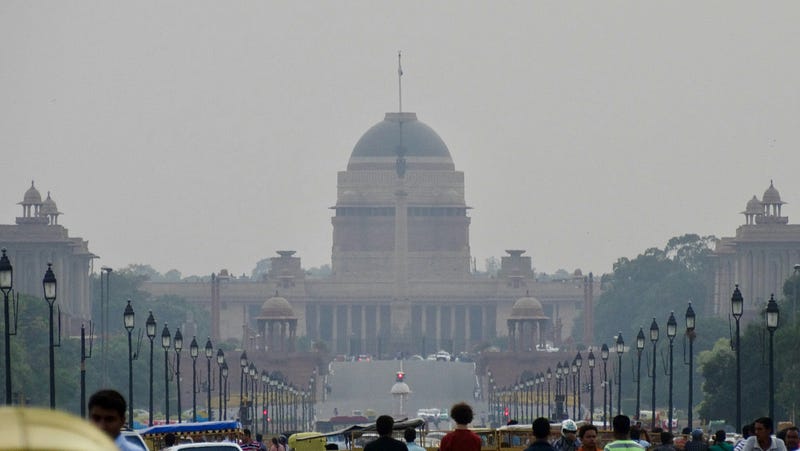
I live in Delhi, one of the most polluted cities in the world. The top 40 of the 50 most polluted cities in the world are from North India. The number one cause is that farmers don’t just harvest one crop as many across the world do. We are poor and populated, and so we harvest again and again. We burn the stubble after harvesting, so we can quickly grow the next crop.
The pollution cover usually starts around the festival of Diwali which is in October or November, depending on the Hindu calendar. This festival is synonymous with lights as Lord Rama returned home after spending 14 years in the forest, and he was welcomed with lots of lights. It’s also the evening when we light fireworks. Growing up, I remember my grandfather getting a big carton filled with various types of fireworks for me. This is a pollution aggregator.
The day after Diwali, the skies are even more grey. BBC published an article called ‘Delhi AQI: Toxic haze in India capital after Diwali festival’, an excerpt from that is:
“The Air Quality Index (AQI) in Delhi was 445, with some places recording readings above 520. The AQI measures the level of PM 2.5 — fine particulate matter that can clog lungs and cause a host of diseases — in the air.
Levels between 101 and 200 are considered moderate, while those between 201 and 300 are poor. Between 301 and 400 is categorised as “very poor” and a figure higher than 400 is considered “severe”.”
At the time of writing this, I’ve been living with a grey cover for nearly four months. It's getting better now that winter is slowly going. By better, I mean the AQI is 197 today instead of the usual 440. We live in the ‘severe’ zone most of the time which is 100x of the WHO limit. But hey, at least today is a good day.
When this started, I remember it was 2019, and I was working at an office job. People said we should wear masks, and so I bought a pack of N95 masks. According to public health experts, exposure to this level of pollution is equivalent to smoking 50 cigarettes a day.
We don’t use masks anymore either. In 2023 after Diwali, the AQI touched 999! A number that is unfathomable since the scale and even the iPhone weather app stop at AQI 500.
When you drive, it’s normal to not see buildings because there's a grey cover everywhere. It first began by appearing hazy as I remember a few years ago as I was waiting to take the metro and couldn’t see buildings clearly. Back then Snapchat was the cool app, and I snapped that to show my friends. Now, the smog has thickened with each passing winter and you don’t see buildings 100m away while driving.
My mom still goes for daily walks, but I don’t anymore because the air is so heavy outside. Your eyes water, throat feels itchy. I went for a jog last month and it did more harm than good. I felt like my chest had something greasy and disgusting inside, which was making it difficult to breathe. My chest felt really heavy.
Picture this — you live in a sub-tropical country, so unlike most countries in the West, you receive plenty of sunshine each winter. Afternoons after lunch are all about sitting under the sun with family. On most days, you don’t need to use a hairdryer after a shower because you can sit under the sun for a few minutes and your hair will dry naturally. But over the years, there’s a grey cover in the sky instead of sunshine. Only when the AQI drops below 200 do the rays of warm sunlight kiss your skin.
Every time you travel outside the city, things look so different.
A year ago, my husband and I travelled to the mountains. He said, “don’t the leaves look so clear and more green?” It was like we suddenly got HD vision because back home everything around us looks hazy. When I attended a wedding in the southern part of India last year, my breathing felt so much lighter. It was then I realised how naturally we’ve adapted to something as effortless as breathing become forceful.
The solutions by the government such as banning firecrackers are not working as it’s not the primary cause, the stubble burning is. Earlier, we even had set days where only odd or even number-plates of cars were allowed so we have fewer vehicles on the road. But with all the multinationals here, this is not a sustainable solution.
Just like the beautiful skies you saw when we hosted the G20 Summit, all that doesn’t exist. Those were measures taken so we can show delegates how clean Delhi is. I can say this confidently because I’ll never forget what happened during the lockdown — I saw clouds in the sky for the first time. We don’t see clouds here at all!
I bought the best air purifier the market has which is by Dyson worth $685. But one can’t have it working 24/7 even though I’m working from home because if I get used to such clean air, I’m likely to fall sick when I go outside. Right now my body can deal with pollution and getting 9 hours of clean air at night feels better than zero.
Now you may wonder, how will this affect us?
A study by SA Rizwan, Baridalyne Nongkynrih, and Sanjeev Kumar Gupta covered an experiment between people from Delhi and Rural India. In the results, people from Delhi had:
- 1.7 times higher risk of respiratory symptoms
- higher prevalence of asthma
- lung function reduced by 40% as compared to 20%
- 36% hypertension as compared to 9.5% in the other group
- higher levels of headache, skin and eye irritation
“Delhi showed a statistically significant (P < 0.05) increased prevalence of restrictive (22.5% vs. 11.4% in control), obstructive (10.7% vs. 6.6%) as well as combined (both obstructive and restrictive) type of lung functions deficits (7.1% vs. 2.0%).”
And long-term consequences for the population of Delhi are:
- asthma
- increased risk of lung cancer and other respiratory diseases
- deadly diseases such as chronic bronchitis, chronic obstructive pulmonary disease or COPD, pneumonia, and even heart diseases.
- this reduces our lifespan by 9 years
I guess we’ll just have to deal with this since there’s no other way out.
I always say this, my country offers luxuries like no other. One doesn’t have to be ‘rich’ for it. You can not clean and cook and pay as little as $50 a month to get it done every single day. But it’s the basics that we get ripped off — clean air, running electricity and water.